
Last Updated on October 31, 2025
Braulio Carrillo National Park: Quick Guide
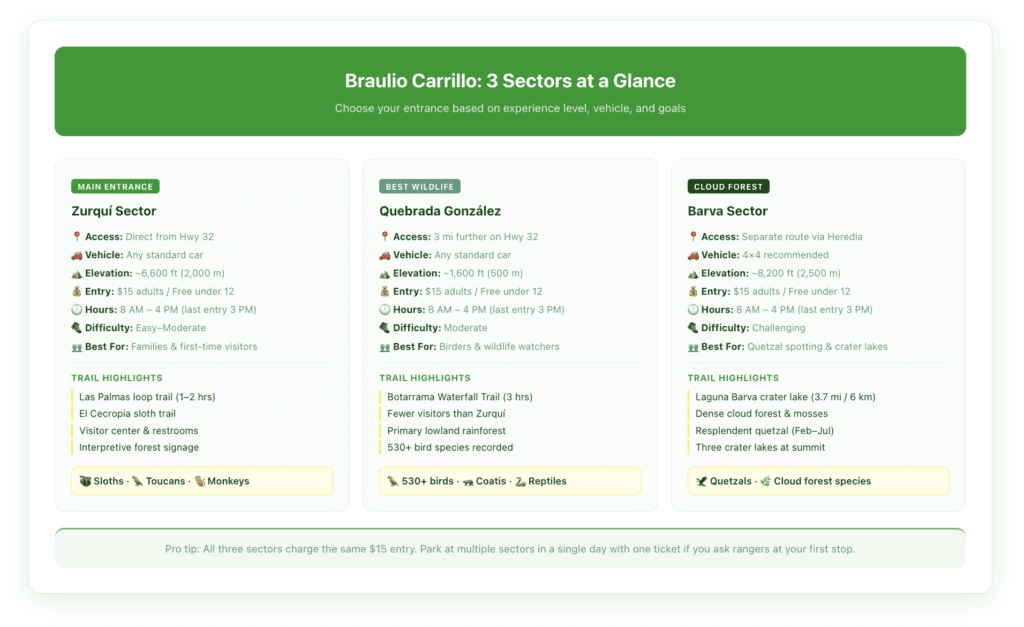
Braulio Carrillo protects 47,000 hectares of primary rainforest, 22 miles from San José on Highway 32. Entry is $15 adults, free for under 12, open 8 AM–4 PM. Any standard rental car reaches the main entrances on fully paved roads—Costa Rica’s most accessible primary rainforest and a natural stop on any Caribbean coast drive.
Quick Facts:
- $15 adults / free under 12; open 8 AM–4 PM (last entry 3 PM)
- Three sectors: Zurquí (families), Quebrada González (wildlife), Barva (cloud forest, 4×4 recommended)
- 530+ bird species; best wildlife window 8–10 AM
- No food inside—bring everything
Top 5 Experiences:
- El Cecropia Trail – Easy 1.5-hr sloth walk at Zurquí
- Botarrama Waterfall Trail – 3-hr hike to a waterfall at Quebrada González
- Laguna Barva Crater Lake – Cloud forest challenge; quetzals Feb–Jul
- Quebrada González Birding – Best early-morning birding near the capital
- Rainforest Adventures Combo – Pair with the aerial tram next door
Heading to Tortuguero or Puerto Viejo? You’re already driving through the park—stop for a morning hike and reach the coast by early afternoon.
If you need any help with a Costa Rica car rental, contact us now!
Braulio Carrillo National Park protects 47,000 hectares (115,830 acres) of primary rainforest, cloud forest, and Caribbean lowlands—and the entrance is 22 miles (35 km) from downtown San José on a fully paved highway. Entry costs $15 for adults, any standard rental car handles the drive, and you’ll be on a trail before 9 AM if you leave the capital at a reasonable hour. Few national parks in Costa Rica offer this combination of accessibility and raw biodiversity. Lonely Planet ranks it among the most overlooked parks in the country, which is exactly what makes it worth prioritizing.
Key Takeaways
- Braulio Carrillo sits 22 miles (35 km) from San José on Highway 32—the same road heading to the Caribbean coast.
- Three separate entrance sectors offer completely different experiences: Zurquí for families, Quebrada González for wildlife, and Barva for the cloud forest.
- Entry is $15 for adults, free for children under 12; open 8 AM–4 PM daily (last entry 3 PM).
- Morning visits (8–10 AM) give you the best wildlife activity before animals retreat from midday heat.
- A standard car handles the main entrances with no 4×4 needed, except for the Barva sector access road.
- The park’s vertical elevation range—36m to 2,896m (118 ft to 9,500 ft)—creates multiple climate zones in a single visit.
Why Does Braulio Carrillo Stay Off Most Travelers' Radar?
This is a park that objectively punches above its weight. It’s Costa Rica’s third-largest national park and protects one of the most significant biological corridors in Central America, connecting the Central Valley highlands to the Caribbean lowlands. Established in 1978, the park’s original mandate was to protect the watershed and forest buffer zone being eroded by development as Highway 32 was built through the mountains. The Rainforest Alliance notes that biological corridors like Braulio Carrillo are critical to species survival as forests fragment around them.
Yet most travelers drive right past it. The highway cuts directly through the park, so people see green on both sides, keep driving toward the Caribbean coast, and never stop.
That’s actually good news for you. While Manuel Antonio National Park draws its 150,000+ annual visitors and requires advance ticket purchases during high season, Braulio Carrillo is rarely crowded. The trails are yours, the wildlife hasn’t been habituated to crowds, and the experience feels like an actual rainforest rather than a managed nature walk.
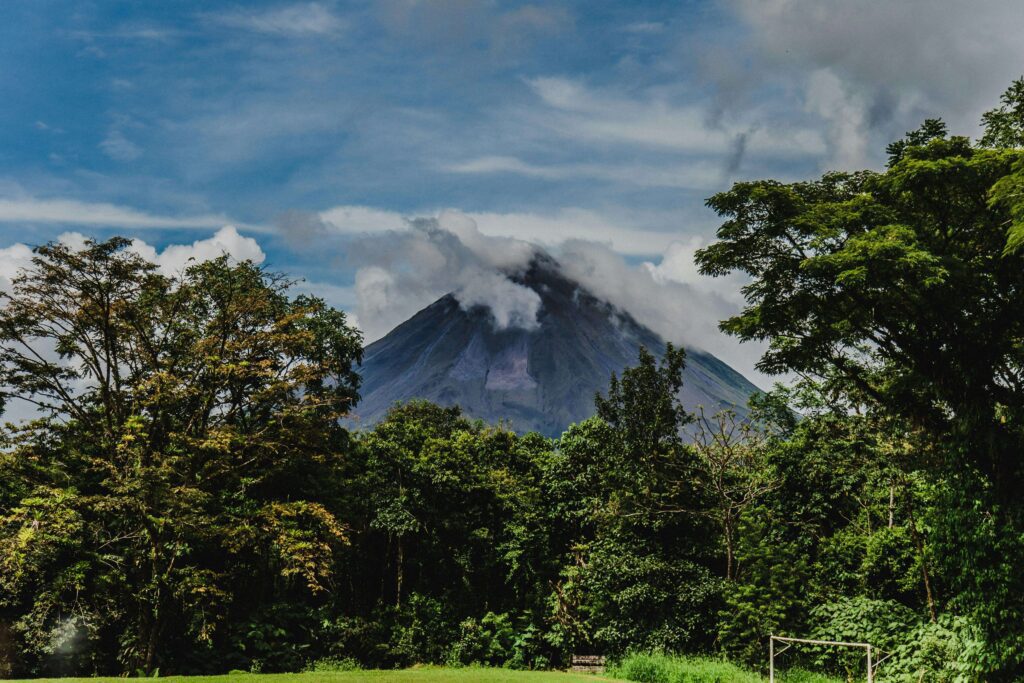
The park’s elevation range does something unusual: it lets you move through multiple ecosystems in a single half-day. Start in Zurquí at roughly 6,600 feet (2,000 m) in montane cloud forest—cool, misty, draped in moss and bromeliads—then drop toward Quebrada González at around 1,600 feet (500 m) where the air thickens, and the forest becomes the kind of humid, towering primary rainforest Costa Rica is famous for.
How Do You Get to Braulio Carrillo from San José?
Take Highway 32 northeast from San José toward Limón. The road is well-signed and fully paved. You’ll pass through the Zurquí Tunnel—at 1,535 feet (468 m) it’s the longest tunnel in Central America—before reaching the park’s main entrance on your right. The drive from central San José takes about 45 minutes in normal traffic.
A few things worth knowing about the drive: the road gains significant elevation before the tunnel, so you’ll experience a noticeable temperature drop from the Central Valley warmth. Pack a light jacket even if it feels warm when you leave San José. Temperatures in the park can run 15–20°F (8–11°C) cooler than the capital.
Any standard car handles this route. Highway 32 is fully paved all the way to the park entrances, and the access roads at both Zurquí and Quebrada González sectors are maintained. The exception is the Barva sector—more on that below—which does benefit from a vehicle with better ground clearance.
If you’re coming from SJO airport, the drive adds maybe 15 minutes to what you’d do from the city center. For travelers heading to the Caribbean coast anyway, the park is a natural stop—you’re driving through it either way.
What Are the Three Sectors of Braulio Carrillo, and Which Should You Choose?
Is the Zurquí Sector Right for First-Time Visitors?
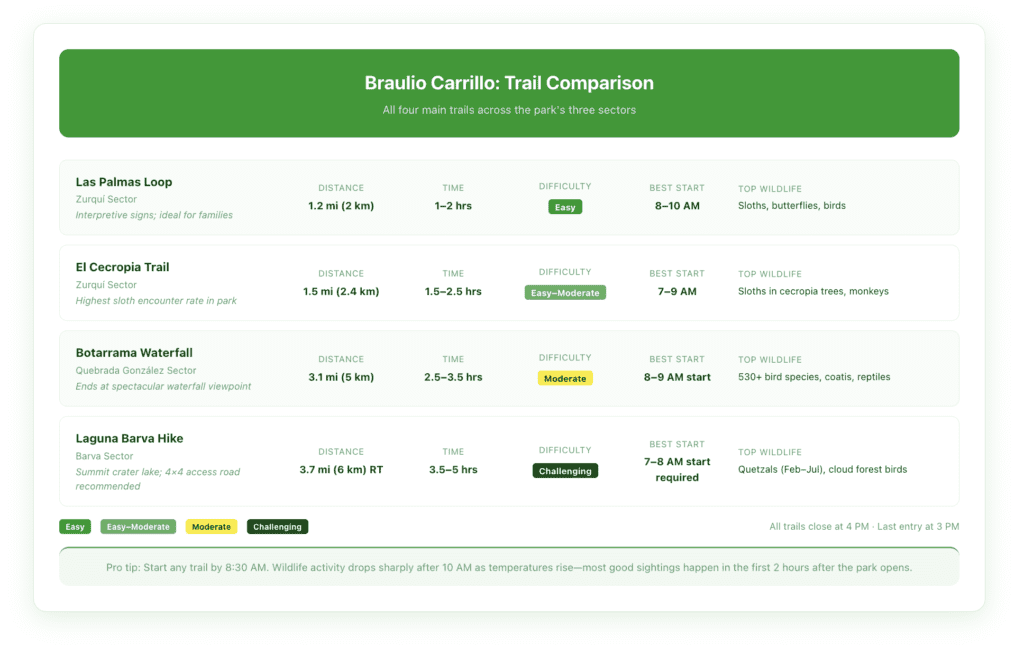
Yes. Zurquí is the main entrance, directly off Highway 32, with a visitor center, restrooms, picnic areas, and the park’s best-marked trail system. The Las Palmas Trail is an easy 1-hour loop through secondary and primary forest, with interpretive signs explaining forest ecology. It’s flat enough for families and rewarding enough for experienced hikers who’ll spot things others walk past.
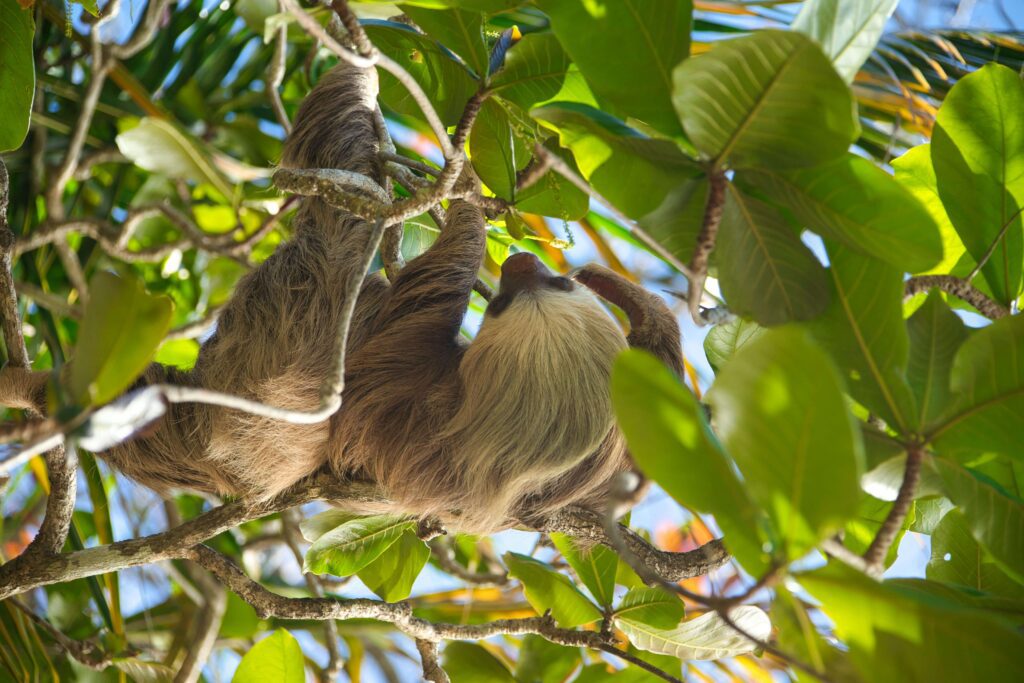
El Cecropia Trail is named for the trees that make this section productive for wildlife—cecropia attract sloths, which feed on their leaves, so morning walks here in particular give you real chances of spotting both two-toed and three-toed sloths hanging motionless above the trail.
Practical details for Zurquí:
- Direct access from Highway 32, clearly signed
- Parking is free
- Drinking water available at the visitor center
- Best for families and first-time visitors
- The trail system is modest—plan 2–4 hours total
Does the Quebrada González Sector Offer Better Wildlife?
Generally, yes. Located about 3 miles (5 km) further along Highway 32 toward the Caribbean, Quebrada González gets significantly fewer visitors than Zurquí. The trails are more challenging, and the infrastructure is more basic, but the wildlife encounter rate goes up when you have the forest to yourself.
This is where serious birdwatchers come. Braulio Carrillo hosts over 530 recorded bird species, making it one of the most productive birding sites near San José. Look for toucans, tanagers, trogons, and hummingbirds. The Sendero Botarrama trail leads to a waterfall viewpoint through primary forest—allow 3 hours for this one.
Howler monkeys are present throughout the park, and white-faced capuchins work the Quebrada González area regularly. Bring binoculars. Coatis are common near both sectors. Jaguars and tapirs exist in the park’s more remote areas, but encounters are genuinely rare.
What’s the Barva Sector, and Is It Worth the Extra Effort?
The Barva sector is a different experience entirely, accessed not from Highway 32 but via a separate route through Heredia province—about an hour from San José through the town of San José de la Montaña. This is the high-elevation cloud forest section of the park, built around the slopes of Barva Volcano, an extinct volcano with three crater lakes at the summit.
The Laguna Barva crater lake is the main draw—a 3.7-mile (6 km) round-trip hike through dense cloud forest at elevations above 8,200 feet (2,500 m). The forest here is different from Zurquí or Quebrada González: older trees draped in mosses and orchids, perpetual mist, and quetzals during nesting season (February through July). If you want to add quetzal spotting to your Braulio Carrillo visit, Barva is where to focus.
The access road to Barva benefits from 4×4 clearance, especially during the green season when it can get muddy. This sector requires more planning than a Highway 32 stop—but it rewards that planning significantly.
What Wildlife Can You Realistically Expect to See?
The honest answer: it depends on timing and patience. Braulio Carrillo isn’t like Manuel Antonio, where wildlife is concentrated and almost guaranteed. The forest is vast—47,000 hectares of it—and animals move through it at their own pace.
What genuinely works in your favor is arriving early. The window from 7 to 10 AM is when most mammals and birds are active. After 11 AM, activity drops noticeably as temperatures rise. This applies across Costa Rica’s national parks—early mornings are consistently the most productive time for wildlife.
Most likely sightings:
- Sloths: Both two-toed and three-toed species inhabit the park. Cecropia trees along El Cecropia trail are your best bet—look for a dark lump in the canopy, often completely motionless.
- Howler monkeys: You’ll likely hear these before you see them. Their calls carry across the forest at dawn and can be heard from miles away
- Birds: 530+ recorded species. Toucans are commonly spotted year-round; resplendent quetzals at Barva during nesting season
- Coatis: These raccoon relatives are confident around trail areas
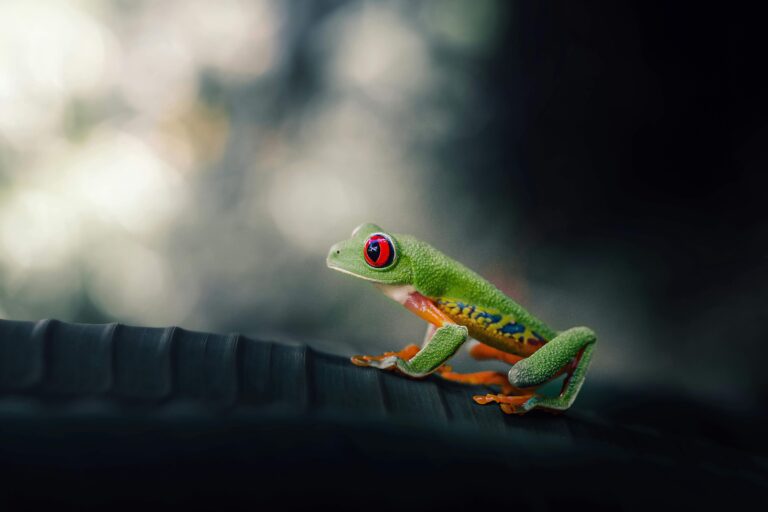
- Frogs: Particularly after rain, red-eyed tree frogs are present in the park
Less common but present:
- Tapirs, ocelots, and jaguars inhabit remote sections and are rarely encountered on the trail
- Snakes, including the fer-de-lance, watch where you step off-trail and near logs
Bring binoculars. The forest canopy sits high, and even a basic pair dramatically improves your sightings. Moving slowly and quietly is more important than covering distance. The Organization of Tropical Studies, which operates La Selva Biological Station just outside the park’s Caribbean boundary, has documented the region’s biodiversity extensively—it’s one of the most researched forest corridors in the Americas.
When Is the Best Time to Visit Braulio Carrillo?
Both seasons have genuine merits here, unlike some Costa Rican destinations where one clearly wins.
Dry season (December–April): Trail conditions are at their best—less mud, clearer paths, more comfortable hiking. Wildlife viewing can actually be better in the dry season when animals concentrate around remaining water sources. Photography is easier with clearer light. The park is never crowded by Costa Rica standards, but December through April is peak season nationally.
Green season (May–November): The forest is at its most lush and vibrant—the greens are deeper, waterfalls are at full volume, and the mist creates atmospheric conditions that photographs beautifully. Wildlife activity is high. The tradeoff is trails that can be muddy (wear proper footwear) and afternoon rain—plan to be back at your car by 1 PM. Morning visits are non-negotiable during the green season.
Whatever the season, mountain weather in Costa Rica changes fast. Dress in layers, bring a rain jacket, and don’t let the afternoon clouds at Zurquí surprise you even in February.
How Does Braulio Carrillo Fit Into a Bigger Caribbean Coast Day?
This is where Braulio Carrillo really shines as a travel planning tool. The park sits directly on Highway 32, the only route from San José to the Caribbean coast. Every traveler heading to Puerto Viejo, Cahuita, or Tortuguero drives through it.
A practical same-day structure: Leave San José by 7:30 AM, arrive at Zurquí or Quebrada González by 8:15 AM, hike for 2–3 hours, eat the lunch you packed at a picnic table, and continue toward the Caribbean coast by noon. You’ll reach Puerto Viejo by mid-afternoon with time for a swim before sunset. This kind of flexibility is exactly why planning your SJO road trip route around the Highway 32 corridor pays off.
Alternatively, if you’re returning from the Caribbean, Braulio Carrillo makes a natural re-entry point. You’ve had beaches; now you want a forest. Stop at Quebrada González on your way back to San José, spend two hours on a trail, and arrive in the capital for dinner, having done both ecosystems in a single day.
What’s next door: Rainforest Adventures Costa Rica Atlantic is located just outside the park on Highway 32—a 475-hectare private reserve with Costa Rica’s longest aerial tram and a 10-cable zipline. It’s a different experience from the national park (more structured, guided, with admission from $59/adult) and pairs well if you want to see the forest canopy both from the ground and from above. If you’re building a one-week Costa Rica itinerary that includes the Caribbean coast, Braulio Carrillo, and Rainforest Adventures together, make a full and genuinely memorable morning stop.
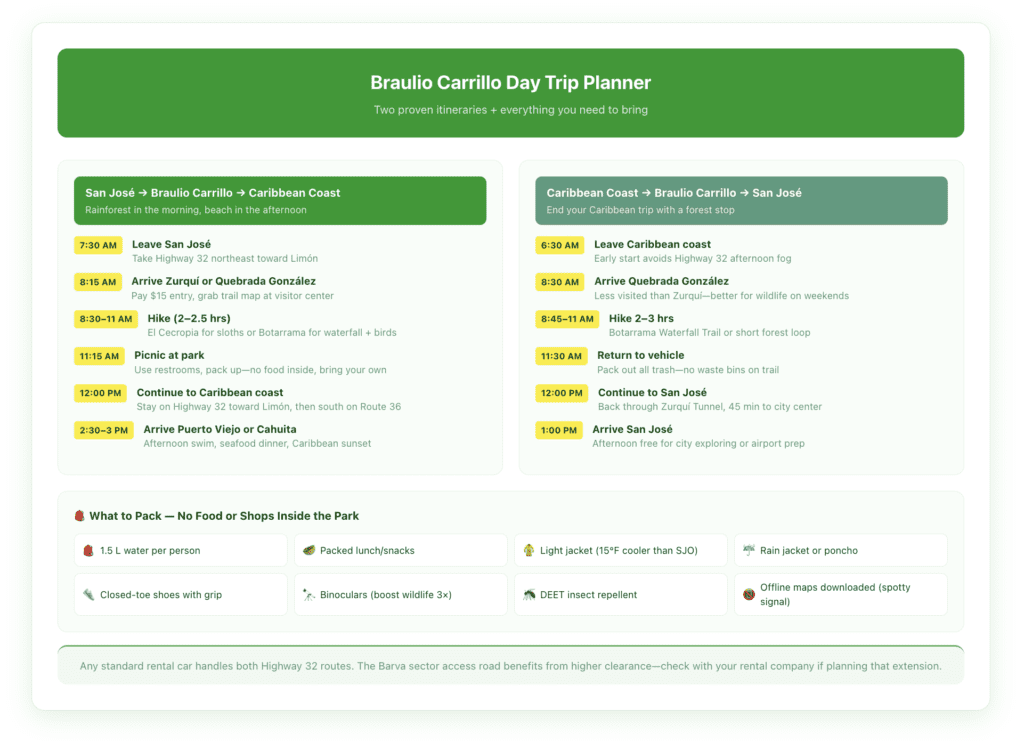
What Do You Need to Bring to Braulio Carrillo?
The park has no food service inside. Bring everything you’ll need for the duration of your visit. There are no vending machines and limited facilities beyond basic restrooms at the main entrances.
Essentials:
- Water (at least 1.5 liters per person—more if you’re hiking Barva)
- Food/snacks or a packed lunch—there’s nothing to buy once you’re inside
- Rain jacket or poncho, regardless of the forecast
- Layers—it can be 20°F (11°C) cooler than San José at the Zurquí elevation
- Closed-toe shoes with grip; hiking boots preferred for anything beyond Las Palmas
- Insect repellent with DEET
- Binoculars, if you have them
- Sunscreen for exposed sections
Leave behind: Anything you can’t afford to get muddy or wet. Cell coverage is intermittent; download offline maps before you leave the San José area.
Cell coverage is patchy inside the park. The Instituto Meteorológico Nacional publishes daily forecasts for the Central Valley and Caribbean slope, so you want to check conditions before heading out.
Is a Guide Worth It at Braulio Carrillo?
For wildlife, the answer is probably yes—at least for a first visit. The park’s trails are well-marked, so you don’t need a guide for navigation. But wildlife spotting in dense rainforest is a different skill set. A naturalist guide knows where animals tend to be, carries a spotting scope for canopy sightings, and can identify birdsong. The Tico Times travel section periodically covers guide services operating near Braulio Carrillo and the Highway 32 corridor.
If you’re going independently, the best substitute for a guide is moving slowly, stopping often, and listening as much as looking. Most people spot far more wildlife when they stop walking than when they’re covering ground.
For families traveling with kids, a guide is particularly valuable—the experience goes from “we saw some birds” to a running narration with interesting facts that keep children engaged.
Entry Fees and Practical Information
- Adults: $15 USD
- Children under 12: Free
- Hours: 8:00 AM–4:00 PM daily; last entry 3:00 PM
- Payment: Cash (USD or colones); credit cards not guaranteed at all entrances
- Advance reservations: Not required for standard visits; arrive early during holiday weekends
The SINAC online booking system handles advance tickets. Note that SINAC’s website has documented server reliability issues—if it won’t load, flag the timing and call the park directly, or budget to pay cash at the gate. Tickets are also available through local tour operators if you’re booking a guided visit.
No food, no shops, no Wi-Fi inside. Basic restrooms at Zurquí and Quebrada González. Parking is free at all three sectors. At $15 entry, it’s one of the better-value national parks in Costa Rica for what you get.
Frequently Asked Questions
Does Braulio Carrillo National Park require a 4×4 vehicle?
No, for the two main entrances at Zurquí and Quebrada González. Both are directly accessible from the fully paved Highway 32. The Barva sector uses a separate route that benefits from higher clearance, especially in the green season—a 4×4 makes that access more comfortable, but it isn’t strictly mandatory in the dry season.
Can you visit Braulio Carrillo without a guide?
Yes. The main trails at Zurquí and Quebrada González are well-marked and safe to walk independently. A certified naturalist guide significantly improves wildlife sightings and adds context to what you’re seeing, but it’s not required. If you go solo, move slowly, stop frequently, and spend time listening.
How long do you need for a Braulio Carrillo visit?
Two to four hours cover a solid visit at one sector. A half-day (4–5 hours) lets you explore two sectors or do a longer trail like Botarrama. If you’re combining Barva with either of the Highway 32 sectors, budget a full day—the two access routes are separate drives.
What’s the difference between Braulio Carrillo and Rainforest Adventures?
Braulio Carrillo is a national park: $15 entry, self-guided trails, genuine wilderness, minimal facilities. Rainforest Adventures is a private eco-park next door with structured guided experiences, including the aerial tram ($59+/adult), zipline, butterfly garden, and reptile exhibit. The national park offers more authentic wilderness; Rainforest Adventures offers more guaranteed sightings and structured programming. Many visitors do both on the same day.
Are there any animals to worry about in Braulio Carrillo?
The fer-de-lance is Costa Rica’s most common venomous snake and is present in the park. Stay on marked trails, watch where you step, and avoid putting your hands in undergrowth or under logs. Maintain distance from all wildlife. There are no animal encounters that should make you fear the park—just the standard common sense for any rainforest.
Can you combine Braulio Carrillo with a San José day trip, or is it better as a standalone?
Both work. The park’s location on Highway 32 makes it a natural add-on when leaving or returning to San José. A standalone half-day trip from the capital is totally reasonable—you’d leave by 7:30 AM, be hiking by 8:30 AM, and be back in the city for a late lunch. It also works seamlessly as a Caribbean coast route stop without adding significant time to your drive.
Is Braulio Carrillo good for birdwatching?
Exceptionally. With 530+ recorded species across multiple elevation zones, it’s one of the most accessible birding sites in the Central Valley region. The Barva sector is particularly productive for high-elevation species, including the resplendent quetzal during nesting season (February–July). Quebrada González is strong for mid-elevation species. Early morning visits maximize sightings.