
Last Updated on November 3, 2025
Caño Negro Boat Tour at Los Chiles: What's Covered
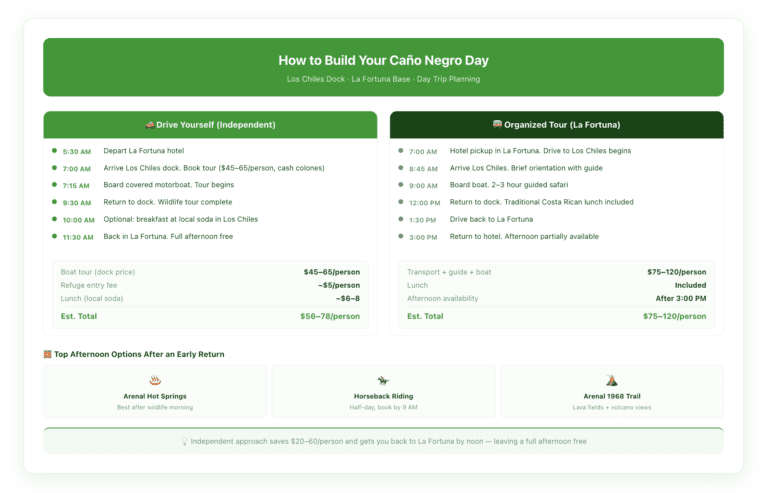
The Caño Negro Wildlife Refuge boat tour on the Río Frío runs 2-3 hours from the Los Chiles dock, about 90 minutes north of La Fortuna on paved Route 142. Covered motorboats hold 10-20 passengers and deliver wildlife sightings—caimans, three monkey species, sloths, and 300+ bird species—that rival any national park in the country. Book directly at the dock for $45-65 per person, or join an organized day tour from La Fortuna for $75-120, including transport and lunch. A standard rental car handles the drive.
Quick Facts:
- Best timing: December–April for concentrated wildlife; February–March peak for migratory birds
- Departure: Los Chiles dock, 90-minute drive from La Fortuna on Route 142
- Wildlife density: 20-30 caimans, three monkey types, jabiru stork (endangered), gaspar “living fossil” fish
- Cost: $45–65/person at dock; $75–120 with organized tour (transport + lunch included)
- No 4×4 needed: Route 142 is paved year-round; standard vehicles make the full route
Top 3 Reasons to Go:
- Wildlife per hour — More concentrated animal sightings than most Costa Rica day trips, without hiking; caimans and monkeys are essentially guaranteed
- Affordable access — $45–65 at the dock is among the lowest-cost wildlife experiences in northern Costa Rica; it pairs naturally with Arenal hot springs the same afternoon.
- RAMSAR wetland scale — 9,969 hectares of internationally recognized habitat; the lagoon floods to 3,000 acres in the green season—a completely different ecosystem from Arenal or Palo Verde
Driving yourself to Los Chiles gives you full schedule control and saves $20–60 per person versus organized tours. Contact us now if you need help choosing the right vehicle for your northern Costa Rica itinerary.
The Caño Negro Wildlife Refuge boat tour puts you within 30 feet (9 meters) of wildlife that most Costa Rica parks keep at a distance. Covered motorboats depart the Los Chiles dock daily, running 2-3 hours through one of Central America’s most important RAMSAR-designated wetlands.
Key Takeaways
- Wildlife density: Expect 20-30 caimans, three monkey species, sloths, and 300+ bird species on a single 3-hour boat tour.
- Cost: $45-65/person at the Los Chiles dock; $75-120 with an organized tour from La Fortuna.
- Access: 90-minute drive from La Fortuna on paved Route 142; no 4×4 required.
- Best season: December-April for concentrated wildlife; February-March for peak migratory birds.
- No hiking needed: 100% boat-based, family-friendly, and accessible for all fitness levels.
- Not always inside the refuge: Much of the best wildlife viewing happens on the Río Frío before reaching the official lagoon—and it delivers just the same.
How Does the Río Frío Boat Tour Actually Work?
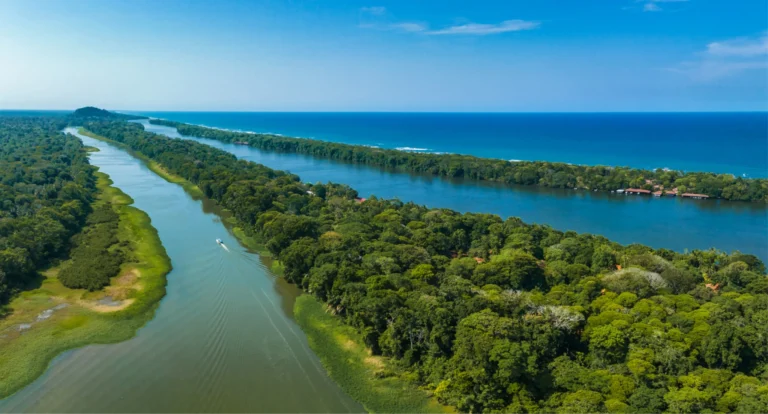
Tours launch from the Los Chiles municipal dock, a small riverfront town 4 miles (7 km) from the Nicaraguan border. Covered motorboats hold 10-20 passengers with shaded bench seating along both sides, putting you eye-level with the riverbanks as you drift slowly upstream. You’re essentially floating in a blind—wildlife has largely learned to tolerate boats at this slow pace, and a good captain cuts the engine entirely when something worthwhile appears ahead.
Tours cover roughly 14 miles (22 km) of river total, running 2-3 hours on the water. Your bilingual naturalist guide handles spotting duties while the captain navigates channels and shallows. Most operators depart 7:00-8:00 AM, catching wildlife during the most active morning window before the heat sets in around 10:00 AM. The pace is deliberately unhurried—this isn’t a scenic cruise, it’s a floating safari where the guide might ask you to hold still for five minutes while a sloth slowly descends into view.
One thing that surprises first-timers: many of the best sightings happen on the Río Frío before reaching the official refuge boundary. The gallery forest lining the river creates a natural wildlife corridor, and experienced guides know every productive bend and shaded tree. Some organized tours from La Fortuna technically stay outside the lagoon entirely—yet still deliver every sighting on the list. For a detailed overview of the refuge itself, the Caño Negro wildlife refuge guide covers the broader context and what makes this ecosystem unique.
What Happens at the Los Chiles Dock?
The dock is easy to find in Los Chiles town. During high season (December-April), boat captains and guides wait from around 6:30 AM, and you can simply show up and book a tour for $45-65 per person. Cash in colones is essential—many captains don’t accept cards. Ask your captain which section of the river was most productive that morning; the locals who fish these waters year-round know the patterns better than any itinerary.
If you’re driving yourself with a rental car, you control every variable—departure time, pace of the drive north, and your afternoon plans. Organized tours from La Fortuna run $75-120 per person and include hotel pickup, transportation, bilingual guide, and a traditional casado lunch—a genuine full-day commitment returning you to town around 2:30-3:00 PM.
If you want the afternoon free for Arenal hot springs or a hanging bridge tour, the independent approach works better.
What Wildlife Will You Actually See on the Río Frío?
The wildlife density here is legitimately unusual by Costa Rica standards. The combination of open water, gallery forest, and shallow wetland edges creates an overlapping habitat that keeps different species visible simultaneously—things that stay hidden in dense jungle appear right at the waterline here.
What Will You Almost Certainly See?
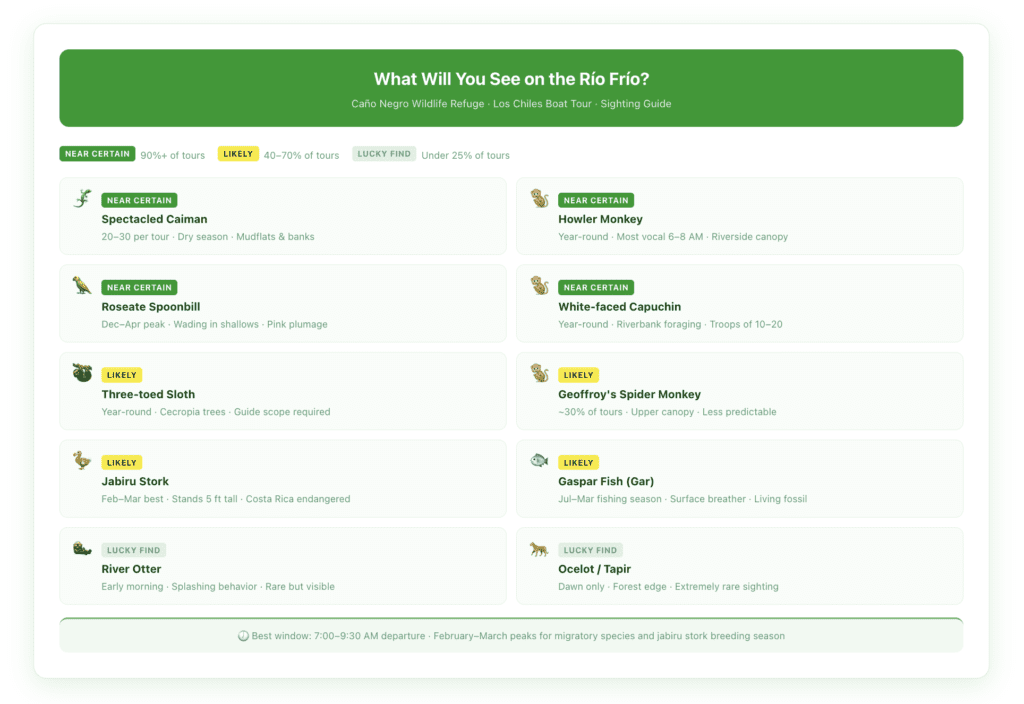
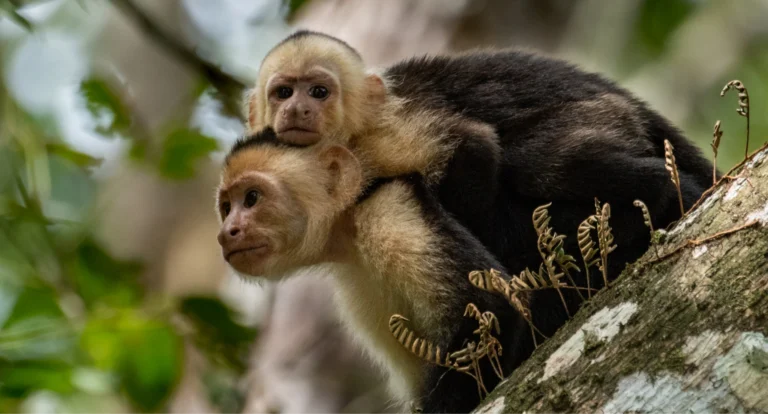
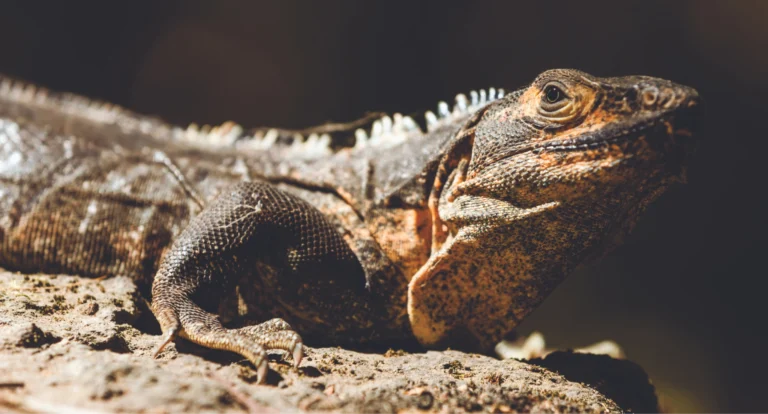
Spectacled caimans are the Río Frío’s most reliable residents—most dry-season tours encounter 20-30 individuals basking on mudflats or half-submerged along the banks. Green iguanas drape from overhanging branches close enough to photograph with a phone. Jesus Christ, lizards (basilisks) sprint across the water’s surface on their hind legs when startled. Howler monkeys announce their territory with calls that carry across the wetland, especially loud in the first 90 minutes of daylight, and white-faced capuchin monkeys forage predictably along the riverside vegetation. Great blue herons, snowy egrets, and roseate spoonbills work the shallows in concentrated groups—the spoonbills’ pink plumage against the green riverbank is genuinely striking.
What Are the Lucky Sightings?
The jabiru stork is Caño Negro’s most iconic resident and the one that draws serious birders from across the world. Standing nearly 5 feet (1.5 meters) tall, it’s the largest flying bird in the Americas and one of Costa Rica’s most endangered, with fewer than 100 individuals remaining in the country. The February-March breeding season gives the best odds.
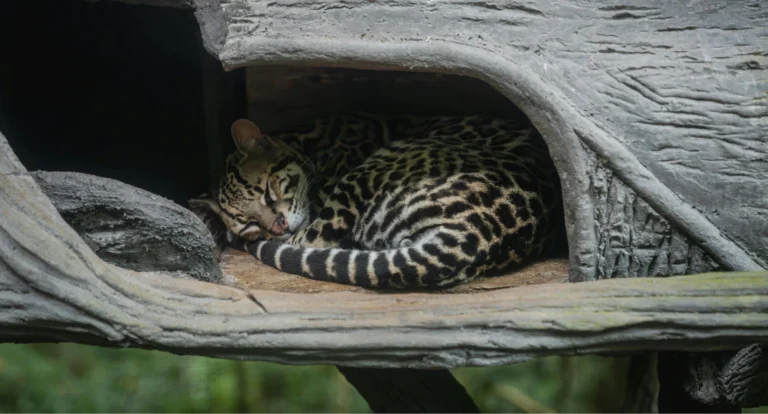
The Nicaraguan grackle—found nowhere else in Costa Rica outside Caño Negro and the border wetlands—perches along the river channels in loose flocks, making it a solid tick for any birding life list. Mantled howler monkeys are essentially guaranteed from the boat; river otters splash through the early morning water on occasion. Extremely lucky visitors catch glimpses of tapirs or ocelots along the forest edge at dawn—your guide will genuinely celebrate if this happens.
What’s Living Under the Water?
The gaspar fish (tropical alligator gar) is the Río Frío’s most unusual resident—a living fossil that has remained essentially unchanged for 150 million years. Its swim bladder functions as a lung, letting it breathe air, and its snout contains multiple rows of teeth. Locals prize it highly for its texture during fishing season (July-March). The river also holds tarpon, snook, and guapote. During the rainy season, when water levels connect the Río Frío to Lake Nicaragua, bull sharks occasionally make their way this far upstream—a fact that impresses most boat passengers considerably more than the birds.
When Is the Best Time to Visit for the Boat Tour?
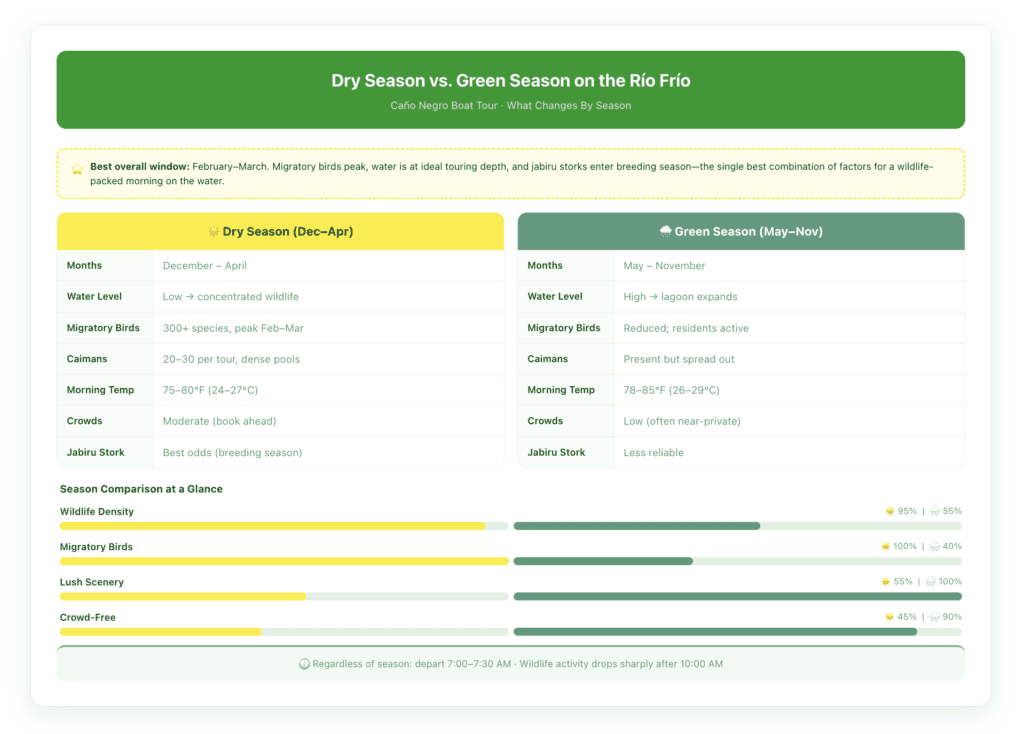
February and March sit at the peak of everything: migratory birds from North America join year-round residents, the Río Frío drops to optimal navigation depth, jabiru storks enter breeding season, and caiman concentration around shrinking pools reaches its highest point of the year. Morning temperatures stay comfortable at 75-80°F (24-27°C) before climbing to 90°F (32°C) by midday. The Costa Rica dry season guide and the regional weather patterns article both have useful details on what this means for northern Costa Rica specifically.
December and January are excellent months with slightly fewer crowds than peak February-March. Early December offers the added bonus of cheaper accommodation in La Fortuna before holiday pricing kicks in. April remains strong for wildlife, but the lagoon starts refilling, spreading animals over a wider area.
The rainy season (May-November) delivers a completely different experience. The lagoon expands dramatically as the Río Frío floods the surrounding plains, creating a shallow inland sea that acts as a major stopover on the North American bird migration flyway. Resident wildlife disperses across more water, making concentrated sightings harder, but the overall atmosphere is remarkably lush. For travelers interested in wildlife viewing across different ecosystems, the refuge rewards visits in any season with different rewards.
What Time Should You Board the Boat?
Morning departures—7:00 to 7:30 AM—consistently outperform afternoon tours. Wildlife drops off significantly by 9:30-10:00 AM as animals retreat from the heat. If an operator suggests a 1:00 PM departure, push back or choose someone else.
How Do You Get to Los Chiles from La Fortuna?
Take Route 142 north from La Fortuna through the town of Muelle toward Los Chiles. The road is paved the entire 56 miles (90 km), though the final stretch has potholes worth slowing down for. Plan 90 minutes from La Fortuna town center to the dock. For anyone driving in Costa Rica for the first time, this is one of the easier northern routes—flat farmland, clear signage, and no mountain passes. The drive itself is pleasant: scan roadside trees for toucans,s and you’ll likely spot one or two before reaching the dock.
Coming from Liberia Airport? Take Highway 1 to Cañas, then Route 142 through Upala. Budget 2.5 hours. The Rincón de la Vieja corridor is a logical first stop on this route before continuing north, combining two different natural experiences in a single day.
A 4×4 isn’t required for the Los Chiles route. The roads are well-maintained paved surfaces year-round. Where higher clearance occasionally helps: during heavy green-season rain, some sections between Muelle and Los Chiles can have standing water. For choosing the right vehicle for northern Costa Rica itineraries, see the vehicle requirements guide.
What Should You Bring for the Río Frío Boat Tour?
The boat has a shade canopy, but the sun reflecting off the open water doubles your exposure. Most first-timers don’t account for this until they’re already on the water.
Binoculars top the list. Boats maintain 30-50 feet (9-15 meters) of distance from wildlife to avoid disturbing animals, and you lose significant detail without magnification. An 8×42 pair hits the sweet spot between portability and performance. A camera with zoom serves the same purpose—phone cameras work reasonably well for caimans and large iguanas at close range, but the jabiru you’ll be watching from across the river requires at minimum a 200mm equivalent lens. Serious birders and photographers bring 300-400mm.
SPF 50+ sunscreen applied to unexpected spots: the underside of your chin and nose get intense reflected light off the water—spots that never get sun at home. Lightweight long pants and long sleeves do double duty: sun protection plus mosquito defense, which intensifies in the green season along the riverbanks. Cash in colones is essential if you’re booking at the dock. A dry bag or large ziplock protects electronics when the boat picks up speed between sections.
What Else Is Worth Doing Before or After the Tour?
The boat tour returns you to Los Chiles by 10:00-10:30 AM on a 7:00 AM departure, leaving a full afternoon. Most travelers head back to La Fortuna for Arenal hot springs—the contrast of a cool morning on the river followed by afternoon thermal pools at 102°F (39°C) creates a legitimately excellent day. Horseback riding also fits well in the afternoon window.
The Arenal 1968 lava trail is another strong afternoon option, and if you’re staying multiple nights in La Fortuna, a morning coffee farm visit before the Caño Negro departure adds useful local context to the drive north.
For the northern zone itself, Tenorio Volcano National Park is an hour from Los Chiles and offers the celestial-blue Río Celeste—a completely different ecosystem from the wetland you just floated through. Heading toward the Caribbean? Route 4 from Los Chiles connects to the highway near San Carlos, shortening the drive to Tortuguero considerably for travelers combining both wildlife experiences. Braulio Carrillo National Park sits further along this Caribbean corridor and makes a logical add-on for rainforest hiking on the same trip.
For 2-week itineraries that include the northern zone, Caño Negro fits naturally as a day 3 or 4 departure from La Fortuna.
Comparing Caño Negro to similar Costa Rica experiences: the Peñas Blancas Safari Float runs on a quiet raft just 30 minutes from La Fortuna for a more intimate experience. Palo Verde National Park offers comparable wetland birding in Guanacaste. Both have their strengths—Caño Negro wins for sheer wildlife density and the RAMSAR wetland scale; Peñas Blancas wins for proximity and silence.
For 1-week itineraries anchored in La Fortuna, Caño Negro fits naturally as a morning day trip, leaving plenty of time for Lake Arenal activities in the afternoon.
The Arenal National Park trails also make an excellent same-day combination if you’re back in town by noon.
Having reliable transportation makes the difference between paying $120 for an organized tour and $65 for the same boat tour you booked yourself at the dock. You can book accommodations near Arenal and use your rental car to run the Caño Negro morning trip independently, returning in time for the afternoon on your own schedule.
Frequently Asked Questions
How much does it cost to visit Caño Negro?
Booking directly at the Los Chiles dock costs $45-65 per person for a 2-3 hour boat tour, plus a $5 per person refuge entrance fee (typically included in tour prices). Organized day trips from La Fortuna run $75-120 per person and include hotel pickup, transportation, bilingual guide, and a Costa Rican lunch. Driving yourself and booking at the dock saves the most money, though you give up the convenience of fully guided logistics.
How long is the Caño Negro river boat tour?
The boat portion itself runs 2-3 hours on the water. On an organized tour from La Fortuna, expect 7-8 hours total: 90 minutes driving each direction, 2-3 hours on the river, and time for lunch. If you drive independently to Los Chiles, the boat tour runs 2-3 hours, and you’re back in La Fortuna by early afternoon—typically within 5 hours of departing your hotel.
Is Caño Negro worth visiting for non-birders?
Absolutely. Watching 25 caimans share a pool with roseate spoonbills, spotting howler monkeys at eye level from the boat, and seeing basilisk lizards sprint across the water surface is genuinely entertaining regardless of birding interest. The jabiru stork—standing 5 feet (1.5 meters) tall in the shallows—is one of the more visually impressive wildlife moments available anywhere in Costa Rica. You don’t need a life list to appreciate it.
What should I wear to Caño Negro?
Lightweight long pants and a long-sleeve shirt work better than shorts for the boat tour—you’re in open sun over water for 2-3 hours, and the mosquitoes along the riverbanks are real. Choose moisture-wicking fabric that dries quickly if splashed. A wide-brim hat that shades your neck matters more than most people expect. Bring a light layer for the early morning drive—it can be noticeably cool in the car at 5:30 AM, even during the dry season.
Is there lodging in Caño Negro?
Yes—Natural Lodge Caño Negro and Hotel de Campo Caño Negro both sit inside or adjacent to the refuge and are designed specifically for birdwatchers wanting dawn and dusk access on the water. Both have workable but rustic facilities. Most travelers base themselves in La Fortuna (90 minutes away), where accommodation quality, dining, and evening activities are significantly better. Staying in the refuge makes sense for dedicated birders doing multiple morning tours over two or three days.
How does Caño Negro compare to Tortuguero?
Completely different experiences. Caño Negro is a freshwater wetland with a boat tour you can do as an easy morning day trip from La Fortuna—costs $45-65 at the dock and fits into 5 hours total. Tortuguero is a Caribbean coastal park famous for sea turtles and canal wildlife that requires overnight stays and boat-access logistics. Caño Negro costs half as much and fits into a half-day. Both deliver outstanding wildlife, but Caño Negro is significantly more accessible for typical Costa Rica itineraries.
Do I need my passport for the Caño Negro boat tour?
You don’t need to cross the border, but it’s worth carrying a copy. Los Chiles sits 4 miles (7 km) from Nicaragua, and occasional border checkpoint activity exists in the area. Some organized tour operators specifically request a passport copy before booking. Having your physical passport or a clear photocopy with you handles any questions that come up.