
Last Updated on October 23, 2026
Quick Guide to Carara National Park
Carara National Park is Costa Rica’s most reliable spot to see scarlet macaws in the wild, sitting at the only dry-to-humid forest transition zone on the Central Pacific coast. Entry is $10, no 4×4 needed, and it’s 1 hour from SJO Airport.
Quick Facts:
- Entry: $10 adults — pre-purchase via SINAC (no on-site sales)
- Hours: 7 am–4 pm dry season; 8 am–4 pm green season
- Wildlife peak: 6–9 am
- Laguna Meandrica closed September–October
Top 3 Experiences:
- Scarlet macaw viewing — Arrive at opening; Tarcoles Bridge (5 min north) is the country’s best macaw spot
- Universal Access Trail — Costa Rica’s most wheelchair-accessible rainforest path
- Laguna Meandrica — Oxbow lagoon with herons, kingfishers, and open-water bird watching
Carara sits between SJO Airport and Manuel Antonio National Park on the same highway route — a natural stop, not a detour. Freelance guides at the entrance run $60/two people for 2.5 hours and dramatically improve sighting success.
If you need any help with a Costa Rica car rental, contact us now!
Carara National Park is the easiest place in Costa Rica to see scarlet macaws in the wild — and most travelers drive right past it. Situated along Highway 34 at the only transition zone between dry and humid forest on the Central Pacific coast, this 20-square-mile protected area delivers 430+ confirmed bird species, wheelchair-accessible trails, and genuine primary rainforest just 46 miles (74 km) from San José. Entry is $10, no 4×4 needed, and you can explore the whole park in a single morning.
Key Takeaways:
- Carara protects Costa Rica’s largest nesting population of scarlet macaws — a direct result of its rare transition zone ecology.
- Located 46 miles (74 km) from San José and 9 miles (14.5 km) from Jacó on fully paved Highway 34.
- Four trails at the ranger station plus a separate lagoon section — around 3.6 miles (5.8 km) total.
- Best wildlife window is 6–9 am; macaws, toucans, and trogons are most active in early morning hours.
- Entry is $10 USD for adult foreigners; tickets must be purchased in advance through SINAC’s online portal — no on-site sales.
- Standard vehicles handle the access road fine — no 4×4 needed at any point.
Is Carara Actually a Rainforest?
Sort of — and that “sort of” is exactly what makes it special. Carara National Park sits at the only transition zone on the Central Pacific coast, where the tropical dry forest of Guanacaste bleeds into the humid rainforest that dominates further south. Neither ecosystem fully takes over — they mix here, creating conditions where species from both forest types share the same trails.
The name “Carara” comes from the Huetar indigenous language, meaning “river of lizards.” That’s fitting, because the Río Grande de Tárcoles forms the park’s northern boundary, and it’s among the most crocodile-dense rivers in Central America. The park itself was originally established as a biological reserve in 1978 before being reclassified as a national park in 1998. If you’re building a broader trip that spans multiple forest types, Rainforest Adventures near Braulio Carrillo offers a primary-forest aerial tram experience on the Atlantic side of the country — a useful comparison point for understanding just how different Costa Rica’s regional ecosystems are.
What this transition zone means in practice: birds, mammals, and reptiles that typically don’t coexist end up sharing the same trails. A dry forest species like the white-throated magpie-jay might be spotted 50 feet from a scarlet macaw — a bird that thrives in humid forest conditions. It’s a biological overlap you won’t find in parks that sit cleanly within one ecosystem type.
What Animals Are Actually in Carara National Park?
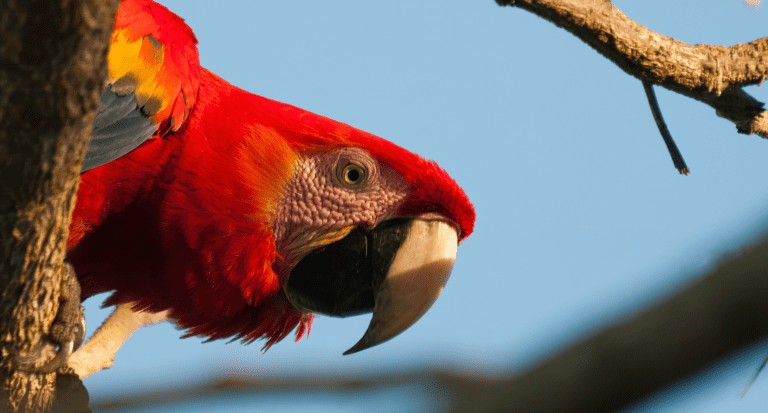
Scarlet macaws are the headliners. Carara harbors Costa Rica’s largest nesting macaw population, and their size makes them hard to miss — brilliant red with blue and yellow wings, calling loudly as they fly in pairs between feeding trees. The Tarcoles Bridge just north of the park is the single best macaw-watching spot in the country, with 20–40 birds gathering at dusk (around 5:30 pm) and returning east at dawn (6–6:30 am). Even visitors focused on hiking the trails will typically spot macaws flying overhead in the early morning.
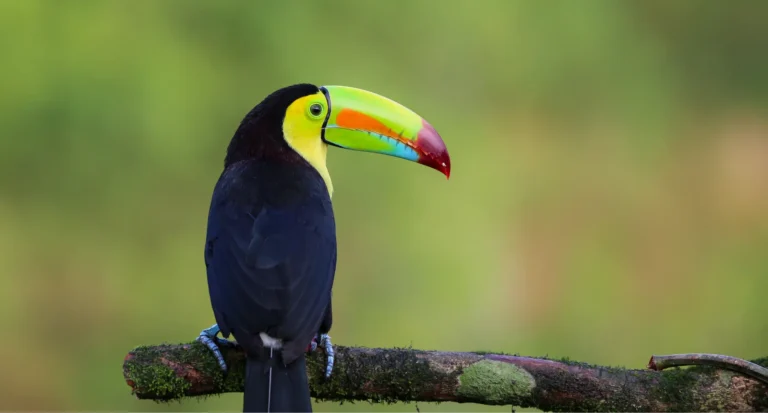
Beyond macaws, expect toucans — keel-billed and chestnut-mandibled are both common — plus motmots, jacamars, and multiple trogon species, including the striking black-headed trogon. Serious birders track over 430 confirmed species inside park boundaries, a number that reflects the ecological overlap driving all that diversity.
For anyone already planning to look for Costa Rica’s best birds, Carara deserves a half-day of its own. And if birding is a priority across your whole trip, understanding Costa Rica’s weather by region helps you time each park stop for maximum wildlife activity.
Mammals are harder. The dense canopy works against you: white-faced capuchin monkeys and Central American squirrel monkeys both live in the park, but stay high and camouflaged. Three-toed sloths do appear, but their algae-covered fur blends perfectly with the forest. Coatis are more reliably spotted foraging on the forest floor in the early morning. If you encounter a northern tamandua — a tree-climbing anteater — consider yourself genuinely lucky. They’re present but rarely seen by casual visitors.
American crocodiles live in the Tarcoles River, but you’ll see them far more reliably from the Tarcoles Bridge viewpoint outside the park than from any trail inside it. That bridge stop takes 15 minutes and is worth it regardless of what else you’re hoping to spot.
Where Is Carara and How Do You Get There?
Carara sits on Highway 34 in Puntarenas Province, about 55 miles (90 km) from San José. The drive from SJO follows Highway 27 west toward Caldera, then Highway 34 south — roughly one hour on fully paved roads with no mountain driving involved. From Jacó, it’s about 15 minutes north along the same coastal highway.
The roads here are genuinely easy by Costa Rican driving standards. This isn’t Monteverde or Santa Teresa. No unpaved sections, no river crossings, no sharp mountain grades. A standard sedan handles the park access road fine, and both parking areas are free and spacious. If you’re comparing which vehicle you actually need for the Central Pacific, Carara is the rare destination where the answer is simply: any car works.
Coming from Juan Santamaría Airport (SJO), the most logical approach is to combine Carara with a beach stay in Jacó or continue south toward Manuel Antonio National Park — they’re all on the same coastal highway.
This stretch of the Central Pacific is built for road trippers: easy highway access, no technical vehicle requirements, and multiple worthwhile stops within an hour of each other. If you’re still deciding between SJO and Liberia, the Costa Rica airport guide breaks down which one makes sense for a Central Pacific-focused trip.
What Are Your Transportation Options from Jacó?
Your own vehicle gives the most flexibility — arrive at opening time when wildlife activity peaks and combine the park with other stops at your own pace. Tour operators in Jacó offer guided excursions that bundle transport, entrance, and a bilingual guide, which works if you’d rather not handle logistics independently. The tradeoff: tours typically arrive after the most productive wildlife window has already passed.
Taxis from Jacó (Playa Hermosa) will get you to the entrance, but drivers won’t wait 3 hours inside — arrange a specific pickup time and budget accordingly. Public buses do pass Highway 34, but timing rarely aligns with the early-morning window that makes Carara worth visiting.
What Are the Best Months to Visit Carara?
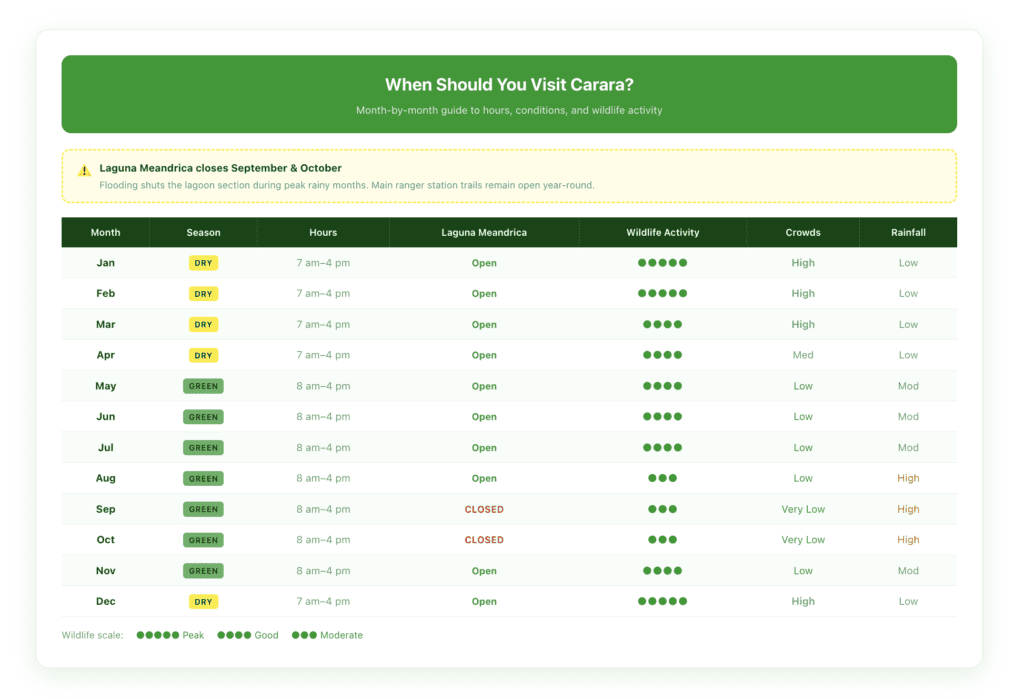
Carara is open year-round, and both seasons have genuine advantages.
Dry season (December–April) gives you earlier park hours (7 am instead of 8 am), drier trail conditions, and clearer skies for photography. Wildlife viewing is strong because animals concentrate around reliable water sources, as they do throughout Costa Rica’s dry season. This is also peak tourist season nationally, but Carara rarely feels crowded compared to Manuel Antonio.
The green season (May–November) brings vivid, lush forest, significantly fewer visitors, and lower accommodation costs in Jacó and elsewhere. The green season is excellent for birding — resident species stay active year-round, and the forest looks its most photogenic after rain. Trails can be muddy, but are always walkable. If you want to understand how each season affects different regions of Costa Rica, the Central Pacific’s patterns are fairly predictable — mornings stay clear through most of the green season, with afternoon showers typically arriving around 2 pm.
The main caveat: Laguna Meandrica closes completely in September and October due to flooding from heavy rains. During those two months, you’re limited to the main ranger station trails. If the lagoon section matters to you, plan around this.
How Much Does It Cost and How Do You Buy Tickets?
Entry fees: $10 USD plus tax for adult foreign visitors, $5 USD plus tax for children aged 5–12, and free for children under 2. Costa Rican residents pay separate rates. Parking is free at both park sections.
There are no on-site ticket sales. The park moved entirely to advance online booking through the SINAC ticketing system in September 2023. Show up without a pre-purchased ticket, and you’ll be turned away at the gate. Book at least a few days ahead, and if you’re visiting during dry season holiday periods, book a week or more in advance since popular time slots sell out. The system itself can be slow — create your SINAC account and complete the purchase at least 48 hours before your visit.
A practical note on costs: this is one of Costa Rica’s most budget-friendly wildlife experiences. Ten dollars for a primary rainforest teeming with macaws, no shuttle required, and free parking is an excellent value. For comparison, AllTrails users consistently rate Carara as one of the top birding destinations in the country.
Which Trails Should You Walk?
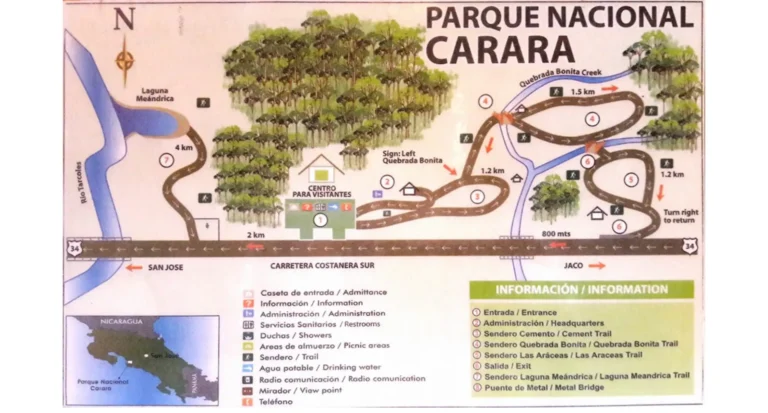
Carara is divided into two sections with separate entrances and parking areas. Most visitors begin at the main ranger station and add Laguna Meandrica if time and the season allow.
What’s at the Main Ranger Station?
Three main trails plus a connector path cover the primary rainforest zone:
Sendero Universal (Universal Access Trail) — 0.74 miles (1.2 km), fully paved and wheelchair accessible. This is Costa Rica’s benchmark for inclusive national park design: a wide, flat path with tactile animal statues and Braille descriptions, rope railings, accessible restrooms, and water fountain rest areas. The canopy closes overhead, and macaws frequently fly directly above the trail in morning hours. Even without accessibility needs, this is a genuinely beautiful walk. If you’re building a Central Pacific road trip from SJO, the Universal Access Trail makes Carara a realistic stop for travelers of all mobility levels.
Sendero Quebrada Bonita — 0.81 miles (1.3 km) circular, looping through primary forest where canopy cover is dense, and monkey sightings are more likely. Elevated platforms and wooden bridges over the creek offer good vantage points. Plan 30–45 minutes at a wildlife-watching pace.
Sendero Las Aráceas — 0.74 miles (1.2 km) circular, named for the Araceae plant family — Monstera, Philodendron, and their massive forest relatives are the botanical highlights here. More intimate than the other trails, with excellent bird and insect opportunities at ground level. The giant ficus tree near the midpoint is worth pausing at.
A shorter Sendero Punto de Encuentro de Ecosistemas (Ecosystem Meeting Point Trail) — 0.4 miles (650 m) — connects Quebrada Bonita to the Universal Access path and traverses the exact border where dry and humid forest species overlap. If you only have time for two trails, this connector is worth including.
What’s at Laguna Meandrica?
The lagoon section sits about half a mile (800 m) north of the main ranger station on Highway 34, with its own separate parking and entry. The trail covers roughly 1.2 miles (2 km) around an oxbow lake formed by the Tarcoles River — a flat walk through gallery forest with sections that run close to the river.
This section draws serious birdwatchers specifically. Herons, kingfishers, jacanas, anhingas, and boat-billed herons frequent the water’s edge, and the more open sightlines along the shoreline make spotting easier than the closed canopy of the main trails. Crocodile sightings inside the park are also more likely here than anywhere on the ranger station trails.
Two reminders: Laguna Meandrica closes entirely in September and October due to flooding. And given the trail’s proximity to the river, stay on marked paths.
Should You Hire a Guide?
If wildlife viewing is the point, yes — the margin of difference between an independent visit and a guided one is significant at Carara. This isn’t a park where the animals come to you. Guides here carry spotting scopes that transform a distant bird into a frame-filling subject, and they know which specific trees the macaws use and at what time of morning. This is especially true if you’re coming from a base in Jacó or Playa Hermosa and want to make the most of an early start.
Experienced birding guides spot the sloth you walked past, identify calls before you even look up, and distinguish six nearly identical trogon species from a flash of green in the canopy. If scarlet macaw photography is your goal, a guide shortens the time from “hopeful” to “got it” dramatically.
Freelance guides station themselves near the main ranger station entrance, especially during the dry season. Expect to pay around $60 USD for two people for 2.5 hours, plus roughly $10 per additional person. In peak months (December–April), arrive early — skilled guides fill their morning slots by 7:30 am. The park’s growing reputation as a birding destination is well-documented, and conservation success with macaw populations here is increasingly cited as a model for Costa Rica’s national park system.
Going independent? Walk slowly, scan the canopy rather than the trail ahead, and watch for other visitors with their necks craned upward. Birders are a generous community and tend to share sightings freely. If you’re planning a wider wildlife-focused trip, Caño Negro Wildlife Refuge in the north and Carara in the Central Pacific together cover two entirely different ecosystems — wetlands versus primary rainforest — and complement each other well as part of a longer itinerary.
What Should You Pack for Carara?
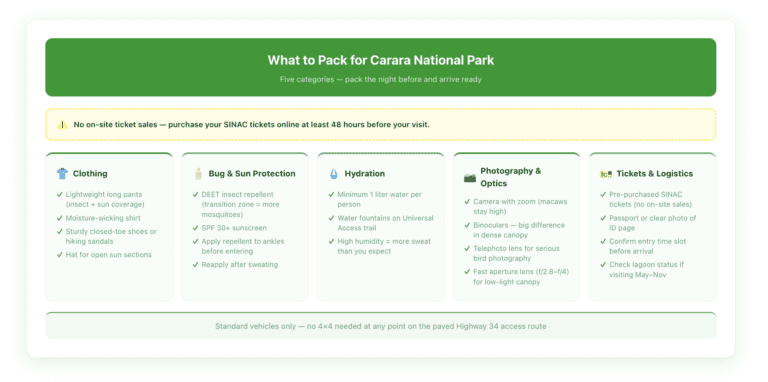
Clothing: Lightweight long pants and a moisture-wicking shirt protect from insects and sun while staying comfortable in the humidity. Sturdy closed-toe shoes or hiking sandals with tread handle the well-maintained but occasionally muddy trails. Skip the flip-flops. This is similar packing logic of other Costa Rica national parks and activities — layers and closed-toe shoes cover most situations.
Bug and sun protection: The transition zone creates prime mosquito habitat. Apply repellent liberally before entering, focus on ankles and exposed skin, and reapply after sweating. Even with good canopy cover, sun exposure appears in open sections — bring SPF 30+ and a hat.
Hydration: Carry at least 1 liter of water per person. The park has water fountains along the Universal Access trail, but having your own supply means staying properly hydrated throughout. The humidity makes you sweat more than you realize.
Photography and optics: A camera with good zoom capability captures distant wildlife effectively; a telephoto lens is worth it for serious bird photography. Binoculars make a genuine difference for spotting birds in the canopy. The lighting under dense cover is challenging — fast lenses (f/2.8–f/4) handle it better than consumer zoom lenses.
Tickets and logistics: Pre-purchase your SINAC tickets before leaving your accommodation. Confirm your entry time. Bring your passport (or a clear photo of the ID page) — rangers verify identity at entry. Check whether Laguna Meandrica is open if you’re visiting between May and November.
How Does Carara Compare to Other Central Pacific Parks?
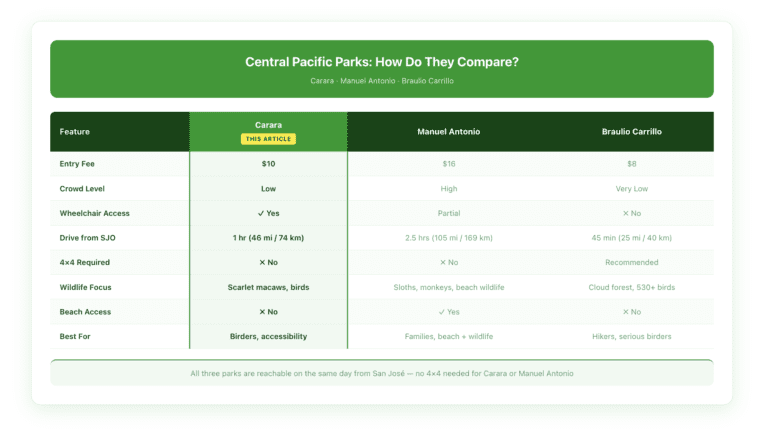
Carara is genuinely different from Manuel Antonio in ways that should affect your planning. If you’re deciding between the two for your budget, keep in mind that Carara is significantly less expensive in aggregate — lower entrance fee, free parking, and no shuttle required.
Manuel Antonio combines beach access with forest trails and reliably habituated wildlife — monkeys wander near the beach, sloths appear regularly on main paths, and the experience resembles a guaranteed highlight reel. The tradeoff is crowds. Manuel Antonio caps daily visitors at 600 and fills regularly during high season, with popular trail sections feeling congested by mid-morning. Carara asks more of you in terms of patience, but for birding — especially for scarlet macaws and the incredible diversity the transition zone creates — Carara is in a different category.
Braulio Carrillo offers a useful comparison for cloud forest enthusiasts: also undervisited relative to its quality, also excellent for birds, but at a much higher elevation with more demanding trails and completely different weather patterns. If you’re planning a 1-week itinerary anchored in the Central Pacific, Carara and Manuel Antonio complement each other well as a single-day double stop. Planning a longer 2-week route starting from SJO? Carara makes a natural opening stop before heading inland or south. For first-timers figuring out what to do in Costa Rica across 50+ activities, Carara consistently delivers strong value for the time and cost invested.
For travelers with mobility limitations, Carara’s Universal Access Trail is far and away the best accessible rainforest experience in Costa Rica — no other major national park comes close in terms of trail quality and inclusive design. For a completely different forest experience, Monteverde’s wildlife sits at high elevation in a cloud forest — same diversity ambition, very different ecosystem, and access challenge.
How Can You Combine Carara with Other Stops?
Carara’s position on Highway 34 makes it a natural add-on rather than a standalone destination.
Carara + Tarcoles Bridge + Jacó — Start at the bridge at 6 am for the morning macaw flight, enter Carara at 7 am (dry season), hike for 3 hours, then continue 9 miles (14.5 km) south to Jacó for lunch and beach time. Full day, one highway, zero backtracking. If you’re basing yourself in the San José area, this is a natural day trip that works particularly well during the dry season. From Jac,ó you can also add a half-day of adventure with Costa Rica ziplines in the nearby hills — canopy access without the long drive to Monteverde.
Carara + Manuel Antonio — Both parks are on the same coastal route. Arrive at Carara when it opens for the wildlife peak, spend the morning hiking, then drive about 1.5 hours south for an afternoon at Manuel Antonio or to check into accommodation near Quepos. These two parks together cover the Central Pacific’s best wildlife in a single day if you start early enough. Divers and snorkelers in the group can add Caño Island to the itinerary — it’s accessible from Uvita and Drake Bay, and its marine biodiversity rivals what Carara offers on land.
Carara as a departure day stop — If your flight leaves in the evening, Carara is one of the few national parks close enough to SJO Airport to visit on a travel day without stress. Leave San José by 6 am, explore the park 7–10 am, and be back well ahead of any afternoon international flight. If you need a full walkthrough of what to expect at SJO on departure day, that’s worth reading before building this plan.
Choosing the right vehicle matters less here than at most Costa Rica destinations — a standard sedan is perfectly adequate — but having your own vehicle from Vamos is what makes the timing work. Arriving at 7 am instead of 9 am isn’t a minor detail at Carara; it’s the difference between seeing macaws in active morning flight and arriving when the forest has already gone quiet. If you also want to explore the SJO airport road trip routes available to Central Pacific travelers, the Pacific Coast Explorer route puts Carara as stop one before heading through Jacó toward Playa Hermosa and Manuel Antonio.
Pack your binoculars, buy your tickets a few days ahead, and get there early. The first hour after opening is when Carara earns its reputation.
Frequently Asked Questions
Is Carara National Park worth it?
Yes, particularly if you care about birdwatching or want to see scarlet macaws in the wild. Carara delivers Costa Rica’s most reliable macaw sightings, 430+ bird species, and a genuinely distinctive ecological experience at the transition zone between dry and humid forest. At a $10 entry with no 4×4 needed and free parking, it’s one of the most accessible and affordable wildlife destinations in the country. Arrive at opening time to get the most out of it.
Is Carara National Park a rainforest?
It’s a transition zone between tropical dry forest and humid rainforest — the only one on Costa Rica’s Central Pacific coast. This means it shares characteristics of both ecosystems, which explains the exceptional biodiversity. You’ll find dry-forest species like the white-throated magpie-jay coexisting with humid-forest species like scarlet macaws within the same trail system.
Does Carara National Park have waterfalls?
No — Carara’s appeal is its forest, birdlife, and the Tarcoles River ecosystem rather than waterfalls. The park protects primary rainforest rather than dramatic topographic features. If waterfalls are a priority for your trip, La Paz Waterfall Gardens near Alajuela and Nauyaca Waterfalls near Dominical are both strong options in the broader region.
What is the most visited national park in Costa Rica?
Manuel Antonio National Park consistently ranks as Costa Rica’s most visited, despite being the country’s smallest national park. It caps daily entries at 600 but fills regularly during peak season. Carara sees significantly fewer visitors, which contributes to a more peaceful, less rushed wildlife viewing experience.
What are the best months to visit Carara?
Carara is worth visiting year-round. December through April (dry season) offers earlier park hours (7 am vs. 8 am), drier trails, and access to all park sections. May through August delivers lush forest and fewer crowds with still-excellent birding. Avoid September and October if you want to visit Laguna Meandrica — it closes those months due to flooding.
How long should you spend at Carara?
Plan 3–4 hours for the main ranger station trails. Add another hour if you’re also visiting Laguna Meandrica. The trails themselves aren’t long, but wildlife watching at Carara genuinely rewards slow, patient walking. Rushing through in 90 minutes means missing most of what the park has to offer.