
Last Updated on March 18, 2026
Children's Eternal Rainforest: Quick Guide
Costa Rica’s largest private reserve spans 56,000 acres across seven life zones — twice the size of the Monteverde Cloud Forest Reserve — funded by schoolchildren from 44 countries starting in 1987. Entry costs $18 adults at most stations, with Bajo del Tigre accessible 10 minutes from Santa Elena, and Pocosol Station near La Fortuna requiring a 4×4 year-round. Every entry dollar goes directly to conservation.
Quick Facts:
- Four stations: Bajo del Tigre (families), San Gerardo (overnight, Arenal views), Pocosol (waterfall, volcanic vents), Finca Stellar (researchers)
- Open 8 AM–4:30 PM; best wildlife 6–9 AM — arrive at opening
- Pocosol is 4×4 mandatory year-round, no exceptions
- Overnight stays at San Gerardo and Pocosol: ~$78–$123/person including meals
- 100% of fees fund conservation — no government budget, no corporate ownership
Top Station Options:
- Bajo del Tigre — 2.2 miles (3.5 km) of easy trails, night walks available, 10 min from Santa Elena. Best for families visiting Monteverde and first-time visitors.
- San Gerardo — Overnight lodging, 3.1+ miles (5+ km) of cloud forest trails, Arenal Volcano views on clear mornings. 4×4 recommended in the green season.
- Pocosol — 6.2 miles (10 km) of trails to a lake, waterfall, and volcanic vents. Best combined with La Fortuna activities.
Pocosol and San Gerardo both sit on roads that require a vehicle matched to the terrain. Check what your itinerary actually needs before booking.
If you need any help with a Costa Rica car rental, contact us now!
The Children’s Eternal Rainforest (Bosque Eterno de los Niños) is Costa Rica’s largest private nature reserve, covering 56,000 acres across northwestern Costa Rica — more than twice the size of the Monteverde Cloud Forest Reserve. What makes it unusual isn’t just the size. It’s that Swedish elementary school children started funding it in 1987, eventually pulling in donations from kids in 44 countries who collectively saved one of Central America’s most ecologically critical landscapes.
Today, four distinct visitor stations offer experiences ranging from easy family-friendly trails near Santa Elena to remote forest with volcanic vents near La Fortuna, with almost no crowds at any of them.
Key Takeaways
- The reserve spans 56,000 acres across seven life zones — premontane rainforest at lower elevations, all the way to cloud forest along the Continental Divide.
- Four stations: Bajo del Tigre (10 minutes from Santa Elena), San Gerardo (views of Arenal Volcano), Pocosol (near La Fortuna), and Finca Stellar (researcher access only).
- Entry costs $18 per adult, $10.80 for children — 100% goes directly to conservation, with no government funding.
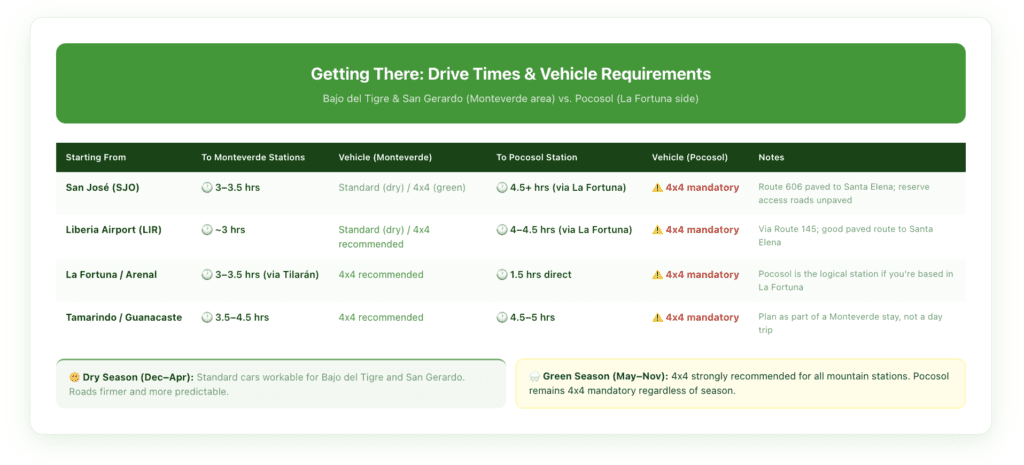
- Pocosol Station requires a 4×4 year-round; Bajo del Tigre and San Gerardo are manageable with a standard car in the dry season.
- Best wildlife viewing happens 6–9 AM regardless of season; the green season actually produces more wildlife activity with fewer crowds.
Why Does This Reserve Exist in the First Place?
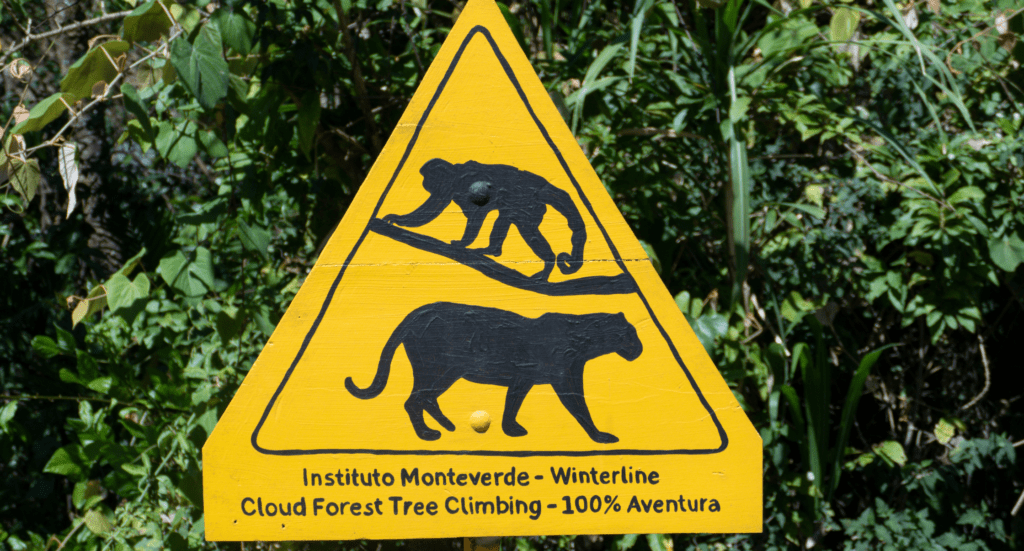
In 1987, American biologist Sharon Kinsman gave a presentation about Costa Rican deforestation to a Swedish elementary class led by teacher Eha Kern. The students were moved enough to start fundraising — bake sales, sponsored walks, whatever they could organize. That initial campaign raised $18,000.
Then the story grew. Students in Japan, England, Germany, and across the Americas started their own campaigns. By 1998, children’s fundraising efforts had protected 18,000 hectares, making it the largest private reserve in Central America at the time. The reserve has since expanded to its current 22,600 hectares (56,000 acres), and fundraising still continues today.
The name “Bosque Eterno de los Niños” — Children’s Eternal Forest — honors those young conservationists directly. It’s managed today by the Monteverde Conservation League, a nonprofit that operates entirely on visitor fees and donations without any government funding. That context matters when you’re paying your entry fee: the money goes straight into forest patrols, environmental education, research, and reforestation projects on degraded land adjacent to the reserve.
Beyond its conservation story, the reserve is ecologically important in ways visitors rarely hear about. It functions as a critical watershed — communities throughout the Monteverde geography and La Fortuna regions depend on water flowing from these forests, and hydroelectric projects fed by reserve streams generate a significant portion of Costa Rica’s electricity. When you’re hiking through it, you’re walking through working infrastructure for a whole country.
Which Station Is Right for You?
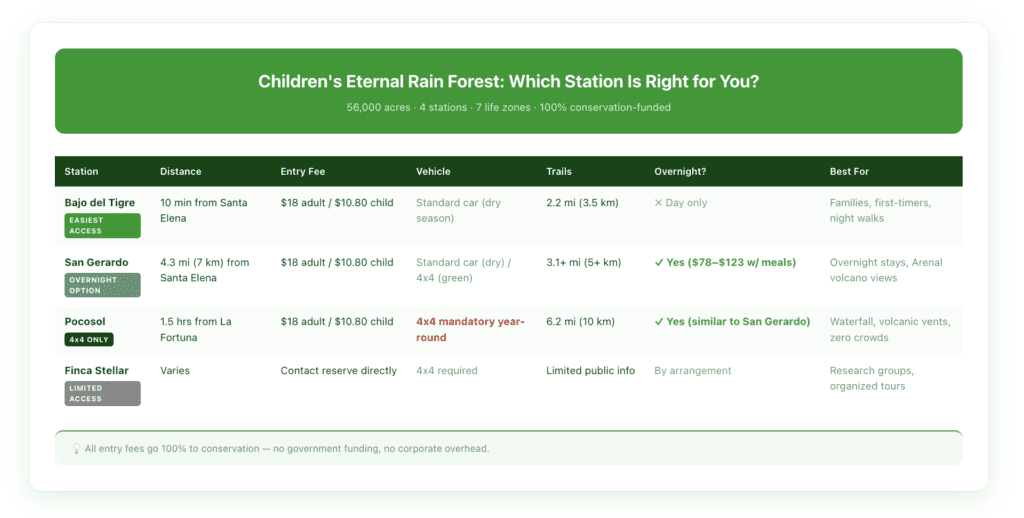
This is the question that shapes everything. The four stations offer completely different experiences, and choosing the wrong one for your base town or fitness level can mean a wasted drive on demanding roads.
Is Bajo del Tigre the Best Option if You’re Based in Monteverde?
For most visitors staying in Santa Elena or exploring Monteverde, Bajo del Tigre is the right starting point. It’s located about 10 minutes from Santa Elena — drive the road toward Curi Cancha Reserve and the Monteverde Cloud Forest Reserve, and watch for signage. You can search “Children’s Eternal Rainforest Bajo del Tigre” on Google Maps for exact navigation.
The station sits in what’s called a “rain shadow forest” — technically, a cloud forest territory, but noticeably drier than the reserves higher up. That changes the hiking experience considerably. Trails stay more manageable, closed-toe hiking sandals work fine in the dry season, and the gentler terrain makes it genuinely appropriate for families with younger kids or anyone who finds the steep trails at other Monteverde reserves too demanding.
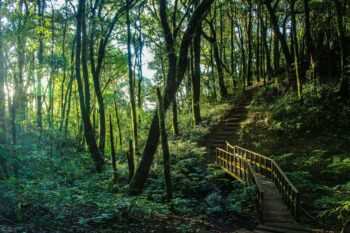
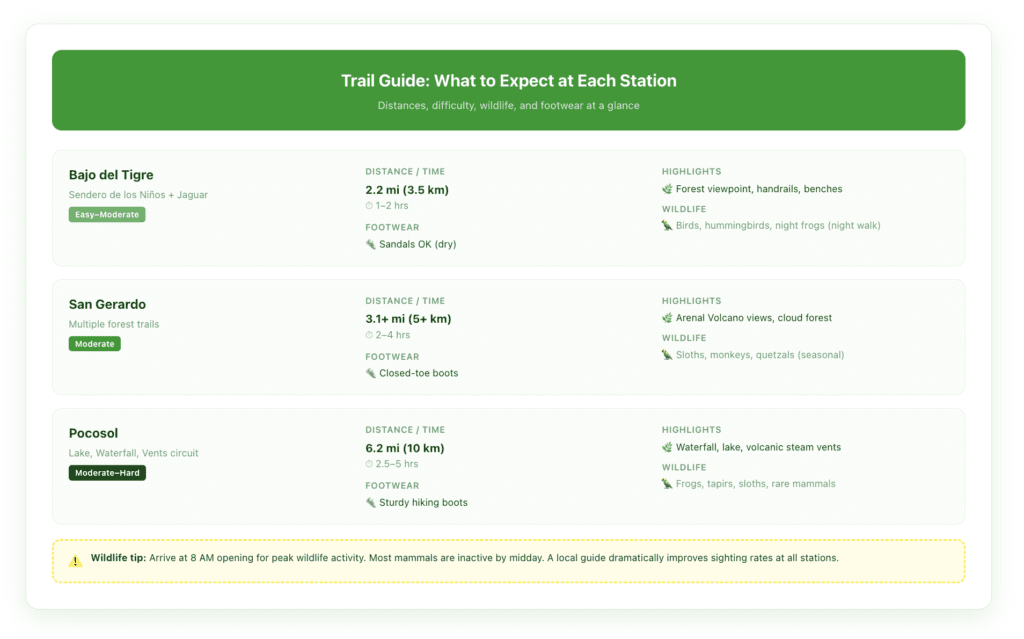
The trail is very well maintained with handrails and benches placed thoughtfully throughout. The steeper section toward the Sendero Mirador viewpoint gives you a forest overlook worth the effort — but that section isn’t mandatory if you have mobility concerns. Budget about 1–2 hours for the standard loop. Entry is open 8 AM–4:30 PM. If you’re traveling with kids, Bajo del Tigre is one of the few reserves in the region that genuinely works for all ages.
One feature worth knowing: Bajo del Tigre offers night walks with advance reservations. The nocturnal version of this forest is a different experience entirely — guides use red-beam flashlights to locate sleeping sloths, frogs, tarantulas, and kinkajous you’d completely miss during the day. If you’re spending 2 or more days in Monteverde, a night walk here is worth adding.
What Makes San Gerardo Station Worth the Extra Drive?
San Gerardo sits about 4.3 miles (7 km) from Santa Elena at 4,000 feet (1,220 m) elevation on the reserve’s Pacific slope. The drive involves partially unpaved roads — straightforward in the dry season, less so during rain. You’ll arrive at a station that feels genuinely remote despite being reachable in under 30 minutes.
The practical draw here is the infrastructure. San Gerardo has over 3.1 miles (5 km) of forested trails, a classroom, and accommodation for up to 32 visitors. Overnight rates run approximately $78–$123 per person, depending on shared versus private rooms, and three meals plus internet are included. For day hikers, the standard $18 entry applies.
On clear mornings, there are views of Arenal Volcano from the station — something you won’t get from the other Monteverde reserves. The overnight option also gives you legitimate dawn and dusk wildlife access, which is when most forest animals are actually moving.
Why Does Pocosol Station Require a 4×4?
Pocosol Station is on the opposite end of the reserve from Bajo del Tigre, positioned at 2,600 feet (800 m) elevation, closer to La Fortuna than Monteverde. The lower elevation puts you in a premontane forest — a completely different ecosystem with different species than the cloud forest stations.
The drive from La Fortuna takes about 1.5 hours on rough roads. This is not a “high clearance recommended” situation — a 4×4 is genuinely mandatory year-round. The route passes the Peñas Blancas rivers and two hydroelectric dams, and the final stretch demands ground clearance and traction that standard sedans simply don’t have. If your rental vehicle is a standard car, Pocosol isn’t accessible to you regardless of the reason.
What you get for the effort is remarkable. Pocosol has 6.2 miles (10 km) of trails leading to a pristine lake, a waterfall, and volcanic vents where you can see active geothermal activity. Mycologists have visited Pocosol specifically for its fungi diversity. The challenging access means you’ll almost certainly have the trails to yourself — a rare experience in any Costa Rican reserve. Overnight stays are available here too, with similar pricing to San Gerardo.
If you’re staying in La Fortuna and want Children’s Eternal Rainforest without the 3–4 hour drive to Monteverde, Pocosol is the logical choice. Search “Pocosol biological station” on Waze for the most accurate routing — standard GPS apps sometimes route incorrectly on these back roads.
What About Finca Stellar?
Finca Stellar is the least developed station and primarily serves researchers and organized student groups. Visitor access is limited, and the Monteverde Conservation League doesn’t actively market this station to independent travelers. If you’re interested, contact them directly through acmcr.org.
What Wildlife Will You Actually See Here?
The biodiversity statistics for this reserve are genuinely impressive — 400+ bird species, 120+ mammals, 60 amphibians — but that doesn’t translate directly into what you’ll see on a given hike. Here’s an honest breakdown.
What Are Your Realistic Wildlife Odds?
The reserve spans 56,000 acres with relatively few visitors on any given day. That’s good news and bad news simultaneously. The forest is undisturbed and genuinely wild, but wildlife dispersal across that much territory means you need either patience, a guide, or early morning timing to reliably encounter animals.
The most accessible wildlife: howler monkeys (you’ll hear them roaring at dawn before you ever see them), white-faced capuchin troops moving through the canopy, coatis foraging along trail edges, and agoutis. Two-toed and three-toed sloths inhabit all stations — they’re just incredibly easy to miss without a trained eye that knows which trees to scan. Tapirs, Costa Rica’s largest land mammal, range throughout the reserve but are primarily active at dawn and dusk.
The resplendent quetzal — the bird people fly to Monteverde specifically to see — inhabits the cloud forest sections, particularly March through June during breeding season. San Gerardo and the upper elevations of the reserve are good territory for quetzal sightings, though Curi-Cancha Reserve and the main Monteverde Cloud Forest Reserve remain the most reliable spots in the immediate area. Three-wattled bellbirds — which the IUCN lists as vulnerable — produce one of the forest’s most distinctive sounds: a loud metallic “bonk” that carries through the trees. Hearing them before you see them is the norm.
Can You Really See All Six Wild Cats?
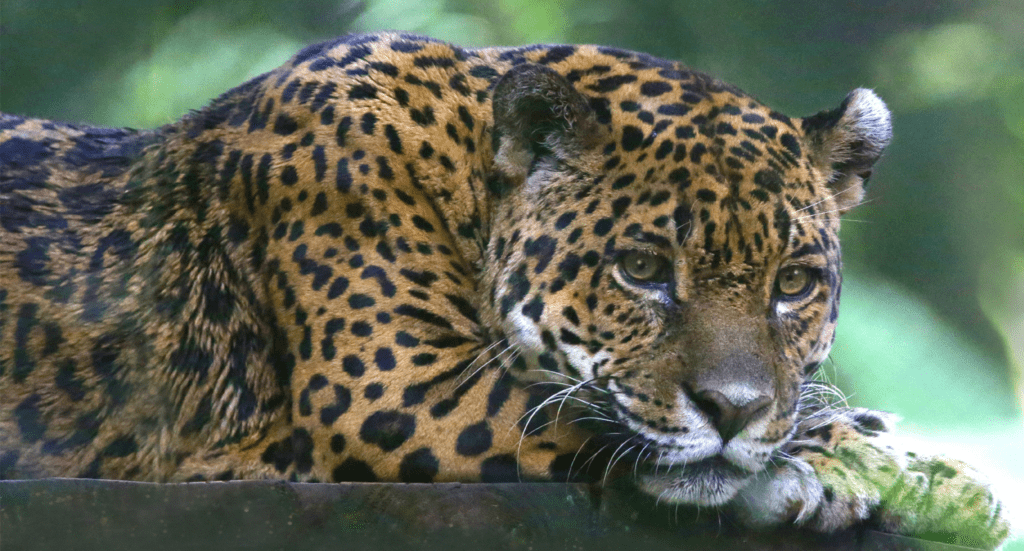
Children’s Eternal Rainforest protects all six Costa Rican wild cat species: jaguars, pumas, ocelots, margays, jaguarundis, and oncillas. But seeing one on a day hike? Your realistic odds are extremely low. These animals are nocturnal, actively avoid human contact, and range over territories that make their concentration at any single location unlikely.
What their presence does tell you is meaningful: this reserve can support apex predators, which means the food chain below them is intact. Camera traps at San Gerardo and Pocosol regularly capture images of cats that visitors walking those same trails will never see. The reserve’s management uses those trap records to assess ecosystem health.
For amphibian enthusiasts, Pocosol is specifically notable. The lower-elevation forest supports species not found in the cloud forest stations, including multiple frog species that become particularly active after rain. Night visits at Bajo del Tigre are the most accessible way to encounter frogs — Costa Rica hosts over 200 amphibian species, and this reserve protects 60 of them. The red-eyed tree frog that’s become synonymous with Costa Rica appears regularly on guided night walks.
When Should You Visit for the Best Experience?
The dry season (December through April) makes trail access easier and more comfortable. Bajo del Tigre and San Gerardo are straightforward in a standard car during these months. But the green season (May through November) offers real advantages specific to this reserve.
Fewer visitors means the wildlife you do encounter behaves more naturally and appears more frequently. Rainfall triggers amphibian activity throughout the reserve — if frogs are a priority, green season morning hikes at Bajo del Tigre or night walks are notably better. The forest at every station looks dramatically more lush, and cloud forest conditions at San Gerardo become more atmospheric. Morning hours (before noon) typically stay clear even during the rainy season, with afternoon showers starting around 1–2 PM.
The one consistent rule, regardless of season: arrive early. Wildlife activity peaks between 6 and 9 AM across all stations. The reserve opens at 8 AM, which means arriving right at opening is worth setting an alarm for. Having your own vehicle — especially a 4×4 if you’re exploring San Gerardo or Pocosol — is the difference between hitting that 8 AM window and spending time coordinating shuttle schedules.
How Do You Actually Get There?
What’s the Drive from San José?
From San José, the drive to Bajo del Tigre and San Gerardo (via Santa Elena) runs about 3–3.5 hours under good driving conditions. Take Route 1 north toward Puntarenas, turn onto Route 606 toward Santa Elena — the final portion of this road is now paved, but the access roads to both stations involve unpaved stretches. A standard car is workable in the dry season; during the green season, a 4×4 becomes the sensible choice. The Children’s Eternal Rainforest fits naturally into a two-week Costa Rica itinerary as a Monteverde highlight.
For Pocosol, San José to La Fortuna is approximately 3 hours, then another 1.5 hours from La Fortuna on rough roads with a mandatory 4×4.
Is This a Realistic Day Trip from Liberia?
From Liberia Airport, Monteverde, and therefore Bajo del Tigre and San Gerardo are about 3 hours away. Pocosol from Liberia routes through La Fortuna at roughly 4–4.5 hours. Both are possible as day trips, but the drive times make multi-night stays in Monteverde or La Fortuna the more practical choice for actually experiencing what the reserve offers.
Can You Combine This with Other Monteverde Activities?
Bajo del Tigre works naturally as a half-day complement to other Monteverde activities — pair it with a morning cloud forest hike at the main reserve, an afternoon coffee tour, or evening canopy ziplines. San Gerardo justifies its own full day, especially if you’re staying overnight.
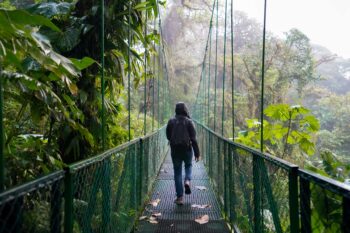
The reserve also connects naturally alongside 100% Aventura’s ziplines, the hanging bridges, or a night walk in Curi-Cancha during a multi-day Monteverde stay.
What Should You Pack and Expect?
Bajo del Tigre: Hiking sandals work fine in the dry season. Light layers (the station sits at a slightly lower, drier elevation), sunscreen, and insect repellent. Binoculars are worth bringing for birds. Cash for entry — no ATMs on site.
San Gerardo and Pocosol: Closed-toe hiking boots are non-negotiable. These trails have steep sections, loose rocks, and roots throughout. Bring at least 2 liters (67 oz) of water per person, trail snacks, a light rain jacket, regardless of season, and download offline maps before departure — cell coverage is unreliable at both stations. Don’t bring an umbrella; it’s useless on narrow forest trails.
For overnight stays at either station, add toiletries, extra layers for cool evenings, and any personal medications. The stations provide meals, but bring your own entertainment for downtime.
Hiring a guide isn’t required, but it changes the experience significantly. Local guides spot animals you’d walk past and can identify bird calls that explain much of what you’re hearing throughout the forest. The reserve’s website lists recommended guides and tour operators for all stations.
How Does This Reserve Compare to Monteverde Cloud Forest Reserve?
It’s worth addressing directly since most visitors are choosing between the two.
The main Monteverde Cloud Forest Reserve offers more manicured trails, better signage, guided tour options on every visit, the La Ventana Continental Divide viewpoint, and a more curated visitor experience overall. It’s also significantly smaller at 26,000 acres and draws far more daily visitors.
Children’s Eternal Rainforest is twice the size, spans seven life zones instead of one, costs the same ($18 adults at most stations), and sends 100% of your entry fee to conservation rather than operating expenses. The infrastructure is more basic, the crowds are minimal, and you’re more genuinely on your own — which is the point.
If you have two or more days in Monteverde, visiting both makes sense. Start your first morning at the main Monteverde Cloud Forest Reserve for the trail infrastructure and Continental Divide viewpoint, then add Bajo del Tigre on your second afternoon or evening for the night walk experience. San Gerardo justifies its own half-day if you want to stay in the reserve system longer.
The practical bottom line: your vehicle choice determines your options more than anything else. Bajo del Tigre and San Gerardo are accessible with a standard car in the dry season, though high-clearance helps. For Pocosol, there’s no flexibility — it’s 4×4 only, year-round, no exceptions. Plan your itinerary around that reality before you book anything else.
Frequently Asked Questions
Why is it called the Children’s Eternal Rainforest?
Swedish elementary school students started it. In 1987, a class led by teacher Eha Kern heard a presentation about Costa Rican deforestation and began fundraising through bake sales and sponsored walks. The movement spread to 44 countries. By 1998, children’s campaigns had protected 18,000 hectares. The name honors those young conservationists directly — “Bosque Eterno de los Niños” means Children’s Eternal Forest in Spanish.
Is the Children’s Eternal Rainforest actually a cloud forest?
Parts of it are, and parts of it aren’t — which is what makes it ecologically unusual. The reserve spans seven distinct life zones. San Gerardo and the upper elevations near the Continental Divide are a genuine cloud forest. Bajo del Tigre sits in a “rain shadow forest” that’s noticeably drier. Pocosol is a premontane rainforest at a lower elevation near La Fortuna. The diversity of ecosystems within one reserve is actually one of its strongest arguments for visiting, especially if you’ve already experienced the main cloud forest reserves.
Is Bajo del Tigre appropriate for kids and families?
Yes, it’s the most family-friendly option in the reserve system. The trails total about 2.2 miles (3.5 km), are well-maintained with handrails and benches, and the flat main section doesn’t require technical hiking ability. The rain shadow location makes it less muddy than higher-elevation cloud forest reserves. Hiking sandals work fine in the dry season. The only section with real elevation gain is the optional Sendero Mirador viewpoint trail, which can be skipped.
Do you need reservations to visit?
For self-guided day hikes at Bajo del Tigre and Pocosol, reservations aren’t required. Guided walks require advance booking, as do all overnight stays at San Gerardo and Pocosol. Night walks at Bajo del Tigre must be booked ahead of time. During peak dry season (December–April), it’s worth contacting the Monteverde Conservation League in advance to confirm availability, especially for overnight stays.
How does Children’s Eternal Rainforest compare to other Monteverde reserves?
The main differences: size (56,000 acres vs. 26,000 for Monteverde Cloud Forest Reserve), ecosystem diversity (seven life zones vs. one), crowd levels (significantly quieter at all stations), infrastructure (more basic), and conservation funding model (100% of entry fees go directly to conservation). Monteverde Cloud Forest Reserve offers better trail systems, more guided tour options, and the Continental Divide viewpoint. Children’s Eternal Rainforest is better for visitors who want an authentic, uncrowded forest experience and direct conservation impact.
What happened to the entry price — some sources say $15, others say $18?
Current entry at Pocosol Station is $18 for adults, $10.80 for children ages 6–12, and $16.20 for students. Some older sources and the draft content brief still reference $15; that pricing has been updated. Confirm current rates directly on the Monteverde Conservation League website before visiting, as fees are subject to change.
Can you visit Pocosol as a day trip without a 4×4?
No. The access roads to Pocosol are rough enough year-round that standard sedans genuinely cannot complete the drive. This isn’t a rainy season caveat or a soft suggestion — it’s a hard requirement. If you’re renting a standard car, either visit Bajo del Tigre or San Gerardo instead, or upgrade your vehicle specifically for this trip.
What’s the best way to spot wildlife here?
Arrive at opening (8 AM) and hike the first 1–2 hours of the day. Most forest animals are active in the early morning and retreat during midday heat. A local guide dramatically improves sighting rates — they know which trees sloths favor, identify birds by call, and can spot a motionless frog against bark that you’d walk past without noticing. For nocturnal species, the night walk at Bajo del Tigre is the most accessible option and covers frogs, sleeping sloths, kinkajous, and insects that don’t appear during daylight at all.