
Last Updated on March 27, 2026
Monteverde Cloud Forest Reserves: What's Covered
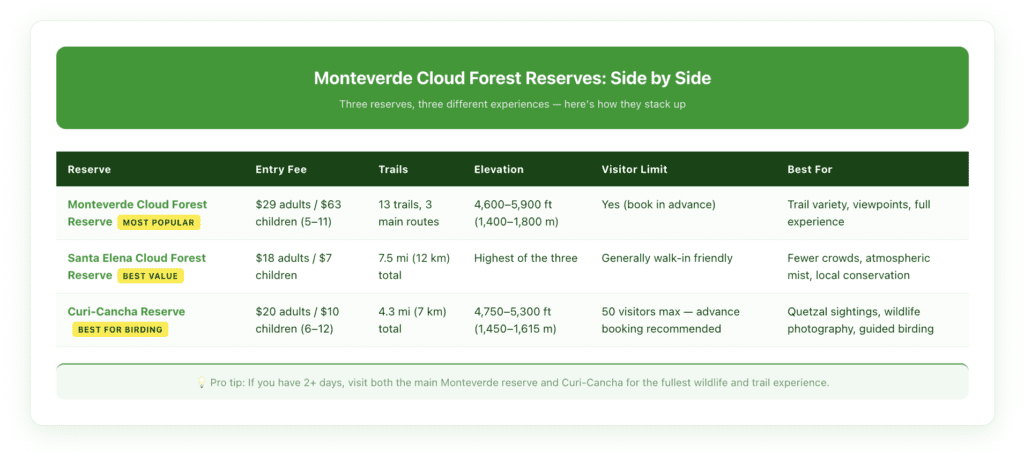
The Monteverde Cloud Forest Biological Reserve protects 26,000 acres of one of Earth’s rarest ecosystems — cloud forest covering less than 1% of global forest cover — with over 400 bird species, 100 mammals, and 500 orchid varieties at 4,600–5,900 feet elevation. Entry runs $29 adults, with advance booking required during peak season. Route 606 is fully paved to Santa Elena; a 4×4 opens reserve access roads and remote lodges.
Quick Facts:
- Quetzal season: February–July breeding season; peak sightings March–April, 6–10 AM with a local guide.
- Three reserves: Monteverde ($29), Santa Elena ($18), and Curi-Cancha ($20) each offer distinct experiences and visitor limits.
- Temperature: 64°F (18°C) year-round — pack layers and a rain jacket for every season.
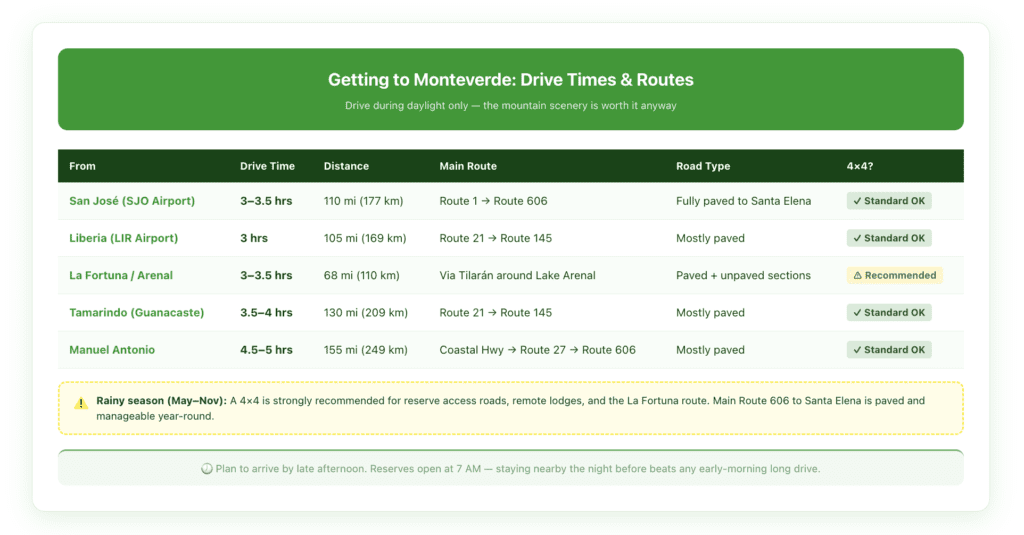
- Drive times: 3.5 hrs from San José Airport, 3 hrs from Liberia Airport.
- Night tours: Reveal sloths, tree frogs, kinkajous, and tarantulas invisible during daylight.
Top 3 Reserve Experiences:
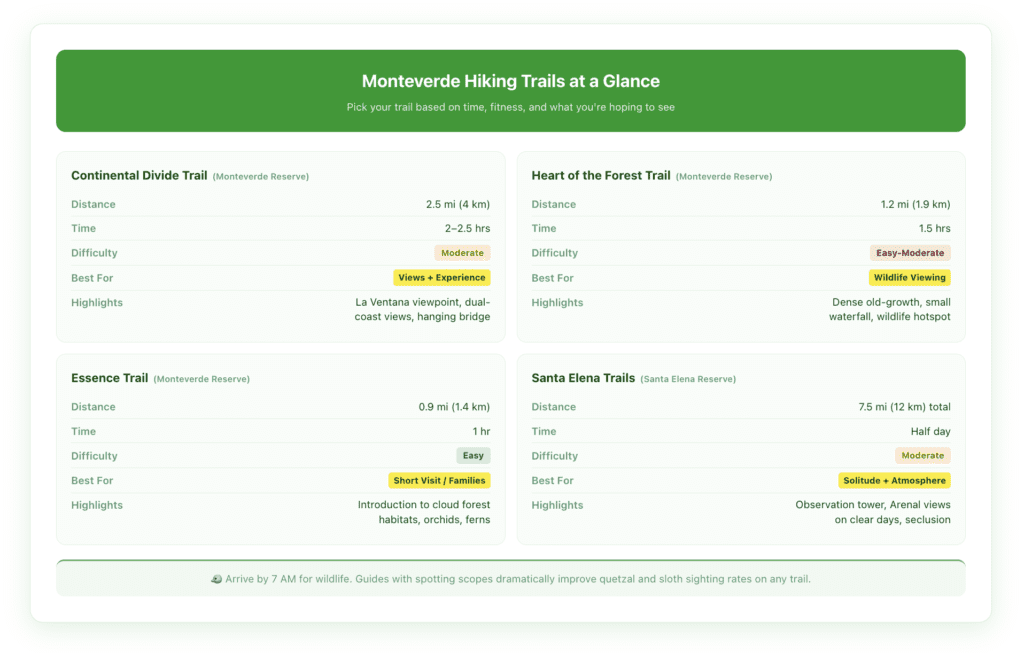
- Monteverde Cloud Forest Biological Reserve — 13 trails, including the Continental Divide Trail (2.5 mi/4 km) with dual-coast views from La Ventana viewpoint. Most comprehensive experience.
- Santa Elena Cloud Forest Reserve — Higher elevation, fewer crowds, observation tower with Arenal Volcano views on clear days. Best atmosphere.
- Curi-Cancha Reserve — Caps at 50 visitors, 200+ bird species recorded, best quetzal sighting odds. Birders’ top pick.
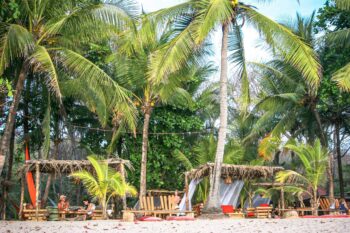
Monteverde pairs naturally with La Fortuna and Arenal on a northern zone loop, or Guanacaste beaches for sun after the cloud forest. Your own vehicle means hitting that 7 AM opening — the single most important Monteverde tip.
If you need any help with a Costa Rica car rental, contact us now!
Yes — the Monteverde Cloud Forest Reserve is worth every bit of the journey. This 26,000-acre biological reserve sits at 4,600–5,900 feet along Costa Rica’s Continental Divide, protecting one of the planet’s rarest ecosystems and sheltering over 400 bird species, 100 mammals, and 500 orchid varieties. You’re talking about 2.5% of the world’s known biodiversity concentrated in a single region. Whether you show up for the resplendent quetzal, the hanging bridges, the ziplines, or simply want to walk through a forest that looks like something out of a fantasy novel, Monteverde delivers.
Key Takeaways
- The Monteverde Cloud Forest Biological Reserve spans 26,000 acres with 13 hiking trails across six ecological life zones.
- Resplendent quetzals are best spotted from February to July, with peak sightings in March to April between 6–10 AM.
- Three main reserves to choose from: Monteverde Cloud Forest, Santa Elena, and Curi-Cancha — each with a distinct personality.
- Average temperature hovers around 64°F (18°C) year-round; rain gear is non-negotiable regardless of season.
- Arriving by 7 AM dramatically improves wildlife spotting and avoids afternoon cloud cover and crowds.
What Actually Makes This Cloud Forest Different?
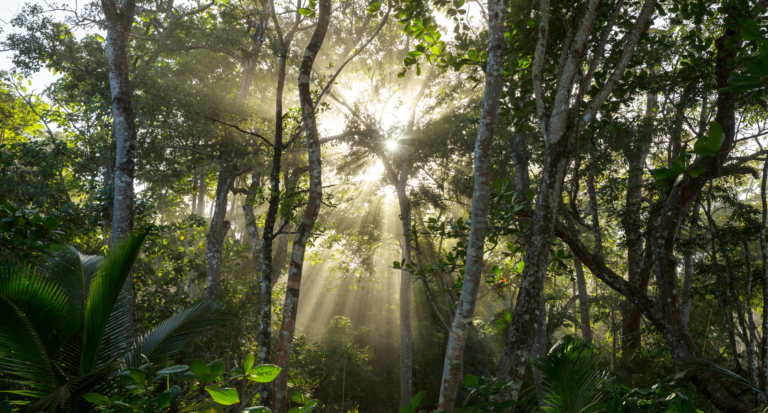
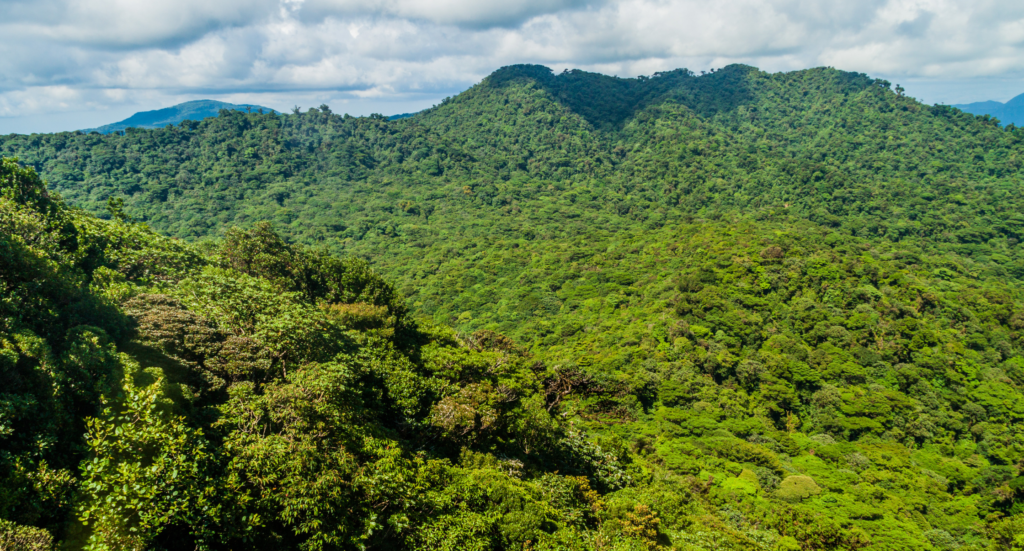
Cloud forests cover less than 1% of Earth’s total forest area, which makes Monteverde’s scale remarkable. National Geographic’s cloud forest research specifically highlights Monteverde as the model ecosystem for studying tropical montane cloud forests — a recognition of just how well-preserved and accessible this place remains. The reserve sits at the intersection of the Pacific slope and Caribbean watershed, where Atlantic trade winds rise against the mountains, cool, and condense into the near-permanent mist that gives the forest its name. The result is an ecosystem so layered with moss, orchids, and bromeliads that you can barely see the ground through the vegetation above.
The reserve was established in 1972 by scientist George Powell and Quaker settler Wilford Guindon, who recognized that the watershed feeding the farmlands below depended on these forests staying intact. That conservation history matters — the Monteverde Cloud Forest has been managed with serious scientific intent for over 50 years.
As The Tico Times has documented, the reserve holds over 50% of Costa Rica’s bird species in a fraction of the country’s total area, which is exactly why the biodiversity here still feels genuinely wild rather than curated.
Why Does the Mist Never Leave?
Monteverde straddles the Continental Divide at elevations between 4,600 and 5,900 feet. Moist Caribbean air rises from the Atlantic slope, cools as it climbs, and condenses into clouds that settle permanently across the reserve. This constant humidity sustains the forest’s extraordinary plant diversity — trees here don’t just grow leaves; they grow entire ecosystems of epiphytes on their bark. The weather patterns in this region make it feel like a different world from the coastal lowlands just 60 miles away.
Which Reserve Should You Actually Visit?
This is the question most visitors don’t know to ask, and it’s the one that shapes your experience most. Monteverde has three solid options, each with a different vibe.
Monteverde Cloud Forest Biological Reserve
This is the flagship — the most famous, most visited, and most trail-rich option. The reserve offers three main trail options (Essence Trail, Heart of the Forest Trail, and the Continental Divide Trail) that can be combined into a multi-hour circuit. The highlight is the La Ventana viewpoint on the Continental Divide, where, on a clear day, you can see the forest dropping toward both the Pacific and Caribbean coasts simultaneously.
Entry details worth knowing:
- Hours: 7 AM–4 PM daily
- Entrance fee: $29 adults, children 5–11 $63 (per the official website — note that prices have changed since earlier publications; confirm before booking)
- Trail highlights: Continental Divide viewpoint, hanging bridge, small waterfall along the River Path
- Location: 3.7 miles (6 km) from Santa Elena town, 1 mile (1.7 km) from the Visitor Center to the reserve entrance via shuttle
All visitors check in at the Harriot Powell Visitor Center first. Parking is $5, and the shuttle to the entrance runs every 15 minutes. If you’re staying in Santa Elena without a car, public buses and shuttles run multiple times daily — though driving yourself gives you the flexibility to catch that critical 7 AM start time.
Santa Elena Cloud Forest Reserve
Sitting at a slightly higher elevation than its more famous neighbor, Santa Elena feels noticeably mistier and more intimate. The 765-acre reserve sees far fewer visitors, which means quieter trails and better odds of actual wildlife encounters. There’s an observation tower with views toward Arenal Volcano on clear days, and 7.5 miles (12 km) of trails through dense cloud forest that feel genuinely untouched.
The practical edge: it costs less ($18 adults, $7 children) and supports the local Santa Elena high school through its proceeds — a community-based conservation model that’s been running for decades. For travelers who want the Costa Rica green season experience without the crowds, this is the right call.
Curi-Cancha Reserve
Curi-Cancha Reserve caps visitors at 50 at any one time, which dramatically increases your wildlife sighting odds. Over 200 bird species have been recorded here, including the resplendent quetzal. The mix of primary and secondary forest with open clearings creates multiple habitat types — exactly what birders and photographers want. Entry is $20 adults, $10 children 6–12, open daily 7 AM–3 PM.
If you have to choose between Curi-Cancha and the main Monteverde Reserve for quetzal sightings specifically, the smaller crowds at Curi-Cancha often tip the scale. The diverse wildlife viewing opportunities throughout Monteverde are what keep serious birders coming back repeatedly.
What Wildlife Will You Actually See?
The cloud forest’s star attraction is undoubtedly the resplendent quetzal — an iridescent green bird with a crimson breast and tail feathers up to 2 feet long that ancient Maya considered sacred. Males are most visible from February through July during breeding season, with peak sightings in March–April. Your best window is early morning (6–10 AM) with a local naturalist guide who knows where active nests are located. Without a guide, finding a quetzal in 26,000 acres of dense forest is mostly a matter of luck.
Beyond quetzals, the cloud forest hosts some genuinely unusual birds. The three-wattled bellbird makes one of Costa Rica’s most bizarre calls — a metallic “bonk” that carries across the entire forest — while emerald toucanets, dozens of hummingbird species, and the rare bare-necked umbrellabird all inhabit these reserves.
Can You See Sloths and Monkeys Here?
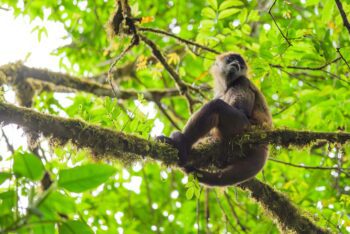
Both two-toed and three-toed sloths live throughout the Monteverde reserves. They’re harder to spot than you’d expect — a motionless sloth in the canopy looks almost identical to a bromeliad cluster. Guides with years of experience know exactly which trees are regular hangouts. Howler monkeys you’ll almost certainly hear before you see them; their territorial roaring carries for miles. White-faced capuchins, coatis, and agoutis make regular trail appearances as well.
Jaguars and pumas do inhabit the remote sections of the reserves, but sightings by visitors are exceptionally rare. These are primarily nocturnal animals that actively avoid human contact, and they stay far from the main trail networks.
What Makes Night Tours Worth It?
The cloud forest changes entirely after dark. Night tour guides use red-beam flashlights to spot sleeping sloths, tarantulas, red-eyed tree frogs, and kinkajous foraging in the trees — none of which you’ll encounter during daylight hours. Tours run approximately 2–2.5 hours starting around 5:30 PM and cost $25–$45 per person. For families visiting Costa Rica with kids, a night tour at Curi-Cancha ranks among the most memorable things you can do in the country.
What Activities Pair Well with the Reserve?
Hiking the cloud forest is the anchor activity, but Monteverde has enough beyond the reserves to fill 3 full days comfortably.
Ziplines and Hanging Bridges
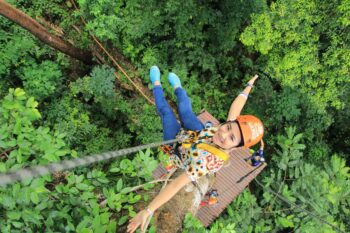
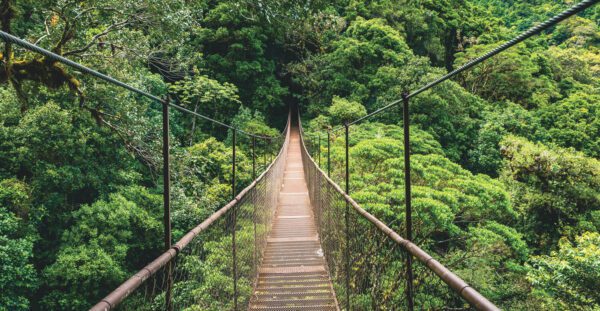
Monteverde is where Costa Rica’s modern canopy zipline was invented, and the region still has some of the country’s best. Selvatura Park runs 15 cables through primary cloud forest at one of the highest elevations in Monteverde, including a mile-long Superman position cable that’s among the longest single ziplines in the country. Their hanging bridges — eight suspension bridges spanning up to 560 feet — let you explore the canopy at your own pace with good wildlife spotting potential.
Treetopia Park (formerly Sky Adventures) offers the only aerial tram in Monteverde, ascending to 5,700 feet with dual-coast views on clear mornings. Their 6 hanging bridges across 1.7 miles (2.7 km) include the longest single span at 774 feet. For the most extreme adrenaline, 100% Aventura has Costa Rica’s longest single zipline at 5,217 feet (1,590 meters) plus a 147-foot (45-meter) Tarzan swing.
For a completely different kind of outdoor experience, El Tigre Waterfalls takes you down into river canyons below the cloud forest — waterfall hikes, natural bridges, and optional horseback return, open daily 7:30 AM–1:30 PM.
Coffee and Chocolate Culture
Monteverde’s high altitude produces some of Costa Rica’s finest coffee, and several farms offer tours that take you from plant to cup. Don Juan Farm is the most established, combining coffee, cacao, and sugarcane production in a single tour. These make a perfect afternoon activity after a morning reserve visit — most tours start around 1–2 PM.
The Children’s Eternal Rainforest — a 56,000-acre private reserve started by Swedish schoolchildren in 1987 — is worth knowing about for the Bajo del Tigre station. It gets far less foot traffic than the main reserves.
How Do You Get to Monteverde?
Getting to Monteverde used to mean navigating a notoriously rough, unpaved road. Route 606 from the Inter-American Highway is now fully paved to Santa Elena, which changes the equation — a regular car can handle the main route during the dry season without any drama.
That said, a 4×4 or high-clearance vehicle earns its keep in Monteverde for a few specific reasons: the access roads to both the reserve and Treetopia involve unpaved stretches that get slippery in the rainy season, remote lodges outside Santa Elena often require it, and the route between Monteverde and La Fortuna around Lake Arenal mixes paved and unpaved sections with variable conditions.
Drive times from major hubs:
- From San José: 3.5 hours via Route 606
- From Liberia Airport: 3 hours via Route 145 — here’s the complete Liberia Airport guide for first-timers
- From La Fortuna/Arenal: 3–3.5 hours via Tilarán (or 2–2.5 hours via jeep-boat-jeep transfer, $30–$50 per person)
Drive only during daylight hours. The route is perfectly manageable, but mountain roads in Costa Rica are best navigated with full visibility — and the scenery through the Tilarán mountains is genuinely worth seeing in daylight rather than rushing through in the dark.
When Is the Best Time to Visit?
For Weather and Hiking
The dry season (December–April) offers the easiest hiking conditions — less rain, drier trails, and more consistent visibility. As Britannica explains, cloud forests generate their own moisture through condensation at the canopy level, which is exactly why “dry season” in Monteverde still means packing a rain jacket. That said, “dry season” in a cloud forest is relative; pack a rain jacket regardless of when you go.
For Quetzal Sightings
February through July is breeding season, which means males are displaying their full plumage and staying near nesting sites. March–April is the peak window. The dry season guide has more details on timing wildlife-focused itineraries.
For Fewer Crowds
The green season (May–November) sees far fewer visitors, lower accommodation prices, and forests at their most lush. Rain mostly falls in the afternoons, leaving mornings ideal for reserve visits. Wildlife can actually be more active as the forest responds to increased moisture.
How Should You Dress for the Cloud Forest?
Temperature averages 64°F (18°C) year-round, but mist and wind make it feel cooler — especially at 7 AM when the trails are at their most productive. Lonely Planet’s Monteverde guide consistently flags the early-morning chill as the thing first-time visitors underestimate most. Pack:
- Light rain jacket or poncho (non-negotiable, even in dry season)
- Closed-toe hiking shoes that you’re okay getting muddy
- Long pants for brush protection and insect coverage
- Layers — a fleece or light jacket for early mornings
- Binoculars — essential for any serious wildlife viewing
- Insect repellent for dawn and dusk activities
Bright colors startle wildlife. Neutral tones — greens, browns, tans — are worth it if you care about wildlife encounters.
How Much Time Do You Need in Monteverde?
Two full days cover the highlights. Three days is the right pace if you want to actually absorb what you’re seeing rather than checking boxes.
Day 1: Morning — zipline and hanging bridges (Selvatura or Treetopia); Afternoon — coffee or chocolate tour, explore Santa Elena; Evening — night tour at Curi-Cancha or the main reserve.
Day 2: Early morning (by 7 AM) — guided birdwatching tour for quetzal sightings; Late morning to afternoon — hike the main Monteverde reserve or Santa Elena reserve.
Optional Day 3: El Tigre Waterfalls in the morning; Children’s Eternal Rainforest at Bajo del Tigre in the afternoon.
With only one day, prioritize a guided cloud forest hike at 7 AM and either the ziplines or a night tour based on your interests.
Where Does Monteverde Fit in a Larger Costa Rica Itinerary?
Monteverde connects naturally with several other Costa Rica destinations by road. The most popular combination is the northern zone triangle:
- La Fortuna/Arenal Volcano — 3–3.5 hours away, with hot springs, volcano hikes, and the Arenal hot springs
- Guanacaste beaches — 3–4 hours to Tamarindo or Flamingo; Liberia Airport sits between these beach towns and Monteverde
- Manuel Antonio National Park — 4.5 hours south, accessible wildlife, and flat beach trails
- Rincón de la Vieja — 3 hours north toward Guanacaste, volcanic hot springs, and hiking
Most two-week Costa Rica itineraries include 2–3 nights in Monteverde alongside Arenal and a beach destination for a balanced trip.
Having your own vehicle changes what’s possible in Monteverde. Shuttles can get you there, but you won’t hit that 7 AM reserve opening, you won’t be able to combine reserves in a single day, and you won’t have the flexibility to linger at a viewpoint or detour to a waterfall on a whim. For the cloud forest, a Vamos rental — particularly a 4×4 if you’re traveling in the rainy season or staying off the main road — is the difference between a good trip and a genuinely memorable one.
Frequently Asked Questions
How long is the hike at the Monteverde Cloud Forest Reserve?
Trail length depends on which route you choose. The Continental Divide Trail is the longest at 4 kilometers (2.5 miles) and takes approximately 2.5 hours at a comfortable pace. The Essence Trail is shorter and takes about 1.5 hours. Most visitors combine two trails for a total of 3–4 hours on the ground. Factor in the visitor center check-in and the shuttle to the reserve entrance, and plan for a half-day minimum.
Do you need reservations for the Monteverde Cloud Forest Reserve?
Yes, and this matters. The reserve limits daily visitors to protect the ecosystem, and during peak dry season (December–April), slots fill up well in advance — especially for morning entry times. Book directly through the official Monteverde Cloud Forest Reserve website. Booking in advance for the Curi-Cancha Reserve is also recommended, given the 50-visitor limit. Santa Elena Reserve is typically walk-in friendly outside of holiday weekends.
Can you visit the Monteverde Cloud Forest without a guide?
Technically, yes — all three reserves are self-guided. But wildlife viewing changes dramatically with a guide. Quetzals, sloths, and most birds are nearly invisible without someone who knows which trees to check and has a spotting scope. If seeing specific animals matters to you, book a guided tour. If you’re primarily interested in experiencing the forest environment and don’t need to identify specific species, self-guided is fine and saves money.
Which is better — Monteverde Cloud Forest or Santa Elena Cloud Forest Reserve?
Different strengths, and they complement each other. The main Monteverde reserve is larger with more trail variety, the La Ventana Continental Divide viewpoint, and the most comprehensive cloud forest experience. Santa Elena sits at a higher elevation (more atmospheric), costs less, supports a local school, and sees fewer visitors. For a single visit, the main Monteverde reserve offers more variety. For atmosphere and solitude, Santa Elena wins. If you have two days, visit both.
Is it better to see quetzals at La Fortuna or Monteverde?
Monteverde has a clear edge for quetzal sightings. The cloud forest habitat at 4,600–5,900 feet is prime quetzal territory, particularly in and around the Curi-Cancha Reserve and the main Monteverde reserve near avocado trees during the February–July breeding season. La Fortuna and Arenal are rainforests, not cloud forests — a different ecosystem with fewer quetzal sightings and no active quetzal breeding activity.
What’s the difference between Selvatura Park and Sky Adventures (Treetopia)?
Both offer ziplines and hanging bridges, but with different strengths. Selvatura runs 15 cables through the primary cloud forest at a higher elevation with arguably the best zipline views in Monteverde, plus butterfly and hummingbird gardens. Treetopia (formerly Sky Adventures) has the only aerial tram in Monteverde and hands-free automatic braking ziplines — better for those less comfortable with traditional hand braking. Price-wise, both are comparable. If you want scenic forest views and more cables, Selvatura. If you want the tram experience and more modern infrastructure, Treetopia.
How difficult is hiking in Monteverde Cloud Forest?
The main trails at the Monteverde Cloud Forest Reserve are well-maintained and accessible to most visitors in reasonable physical condition. The Continental Divide Trail involves some steep sections and steps in the middle portion. Trails can be muddy year-round — waterproof boots make a noticeable difference. The Santa Elena trails are similarly maintained. Curi-Cancha has shorter trails that vary in elevation between 4,750 and 5,300 feet but are generally manageable. None of the main reserve trails requires technical hiking ability; they’re challenging in the way that any forest trail on uneven terrain is challenging.