
Last Updated on March 18, 2026
Rincon de la Vieja National Park: What's Covered
Rincón de la Vieja National Park sits 45 minutes from Liberia in Guanacaste — boiling mud pots, steaming fumaroles, and a turquoise waterfall all accessible without a 4×4. Entry costs $16.95 for adults; tickets must be purchased online via SINAC before arrival, and the Las Pailas sector opens Tuesday–Sunday, 8 AM–3 PM. A standard sedan from Liberia Airport reaches the park in 30 minutes.
Quick Facts:
- Location: 15 miles (24 km) northeast of Liberia; ~30 min from the airport
- Entry: $16.95 adults, $5.65 children ages 2–12 — online only, no on-site sales
- Hours: Las Pailas Tue–Sun 8 AM–3 PM; Santa Maria Thu–Mon 8 AM–3:30 PM
- Trails: Waterfall trailhead closes at noon — enter the park before 12 PM
Top Experiences:
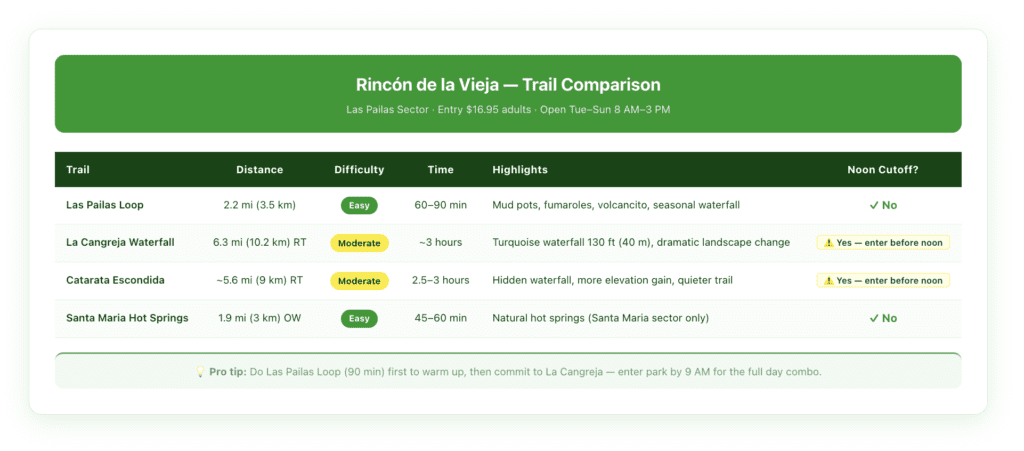
- Las Pailas Loop — Easy 2.2-mile (3.5 km) flat loop; mud pots, fumaroles, volcancito; ~90 min
- La Cangreja Waterfall — Moderate 6.3-mile (10.2 km) hike to a turquoise 130-ft (40 m) cascade
- Rio Negro Hot Springs — Hacienda Guachipelin’s volcanic pools just outside the park; ~$30/adult
- Wildlife — 300+ bird species in tropical dry forest
Works as a Guanacaste beach day trip or a stop en route to Arenal on a 1-week itinerary.
If you need any help with a Costa Rica car rental, contact us now!
Rincón de la Vieja National Park sits just 45 minutes from Liberia and delivers something most Guanacaste beach trips are missing—an active volcano you can actually walk around. Boiling mud pots, steaming fumaroles, turquoise waterfalls, and some of Costa Rica’s best tropical dry forest hiking all come with a $16.95 entry fee, and no 4x4is required for the main entrance. It’s accessible enough for a morning day trip and rewarding enough to anchor an entire night or two of your itinerary.
Key Takeaways
- Location: 15 miles (24 km) northeast of Liberia, roughly 30 minutes from Liberia Airport
- Entry Fee: $16.95 adults, $5.65 children ages 2–12, purchased online only through SINAC — no on-site ticket sales
- Hours: Las Pailas sector Tuesday–Sunday 8 AM–3 PM (closed Mondays); Santa Maria sector Thursday–Monday 8 AM–3:30 PM
- Vehicle: Standard sedans handle the mostly-paved road to Las Pailas; 4×4 recommended for the Santa Maria sector
- Top Trails: Las Pailas Loop — 2.2 miles (3.5 km), easy, ~90 minutes; La Cangreja Waterfall — 6.3 miles (10.2 km) roundtrip, moderate, ~3 hours
- Key Rule: Waterfall trails require entry before noon — rangers cut off new hikers at 12 PM
What Makes Rincón de la Vieja Different from Other Costa Rica Volcanoes?
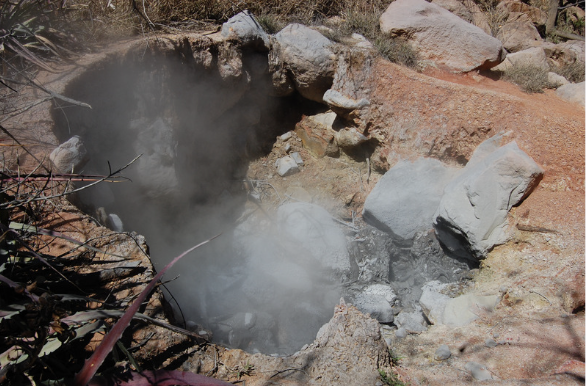
Most volcano experiences in Costa Rica keep you at a distance. Arenal is dormant and can be observed from viewpoints. Poás has an observation platform above the crater. Rincón de la Vieja puts you in the middle of it — walking between actively bubbling mud pots, sulfur-venting fumaroles, and a little volcano (volcancito) that has visibly grown in recent years due to increased geothermal activity.
The Costa Rica dry season months create a dramatic landscape contrast: half the trail runs through shaded tropical dry forest with a cool canopy overhead, and the other half opens onto golden-brown volcanic terrain with mountain views stretching toward Nicaragua. That contrast — dense green jungle into lunar volcanic field — is something you don’t get anywhere else in the country.
Why Is the Volcano Still Active?
Rincón de la Vieja remains one of Costa Rica’s most geologically active volcanoes. Phreatic eruptions were recorded as recently as 2024 and 2025. These aren’t lava flows — they’re steam and gas explosions driven by groundwater meeting superheated rock. The summit crater trail has been closed since 2011, but all lower trails sit well outside the hazard zone and stay open daily as long as conditions allow.
Park rangers monitor conditions around the clock and would close trails immediately if genuine hazards developed. The SINAC online ticketing system also communicates closures before your visit, which is another reason purchasing tickets in advance is essential.
The name “Rincón de la Vieja” translates roughly to “Old Woman’s Corner.” Local legend says a princess named Curabanda, whose lover was thrown into the crater by her father, lived out her days on the volcano’s slopes, developing healing powers — a story that feels fitting given the therapeutic hot springs the geothermal activity now produces on surrounding haciendas.
What Wildlife Will You See on the Trails?
Rincón de la Vieja protects one of Costa Rica’s rare remaining patches of tropical dry forest alongside humid forest at higher elevations. The habitat diversity means impressive wildlife even by Costa Rican standards. Howler monkeys, white-faced capuchins, and spider monkeys move through the forest canopy. Coatis, armadillos, and agoutis forage along trail edges. Over 300 bird species have been recorded in the park, including the long-tailed manakin — a striking blue and red bird that birdwatchers specifically travel here to see.
The shaded first half of most trails is your best window for wildlife. Keep eyes up in cecropia trees for sloths and listen for toucans calling overhead. Early morning, right when the park opens at 8 AM, consistently produces the most sightings.
Which Park Entrance Should You Use?
The national park has two access points with completely different road conditions, hours, and experiences. Most visitors go to Las Pailas, and for good reason.
What Does the Las Pailas Sector Offer?
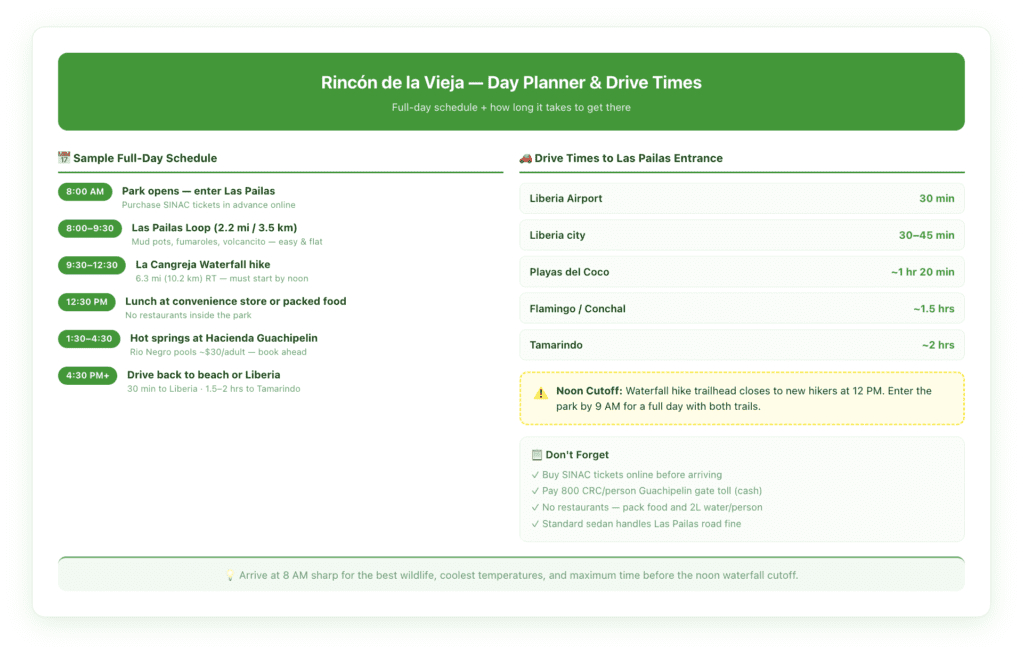
Las Pailas is the main entrance and handles the overwhelming majority of visitors. The road from the Interamericana Highway is mostly paved with a short gravel section — standard sedans manage it fine if you take it slowly. The drive goes through Hacienda Guachipelin’s private property, where you’ll stop at a gate and pay a toll of 800 CRC (roughly $1.50 USD) per person. This is separate from your national park ticket.
Once inside, you’ll find a large free parking lot, clean bathrooms, and a small convenience store stocking snacks and bottled water. There are no restaurants in the park, so bring food if you’re planning a full day. Guachipelin’s adventure activities and hot springs are on that same property but operate completely independently from the national park — you’d pay their own rates to access those.
The Las Pailas sector contains all the volcanic highlights: the mud pots, fumaroles, and the trailheads for both waterfall hikes. Driving from Liberia Airport takes about 30–40 minutes, making it realistic even for early morning starts.
What’s the Santa Maria Sector Like?
Santa Maria opens Thursday through Monday and offers a noticeably quieter experience. Natural hot springs are accessible via a 1.9-mile (3 km) walk from the ranger station — a genuine perk that the Las Pailas sector doesn’t offer. However, the access road to Santa Maria genuinely requires high clearance for the final few kilometers, and that deterioration gets significantly worse during the green season. This isn’t a recommendation to ignore if you’re in a sedan.
Santa Maria also connects to Las Pailas via a multi-mile trail through remote wilderness — an option for ambitious hikers wanting to experience the park’s full expanse over multiple days.
Which Trail Should You Hike?
All trails start from the Las Pailas ranger station. The right choice depends entirely on your time, fitness level, and what you’re most interested in seeing.
What Happens on the Las Pailas Loop?
The 2.2-mile (3.5 km) Las Pailas Loop is the park’s signature trail and works for almost any visitor. It’s flat, well-maintained, and takes about 60–90 minutes at a comfortable pace. The trail passes the Volcancito, a seasonal waterfall (impressive during the rainy season, a trickle in February–March), steaming fumaroles, and the famous bubbling mud pots.
The first half stays under forest canopy — genuinely cool shade on a hot Guanacaste day — before opening onto exposed volcanic terrain. Standing near the mud pots, you’ll smell sulfur before you see them. When you do, you’ll watch gray mud bubble and splatter upward, sometimes reaching a foot high. It’s oddly mesmerizing knowing that Costa Rica actually generates electricity from this same geothermal activity.
This trail works as an introduction or a standalone experience. If you’re visiting as a Guanacaste day trip from the beach, this loop plus the visitor area fills a comfortable morning.
Is La Cangreja Waterfall Worth the Extra Effort?
La Cangreja is the standout of the two waterfall hikes — and it’s earned that reputation. The trail covers 6.3 miles (10.2 km) round-trip with roughly 3 hours of total hiking. You must enter the park before noon to start this hike; rangers close the trailhead at 12 PM.
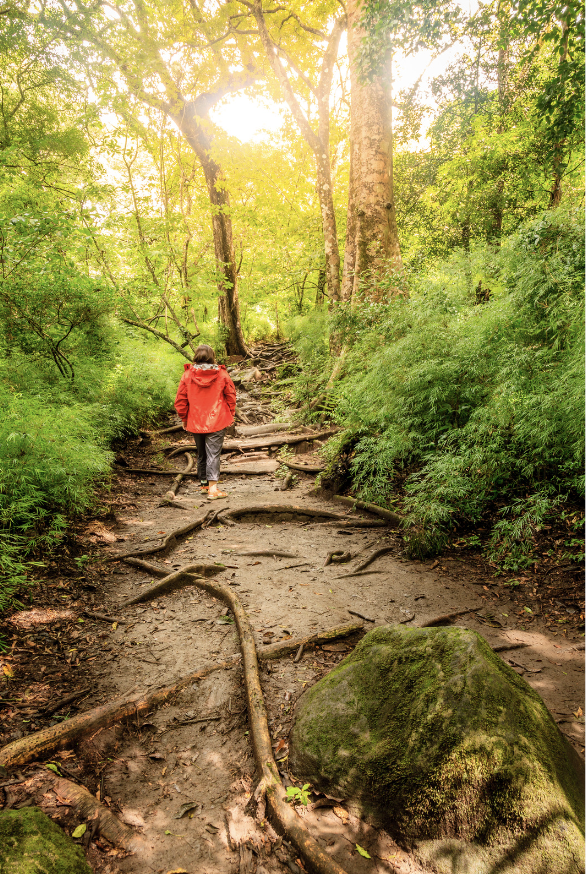
The first half runs under shaded forest with gentle hills and a few small creek crossings. Around the midpoint, the landscape opens dramatically — you’re suddenly surrounded by rolling hills covered in golden dry-season grass, which feels almost alien after the dense forest. Then comes a steep final descent to the waterfall.
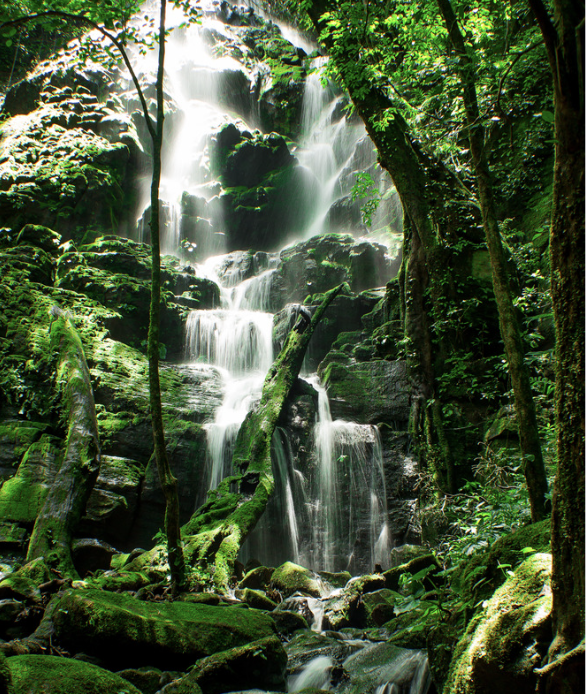
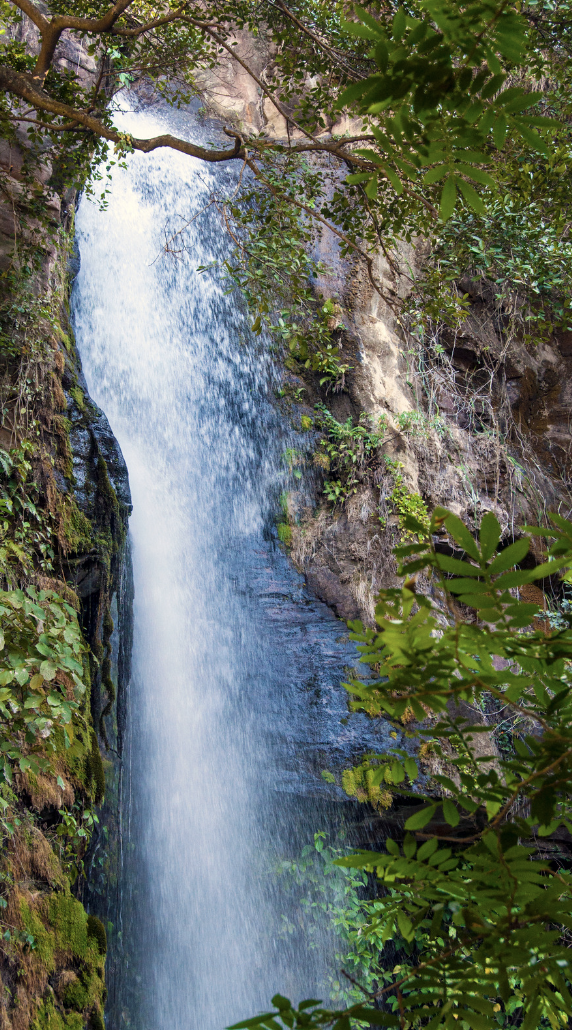
La Cangreja drops approximately 130 feet (40 m) into a pool that glows turquoise from mineral content in the water. The color is genuinely striking. Swimming is officially prohibited due to safety concerns, though you’ll often see visitors ignoring the sign. The viewing area is excellent regardless.
What About Catarata Escondida (Hidden Waterfall)?
The Hidden Waterfall trail covers about 5.6 miles (9 km) round-trip with more elevation gain than La Cangreja — roughly 1,500 feet. Both waterfall trails share the first section before splitting, so technically, you could combine them. Most visitors who’ve done both prefer La Cangreja for its more dramatic cascade and vivid pool color. If choosing just one, La Cangreja wins.
How Do You Get to Rincón de la Vieja?
The park’s proximity to Liberia makes it one of the easiest national parks in Costa Rica to reach. No complex logistics, no inter-city buses, no waiting for tours.
What’s the Drive Like from Liberia?
From Liberia’s main intersection, head toward Curubandé following signs for Las Pailas/Rincón de la Vieja National Park. The drive covers about 15 miles (24 km) and takes 30–45 minutes depending on your starting point. On Google Maps or Waze, search “Parque Nacional Rincón de la Vieja” and select the Las Pailas sector specifically.
The road is mostly paved with a short gravel section and some potholes. A standard sedan handles this fine during the dry season with normal care. During the green season, allow a few extra minutes for wet sections.
If you’re flying into Liberia Airport, picking up your rental and heading directly to the park is a completely realistic first-day plan — you’ll arrive well before 10 AM even with a morning flight.
How Far Is It from Guanacaste Beach Towns?
The park works as a day trip from most Guanacaste bases, and the drives are straightforward — everything routes through or near Liberia. From Liberia Airport, you’re looking at 30 minutes, and from Liberia city itself, about 30–45 minutes. Playas del Coco adds roughly 1 hour 20 minutes, while Flamingo and Conchal are around 1.5 hours. Tamarindo is the furthest at around 2 hours each way — doable, but you’ll want to leave by 6 AM to make the noon waterfall cutoff work.
The standard beach-day combo: park entry at 8 AM, Las Pailas Loop by 10 AM, La Cangreja waterfall done by 12 PM, hot springs at Guachipelin by 2–3 PM, back to Flamingo or Tamarindo for sunset.
When Is the Best Time to Visit Rincón de la Vieja?
Rincón de la Vieja works year-round, but conditions — and what you’ll see — change significantly between dry and green season.
What Does Dry Season Look Like at the Park?
December through April brings consistently dry conditions to Guanacaste. Trails stay firm, the volcanic terrain’s golden-brown hues contrast beautifully with clear blue skies, and you’ll have reliable weather for all-day hikes. This is also peak season, so arrive right at 8 AM on weekends to beat crowds on the waterfall trails.
The seasonal waterfall on the Las Pailas Loop will likely be running low or dry in February–April. That’s not a problem — the mud pots and fumaroles don’t depend on rainfall, and the landscape itself is genuinely photogenic in the dry-season palette.
What Does Green Season Add?
May through November brings afternoon showers, typically arriving around 2–3 PM. Morning hiking stays excellent — often better, because cooler temperatures make the exposed volcanic sections comfortable rather than scorching. The Las Pailas Loop’s seasonal waterfall flows properly during this period, adding another visual element to the trail.
Wildlife activity increases during the green season as animals respond to the abundant water and food. You’ll encounter fewer visitors on trails dramatically, and the forest transforms into deep green rather than dry-season brown. Pack a light rain jacket regardless of season, since mountain weather at Rincón de la Vieja doesn’t always match coastal forecasts.
What Are the Hot Springs Options Near the Park?
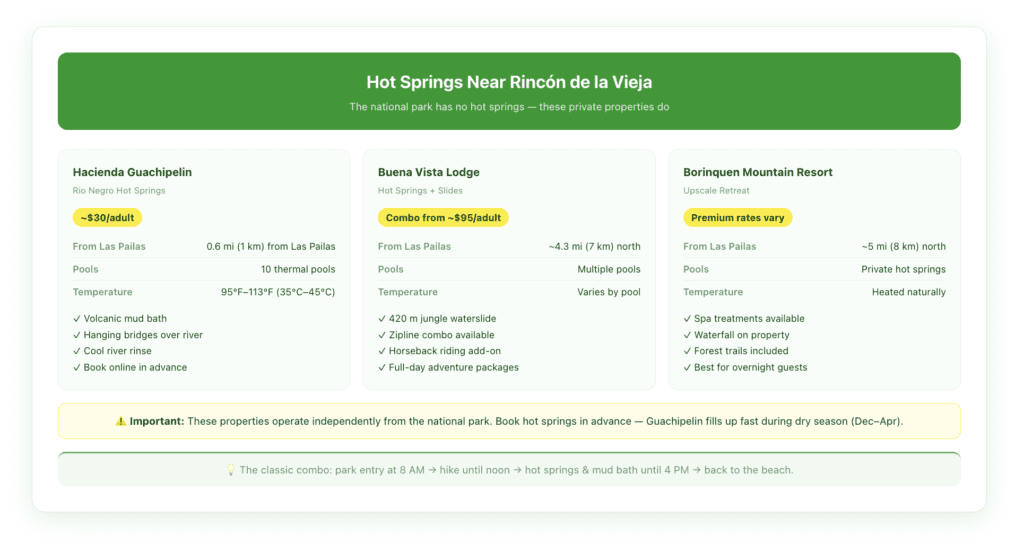
The national park itself has no developed hot springs for visitors. That side of the experience happens at privately-owned properties surrounding the park boundary — most of them a short drive away. Checking TripAdvisor for current ratings before booking is always smart.
Which Properties Are Worth Visiting?
Rio Negro Hot Springs at Hacienda Guachipelin is the most popular option and sits right on the road to Las Pailas. Ten thermal pools ranging from 95°F to 113°F (35°C–45°C) are heated naturally by volcanic activity. Three hanging bridges connect pools on both river banks, and the volcanic mud bath is the crowd favorite — you cover yourself in mineral mud and rinse in the cool river. Day passes run about $30 per adult. Reserve in advance online or at the hotel front desk, since this place fills up quickly during the dry season.
Buena Vista Lodge offers similar hot springs plus what they claim is Costa Rica’s longest jungle waterslide — 420 meters. Their combo tours bundle ziplining, horseback riding, and hot springs access into full-day packages. This property sits slightly further north of the main park entrance.
Borinquen Mountain Resort provides a more upscale experience with private hot springs access, on-property spa treatments, and a waterfall on the grounds. Rates are considerably higher than the other options but reflect the privacy and quality.
What Combo Tours Are Available?
Multi-activity combo tours offer excellent value if you want a guided, high-energy day rather than independent hiking. The Guachipelin full-day package typically includes canopy ziplining, white water tubing, horseback riding, waterfall visits, hot springs, and mud bath access, plus lunch — roughly $120–150 per person. For the 50 Costa Rica activities comparison, Guachipelin’s combo consistently ranks among the best value adventure days in the country.
The key distinction: national park trails are independent exploration, while adventure park activities at surrounding haciendas are guided experiences. You can absolutely do both in a single day if you start at 8 AM.
What Should You Pack for a Day at Rincón de la Vieja?
The park’s combination of tropical dry forest and exposed volcanic terrain requires specific preparation — more than your typical beach day.
What Clothing Works Best?
Lightweight, breathable long pants protect against thorny vegetation and biting insects in forest sections. Sturdy closed-toe hiking shoes are non-negotiable for waterfall hikes, where you’ll encounter rocky terrain, roots, and small creek crossings. Sandals work for the Las Pailas Loop in the dry season but create problems on the waterfall trails.
Bring a light rain jacket regardless of season — mountain weather at 4,000 feet (1,200 m) elevation is unpredictable. A hat and sunglasses become critical on the exposed volcanic sections of the trail, where the sun reflects off light-colored rock. If you’re planning hot springs afterward, pack a swimsuit and a change of clothes.
What Gear and Supplies Should You Bring?
The convenience store at Las Pailas is small with a limited selection. Pack:
- At least 2 liters of water per person for waterfall hikes, more in hot weather
- Snacks or lunch — no restaurants inside the park
- Sunscreen and insect repellent
- Binoculars if you’re interested in birdwatching
- Camera with charged batteries
- Cash in CRC for the Hacienda Guachipelin gate toll (~800 CRC per person)
- Your SINAC ticket confirmation on your phone (screenshot it offline)
Can You Combine Rincón de la Vieja with Other Destinations?
The park’s location in northern Guanacaste places it naturally on logical driving routes between Guanacaste beaches and inland destinations. It works both as a day trip and as an anchor destination for 1–3 nights.
What Works for a One-Week Guanacaste Itinerary?
The most popular combo is Rincón de la Vieja plus beach time. Use Liberia or nearby properties as a base for 2 nights to cover the park thoroughly — Las Pailas Loop and La Cangreja on day one, hot springs on day two — then continue to Tamarindo or Playa Conchal for beach days. This approach gives you a genuine volcanic adventure without committing your entire trip to it.
Rincón de la Vieja also sits on the route between Guanacaste and Arenal Volcano. If you’re doing a 1-week Costa Rica itinerary combining beaches with Arenal’s hot springs, the park makes a logical morning stop before continuing east on the Interamericana toward La Fortuna — roughly 3 hours of total driving.
What Other Day Trips Work from This Area?
If you’re basing yourself near the park for multiple nights, nearby options include:
- Llanos de Cortés Waterfall: 35 minutes south of Liberia, a wide cascade with a large swimmable pool — excellent afternoon stop on days you want something easier
- Palo Verde National Park: 1.5 hours south, boat tours through wetlands deliver exceptional birdwatching and crocodile sightings — a completely different ecosystem from Rincón de la Vieja
- Catarata La Leona: A more adventurous, lesser-known waterfall in Curubandé fed by the same volcanic system, involving caves and blue river pools — for guests who want something outside typical tourist traffic
Where Should You Stay Near Rincón de la Vieja?
No hotels exist inside the national park, but several properties cluster around its edges at varying price points.
What Are the Best Properties Near Las Pailas?
Hacienda Guachipelin is the closest option to the Las Pailas entrance and sits directly on the access road. Rooms are rustic-hacienda style, and guests have direct access to both the adventure activities and Rio Negro Hot Springs — a real advantage if you’re planning multiple activity days. Rates include property road access.
Hotel Rincón de la Vieja Lodge provides comfortable accommodations with a quieter atmosphere than the larger haciendas. Good option for those primarily interested in the national park rather than combo adventure tours.
Borinquen Mountain Resort offers the most upscale experience in the region — private hot springs, spa treatments, forest trails on the property, and a higher level of privacy. Best for travelers who want volcano-adjacent luxury rather than a budget jungle stay.
Is Liberia a Better Base?
Liberia offers the best combination of price, amenities, and access. Hotels range from $50 to $150/night, including the Hilton Garden Inn near the airport with its pool, restaurant, and complimentary airport shuttle. From Liberia, you have 24/7 access to supermarkets, pharmacies, ATMs, and varied dining — none of which exist near the park itself.
Using Liberia as a base and doing day trips to the park means a 30-minute morning drive instead of staying at a hacienda, but you gain significantly more flexibility for evening plans and practical needs.
Ready to Plan Your Visit?
Rincón de la Vieja earns its place on Guanacaste itineraries not just as a checkbox but as a genuinely different experience from anything else in Costa Rica. An active volcano you can walk through, a waterfall with mineral-blue water, and hot springs you can soak in afterward — all within 45 minutes of the airport. A standard car gets you there, the trails require no technical skill, and the day fills naturally without effort.
If you’re flying into Liberia and want to explore the park on your own schedule, reserve your rental car through Vamos before you go — especially during dry season when availability gets tight. Our team knows the Guanacaste roads and can pair you with the right vehicle for your full itinerary, whether you’re staying close to the park or continuing toward Arenal afterward.
Frequently Asked Questions
How do I buy tickets for Rincón de la Vieja National Park?
Tickets must be purchased in advance through the SINAC online portal at serviciosenlinea.sinac.go.cr. The park no longer sells tickets at the entrance — arriving without a pre-purchased ticket means turning around. Adult foreign visitors pay $16.95 USD; children ages 2–12 pay $5.65 USD. Book at least one day ahead, and sooner during the dry season when dates sell out. You’ll also pay a separate 800 CRC per person toll to pass through Hacienda Guachipelin’s private property on the way to Las Pailas.
Can you hike to the summit of Rincón de la Vieja Volcano?
No, the summit crater trail has been closed since 2011 due to ongoing volcanic activity. All lower trails, including the Las Pailas Loop and waterfall hikes, remain safely accessible and monitored daily by park rangers. The volcanic features you can access from open trails — mud pots, fumaroles, and the volcancito — are actually more visually impressive for most visitors than a distant crater view would be.
What time should you arrive at Rincón de la Vieja?
Arriving right at 8 AM when the park opens is strongly recommended. Early arrival means cooler temperatures, peak wildlife activity, and the full 4-hour window to start a waterfall hike before the noon cutoff. On weekends during the dry season, trails get noticeably busier after 10 AM. Arriving late also risks hitting the Hacienda Guachipelin hot springs and combo tours at their most crowded midday window.
How physically demanding is the Las Pailas Loop?
The Las Pailas Loop is genuinely easy. The 2.2-mile (3.5 km) trail is flat with no switchbacks or significant elevation gain. The main challenge is the heat on the exposed volcanic section — bring water and wear a hat. Most visitors complete it in 60–90 minutes, including time to observe the mud pots. It’s appropriate for children and adults of average fitness with proper footwear.
Is Rincón de la Vieja safe for tourists?
Yes, the park is safe to visit. While the volcano remains active with occasional phreatic eruptions, the hiking trails and accessible geothermal features sit well below the hazard zone. Park rangers monitor conditions daily and close trails immediately if volcanic risk increases. The more relevant safety consideration is practical: follow rangers’ instructions, stay on marked trails, and keep a safe distance from the mud pots — hot mud that splatters a foot high can cause burns at close range.
What’s the difference between the Las Pailas and Santa Maria sectors?
Las Pailas is open Tuesday–Sunday, has easy road access for standard vehicles, and offers all the volcanic features (mud pots, fumaroles) plus both waterfall trailheads. It handles 90%+ of all visitors. Santa Maria is open Thursday–Monday, requires a high clearance vehicle for the final road section, and offers natural hot springs accessible via a shorter 1.9-mile (3 km) trail walk. Santa Maria is quieter and worth considering if you specifically want natural park hot springs rather than the hacienda operations.
Can you visit Rincón de la Vieja as a day trip from Tamarindo?
Yes, though it requires an early start. The drive from Tamarindo runs about 2 hours each way, so leaving by 5:30–6 AM gets you to the park at opening. You’ll have enough time for the Las Pailas Loop before noon, and many visitors add a waterfall hike before heading back. The round trip is a long day from Tamarindo — it works better as a day trip from closer bases like Playas del Coco (1 hour 20 minutes) or Flamingo (1.5 hours).