
Last Updated on March 27, 2026
Rio Celeste, Costa Rica: What's Covered
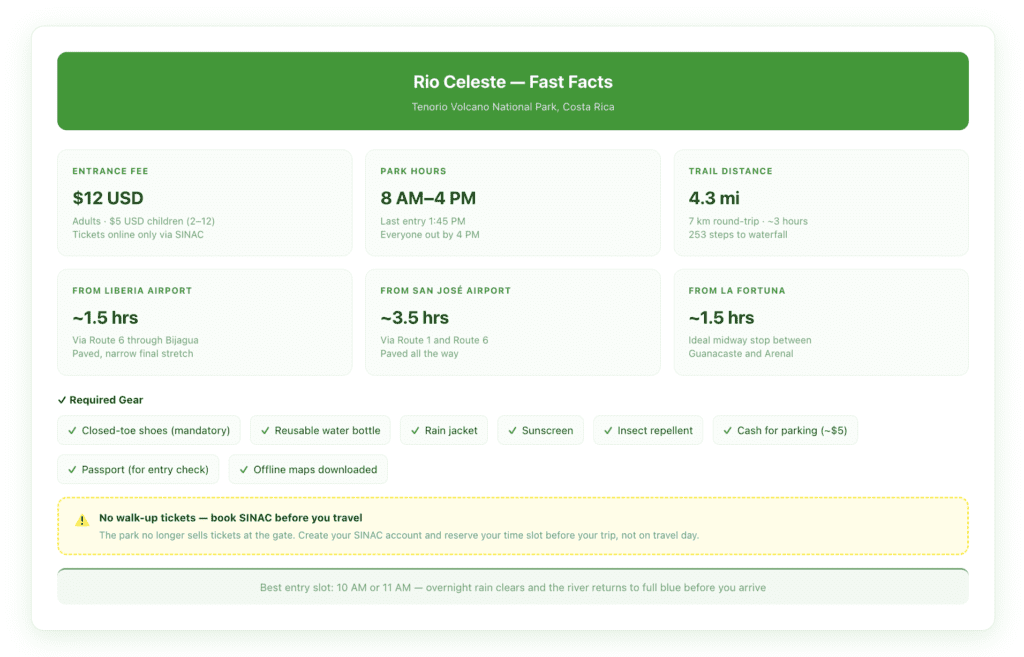
Rio Celeste is a turquoise waterfall inside Tenorio Volcano National Park in Costa Rica’s northern lowlands, about 1.5 hours from Liberia Airport. Adult admission is $12 USD — purchase online via SINAC before arriving since the park sells no walk-up tickets. The 4.3-mile trail takes 3 hours and includes 253 steps to the waterfall. A rental car is the only practical way to get there.
Quick Facts:
- Entry: $12 USD adults, $5 USD children — book via SINAC before your trip
- Trail: 4.3 miles round-trip, ~3 hours; moderate difficulty
- Swimming: Prohibited in the park; free public swim spot 0.6 miles past the entrance
- Required: Closed-toe shoes — rangers turn away sandals at the gate
- Best time: 10–11 AM entry slot for optimal blue color
Top Tips:
- Book SINAC tickets early — sells out during dry season
- Build into a route — ideal midpoint between Guanacaste and Arenal on a one-week itinerary
- Pick up a high-clearance rental from Liberia Airport for the drive
If you need any help with a Costa Rica car rental, contact us now!
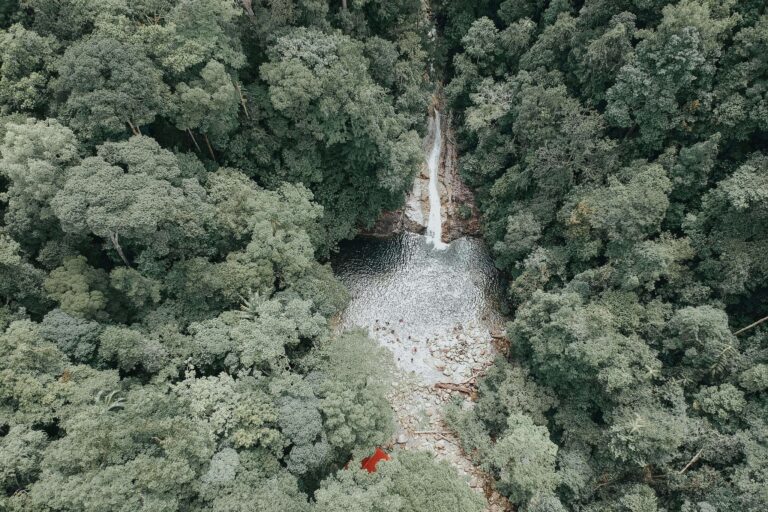
The short answer is yes, but let’s talk about why — and what it actually takes to get there. Rio Celeste is a 98-foot (30-meter) waterfall inside Tenorio Volcano National Park that spills into a pool so vividly turquoise it looks like someone spilled a bucket of sky blue paint in the middle of the rainforest. It’s one of the most visually striking natural wonders in Costa Rica, and unlike a lot of “must-see” spots, it fully delivers on the hype. Getting there takes planning since park tickets must be purchased online in advance, the trail requires actual hiking shoes, and the drive puts you roughly 1.5 hours from Liberia Airport — but none of those things should stop you.
Key Takeaways
- Adult tickets cost $12 USD and must be purchased in advance through the SINAC reservation system; the park does not sell tickets at the entrance gate.
- The full trail is about 4.3 miles (7 kilometers) round-trip and takes around 3 hours, including 253 steps down to the waterfall viewing platform.
- Rio Celeste sits roughly 1.5 hours from Liberia Airport and 3.5 hours from San José Airport, making it a logical stop between Guanacaste and the Arenal region.
- Swimming is prohibited inside the park, but a free public swimming spot with the same blue water exists 0.6 miles (1 kilometer) past the park entrance.
- Mid-morning entry slots (10–11 AM) give the best odds of seeing the blue color in full effect, especially if there was overnight rain.
- Closed-toe hiking shoes are mandatory; park rangers will turn away visitors in sandals or flip-flops without exception.
Why Is Rio Celeste Blue?
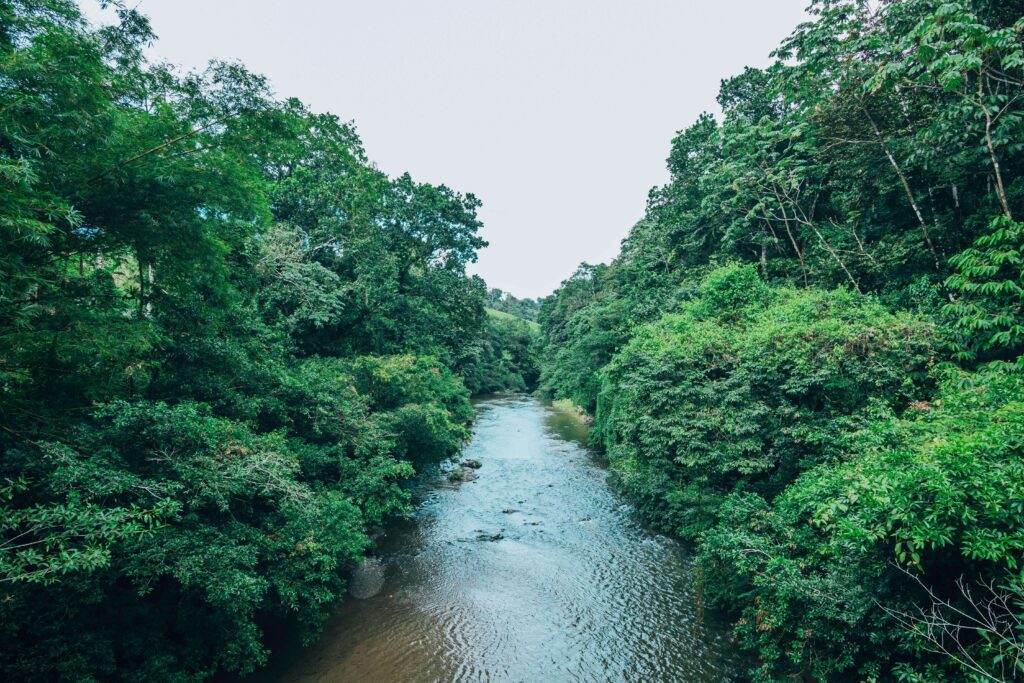
The science behind the color is genuinely fascinating. Researchers from the National University of Costa Rica found that the blue appears when two separate clear rivers meet at a point called Teñideros. One carries volcanic minerals, including sulfur; the other contains particles coated in silica, aluminum, and oxygen. When they merge, the particles scatter sunlight in a way that produces that unreal turquoise hue — essentially the same optical phenomenon that makes the sky blue, but concentrated in a river. A 2013 study published in the American Journal of Science confirmed the optical scattering mechanism specific to this river system.
The Maleku people, an indigenous group whose land the park now occupies, have a more poetic explanation. According to local tradition, God rinsed his brush in the river after painting the sky, leaving behind that impossible blue. Both versions feel true when you’re standing at Teñideros watching two clear streams transform into something that looks entirely fabricated.
Does Weather Affect the Color?
Yes, and this matters for planning. Heavy storms — particularly the kind that hit between October and January — can temporarily flush sediment into the river that disrupts the optical effect. The water turns murky gray-brown during and immediately after major storm events. The good news: the color typically rebounds within a few hours once the rain stops, since the river flows fast and the mineral process restarts quickly.
If you’re visiting during the wetter months, consider staying a night or two in Bijagua de Upala — the small town closest to the park. That flexibility lets you try the next morning again if conditions are off. For the full picture on Costa Rica’s regional weather patterns, our Costa Rica weather guide by region breaks down what to expect throughout the year.
Where Is Tenorio Volcano National Park?
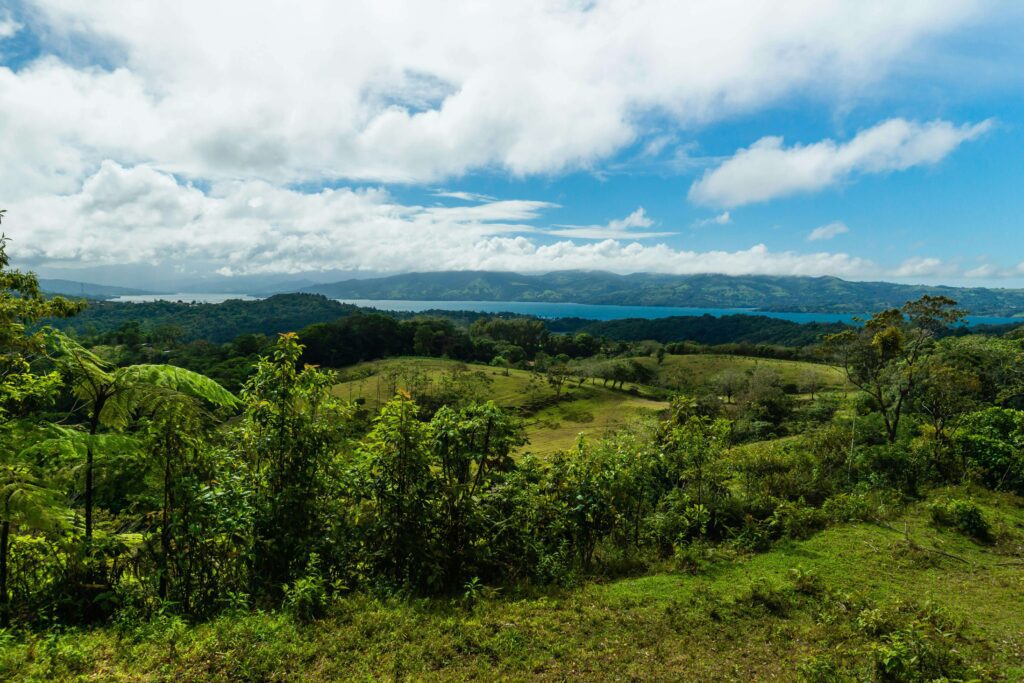
The park sits in Costa Rica’s northern lowlands between Arenal Volcano and the Guanacaste province, straddling the continental divide. The park entrance is a 7-kilometer (4.3-mile) drive from Bijagua, on roads that are paved but narrow and steep in sections. The surrounding landscape is transitional rainforest — dense, humid, and genuinely wild-feeling compared to more touristed parks.
How Far Is Rio Celeste from Major Hubs?
From Liberia International Airport, the drive runs roughly 1.5 hours. Most of the route follows paved roads, with the final stretch to Bijagua getting curvier and narrower. From San José’s Juan Santamaría Airport, plan for about 3.5 hours via Route 1 through the Central Valley and then north.
Coming from La Fortuna and the Arenal area, you’re looking at approximately 1.5 hours. That positioning makes Rio Celeste one of the smartest stops on a one-week Costa Rica itinerary connecting Guanacaste with the Arenal region. Most travelers who visit don’t make it a standalone destination — they build it into a logical route as a half-day midway stop.
It also fits naturally into a longer two-week route that covers multiple regions without backtracking. Our two-week Costa Rica itinerary includes Rio Celeste as a natural midday stop on the drive between Guanacaste and La Fortuna.
What Vehicle Do You Need to Get There?
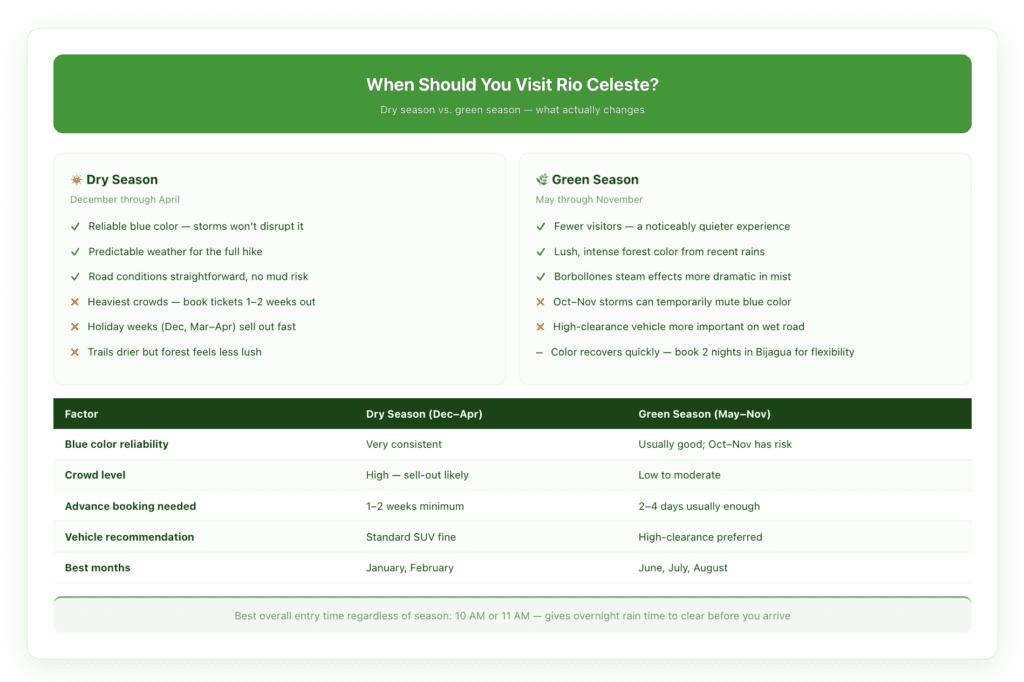
The roads to the park are paved, but that doesn’t mean any car handles them equally well. The final stretch from Bijagua includes steep grades and tight curves. During the green season (May through November), a high-clearance vehicle is strongly recommended since wet pavement on steep grades with no shoulders requires more grip and confidence.
The dry season (December through April) is more forgiving — a standard SUV manages the route without issues. Our guide on vehicle selection can help you match the right rental to your whole itinerary.
When navigating with GPS, search for “Parque Nacional Volcán Tenorio” or “Parqueo del Parque Nacional Tenorio” rather than just “Rio Celeste” — the latter often returns incorrect results. Download offline maps through Google Maps or Waze before leaving Bijagua, since cell signal drops to essentially zero near the park.
How Much Does It Cost to Visit Rio Celeste?
What Are the Current Park Entrance Fees?
Adult admission to Tenorio Volcano National Park is $12 USD plus applicable taxes. Children ages 2–12 pay $5 USD. Costa Rican citizens and residents pay significantly less, around 800 colones. All tickets must be purchased in advance through the SINAC online system. When booking, you’ll choose a 40-minute entry window from slots running 8:00 AM through 1:45 PM. The park closes at 4:00 PM, and everyone must exit by then.
One practical tip: create your SINAC account before your trip begins, not the morning you plan to visit. The site can run slowly or glitch, especially during peak season when thousands of people are booking simultaneously. Having your account ready removes that stress entirely.
What Other Costs Should You Budget For?
Parking runs approximately 3,000 colones (around $5 USD) and is handled by local residents rather than the park itself. It’s unofficial, but paying keeps your car in an attended spot during the hike. Don’t leave valuables visible, regardless — take your passport, wallet, and electronics with you.
If you want a guide, naturalist guides at the entrance typically charge around $55 USD for small groups or $10 USD per person for larger groups. Guiding isn’t required since the trail is clearly marked, but a good guide dramatically improves wildlife spotting. Ask to see their official ICT certification card before agreeing. For travelers watching their budget, cost-effective ways to explore Costa Rica offer practical advice for keeping overall trip costs down.
What's the Rio Celeste Hike Actually Like?
How Hard Is the Trail?
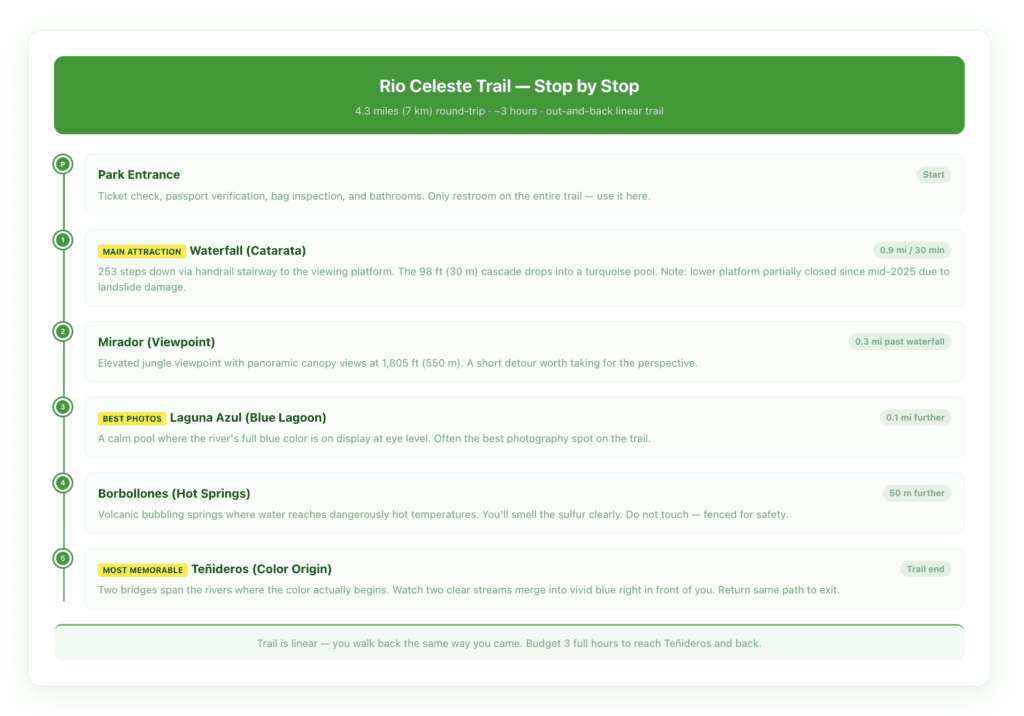
The trail is moderate. Total distance is about 4.3 miles (7 kilometers) round-trip, and most people complete it in 3 hours. The main physical challenge is the 253 steps down to the waterfall viewing platform — and then the 253 steps back up on the return. The steps have handrails, but they can be slippery when wet, so take them at a sensible pace. AllTrails rates the trail as moderate, which accurately reflects the experience for most visitors.
The first section of the waterfall takes around 30 minutes on a mix of concrete path and dirt trail. You’ll cross a small suspension bridge and two creek sections on stepping stones. The trail continues past the waterfall to additional viewpoints, including the Laguna Azul, the Borbollones bubbling hot springs, and Teñideros, where the color origin is clearly visible. This full back section from the waterfall to Teñideros is often the most memorable part of the hike and shouldn’t be skipped.
Trail closure update (as of early 2026): The stairway to the lowest waterfall viewing platform remains partially closed due to landslide damage. You can still descend partway and see the waterfall, but you cannot reach the bottom platform. Check the official Tenorio Volcano National Park Facebook page for the current status before your visit.
What Do You Need to Bring?
Closed-toe shoes are non-negotiable. Park rangers enforce this strictly and will turn you away for sandals, flip-flops, or any open-toed footwear. Trail runners or light hiking boots with decent grip work best. Beyond footwear, pack a reusable water bottle (single-use plastics are banned inside the park), a light rain jacket, sunscreen, and insect repellent. Mosquitoes are real here and can be aggressive, especially in the wetter months.
There are no facilities inside the park beyond the bathroom at the entrance. No food vendors, no water stations. Sort everything out before crossing the entrance gate, and you’ll be fine.
What's the Best Time to Visit Rio Celeste?
When During the Day Is Optimal?
The 10:00 AM or 11:00 AM entry slots consistently produce the best conditions. This timing allows overnight rain to clear and the river to re-establish its full blue color, while still giving you enough time to complete the trail and get back before the afternoon rain window arrives. The 8:00 AM slot works well for beating crowds, but if it rained overnight, the color may be slower to recover.
Since Tenorio Volcano sits in a transitional zone between the Caribbean and Pacific slopes, afternoon rain is common year-round regardless of season. Getting an early-to-mid-morning start is the single most reliable way to complete the hike in dry conditions.
What about the time of Year?
Dry season (December through April) brings the most reliable weather and the most reliable blue color. It also brings the biggest crowds. Tenorio ranks among Costa Rica’s five most-visited national parks, and daily visitor limits mean peak-season tickets sell out days in advance. Lonely Planet consistently lists it among the country’s top natural attractions. Book at least a week ahead; during the December-January holiday window or the March-April spring break period, book further out.
The green season (May through November) offers a genuinely different experience — fewer people, more intense greenery, and a dramatic atmosphere, especially around the Borbollones hot springs section, where steam rises through the mist. The trade-off is that October and November storms can occasionally knock the blue color out of the river for a day or two. If you have schedule flexibility during those months, a two-night stay in Bijagua gives you a backup morning.
Can You Swim at Rio Celeste?
Why Is Swimming Banned Inside the Park?
Conservation and safety both factor in. The fragile mineral balance responsible for the blue color can be disrupted by sunscreen, body lotions, and other contaminants. Additionally, the Borbollones section of the river runs dangerously hot from volcanic activity — the water looks calm but reaches temperatures that would cause serious burns.
Where Can You Swim Legally in the Rio Celeste River?
A free public swimming spot with the same blue water sits about 0.6 miles (1 kilometer) past the park entrance. Search “Rio Celeste Danta Free Pool” in Google Maps or Waze to find it. Parking costs about 1,000 colones, and a short path leads down to a natural swimming hole. The color is just as vivid, and there’s no entrance fee. If you’re traveling with kids, this is the best way to give younger family members the full experience.
What Wildlife Can You Expect to See?
What Animals Live in Tenorio Volcano National Park?
White-faced capuchin monkeys frequently appear near the suspension bridge section of the trail, particularly in the early morning. Howler monkeys are common throughout the forest — you’ll almost certainly hear them before you see them. Coatis, which resemble a long-nosed raccoon, often forage along the path and have learned that hikers represent a potential food source, so don’t feed them. According to SINAC’s biodiversity registry, the park protects more than 300 vertebrate species across its cloud forest and rainforest zones.
Birdwatchers should watch for mot-mots, toucans, and hummingbirds along the trail corridor. For a broader look at wildlife destinations across the country, our Costa Rica wildlife viewing guide covers the best spots by species and season. The park also protects tapirs, pumas, and anteaters — all rare to spot, but the fact that they live here reflects what National Geographic calls Costa Rica’s remarkable biodiversity density, packing 5% of the world’s species into less than 0.03% of Earth’s landmass.
Poison dart frogs in red, blue, and green sit in the leaf litter off-trail. Armadillos occasionally cross the path. Keep your eyes at ground level as well as canopy level — Rio Celeste rewards walkers who pay attention in multiple directions.
What's Worth Combining with a Rio Celeste Visit?
Rio Celeste rarely makes sense as a standalone trip requiring a long drive in and back. The geography rewards building it into a larger route. For travelers heading between Guanacaste beaches and the Arenal zone, it lands almost exactly at the midpoint. Leave Liberia Airport in the morning, hike Rio Celeste for over 3 hours, have lunch in Bijagua, and continue to La Fortuna that afternoon. It’s one of the more satisfying single driving days in the country.
The town of Bijagua itself has solid local restaurants and an authentic rural atmosphere — a noticeably different experience from Costa Rica’s more heavily touristed areas. It’s worth building in enough time to eat there rather than rushing straight back to the highway.
For anyone spending time in the Arenal area, Arenal Volcano National Park and the Arenal 1968 reserve are both realistic day trip options from a La Fortuna base.
The Caño Negro Wildlife Refuge is another strong pairing — it sits about an hour from La Fortuna and offers a completely different experience on the water.
If you’re heading back toward Guanacaste after Rio Celeste, Playa Conchal and the beaches of Guanacaste are both reachable the same afternoon.
Practical Notes Before You Go
Cell signal disappears near the park, so download offline maps before leaving Bijagua. Most carriers lose signal entirely on the road to the entrance.
The parking situation feels chaotic because local residents in yellow vests actively flag you into their respective lots as you arrive. The paid lots closest to the entrance run 3,000 colones and provide convenient access. Unofficial “free” parking exists across the street near a mini-market, but the paid lots closer to the gate are worth the small cost.
After the hike, local restaurants right outside the entrance serve solid Costa Rican food. Los Pilones offers meals and smoothies at reasonable prices. Fruit vendors across the street sell fresh tropical fruit and cold pipa frías (coconut water) — highly recommended for rehydrating after three hours on the trail.
Rio Celeste is one of those places that earns its reputation rather than coasting on it. The color is real, the hike is genuinely rewarding, and the geology behind the whole thing makes it more interesting than just a pretty waterfall. Book your SINAC tickets in advance, wear actual hiking shoes, and build it into a route that makes geographic sense. If you need a rental car to make that happen, Vamos Rent a Car can help you find the right vehicle for the whole trip.
Frequently Asked Questions
How far in advance should you book Rio Celeste tickets?
During the dry season (December–April), book at least a week ahead — and closer to two weeks for holiday periods around Christmas, New Year’s, and Easter. During the green season, a few days ahead is usually fine, though mid-week slots fill faster than you’d expect. Create your SINAC account before your trip so you’re not setting one up under time pressure on travel day.
Is Rio Celeste accessible for seniors or hikers with limited mobility?
The trail to the waterfall is manageable for reasonably fit hikers of any age — 30 minutes on a mix of concrete and dirt path with one suspension bridge. The 253 steps to the viewing platform have handrails on both sides, and most visitors with good knees complete them without much difficulty. The section beyond the waterfall — through Laguna Azul to Teñideros — involves rockier terrain and a few steeper descents. Hiking poles significantly help anyone with knee or ankle sensitivity. The trail is not accessible for wheelchairs or strollers.
What happens if you miss your entry time slot?
Rangers are strict about this, especially during high season when daily capacity limits are in force. Arriving late to a sold-out time slot typically means waiting for the next available opening — which could be hours away, or completely unavailable if everything is booked. Set a buffer of at least 30 minutes when planning your drive. If you’re coming from La Fortuna, that 1.5-hour drive has potential for delays from agricultural traffic and narrow roads.
Can you do Rio Celeste as a day trip from Tamarindo or Guanacaste beaches?
Yes, but it’s a full day. From Tamarindo, you’re looking at about 2.5 hours each way, which means a 5-hour round-trip drive plus 3 hours hiking plus time for lunch. Doable if you leave by 7:00 AM, but you won’t be back at the beach before late afternoon. A better approach is building Rio Celeste into a multi-destination route rather than treating it as a round-trip day excursion from the coast.
Are there any other blue waterfalls in Costa Rica besides Rio Celeste?
Yes. The Blue Falls of Costa Rica (Catarata Las Gemelas) near Bajos del Toro in the Central Valley produces a similar blue color from comparable volcanic mineral chemistry. It’s less visited and requires a 3-kilometer (1.9-mile) hike to reach. Catarata del Toro, also near Bajos del Toro, is a dramatic 270-foot (82-meter) waterfall inside an extinct volcanic crater — a different experience but equally striking. Neither requires the advance ticket reservation system that Tenorio does.
Do you need to carry cash at Rio Celeste?
Yes, for parking (3,000 colones) and the swimming spot (1,000 colones). Your SINAC park ticket is purchased online in advance by credit or debit card. The restaurants outside the entrance accept both cash and cards, but having colones on hand saves headaches in this area where card readers can be unreliable. There are no ATMs near the park — withdraw colones in Bijagua or before leaving Liberia or La Fortuna.
What’s the difference between Tenorio Volcano National Park and Rio Celeste?
They’re in the same place. Rio Celeste is the name of the river and waterfall that flows through Tenorio Volcano National Park. You can’t visit Rio Celeste without entering the park, and the park’s main draw is Rio Celeste. The trail also passes several geological features beyond the waterfall itself — the Laguna Azul, Borbollones hot springs, and Teñideros — but the waterfall is the headline attraction that most visitors come specifically to see.