
Last Updated on March 27, 2026
Tortuguero National Park: What's Covered
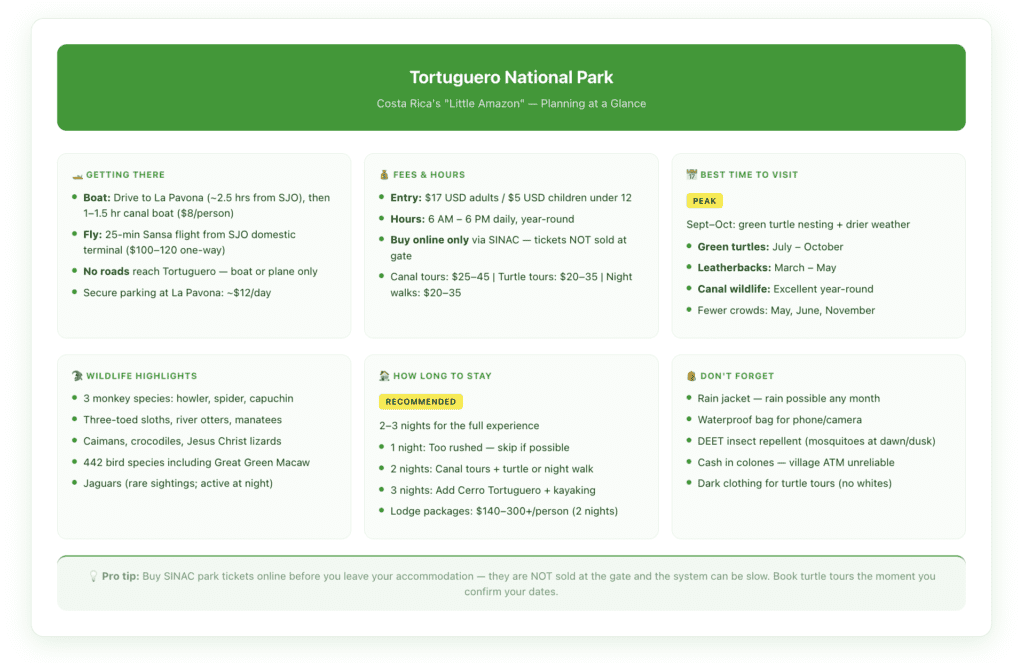
Tortuguero National Park is the most important green sea turtle nesting site in the Western Hemisphere, with thousands of females returning to the same Caribbean coast beaches from July through October. Entry costs $17 USD — purchase online via SINAC before arrival, as tickets are NOT sold at the gate. No roads reach Tortuguero; arrive by boat from La Pavona (1–1.5 hrs, ~$8/person) or 25-minute domestic flight from San José Airport.
Quick Facts:
- Entry: $17 adults / $5 children — SINAC online only; park open 6 AM–6 PM daily
- Turtles: Green turtles July–October (peak Sept–Oct); leatherbacks March–May
- Stay: 2–3 nights covers canal tours, turtle watching, and wildlife encounters
Top 4 Activities:
- Canal Boat Tour — depart 6 AM for peak wildlife along the waterways
- Guided Turtle Tour — book immediately; fills fast August–September
- Kayaking — motorboat-restricted channels deliver silent wildlife encounters
- Night Walk — frogs, tarantulas, kinkajous in a completely different ecosystem
Drive to La Pavona, park securely ($12/day), complete Tortuguero, then head south to Cahuita or Puerto Viejo — the cleanest Caribbean coast logistics play for anyone with a rental car.
If you need any help with a Costa Rica car rental, contact us now!
Tortuguero National Park is the only place in the Western Hemisphere where green sea turtles nest in such massive numbers — and watching them haul themselves up a black sand beach at midnight to lay eggs is the kind of moment you don’t forget. Located on Costa Rica’s northeastern Caribbean coast, this roadless, canal-laced wilderness covers 77,000 acres of rainforest, lagoons, and waterways teeming with jaguars, manatees, monkeys, and over 400 bird species. Getting here requires a boat or small plane — there are no roads, which filters out the casual crowd and keeps the experience genuinely wild. If you’re willing to plan ahead, Tortuguero delivers wildlife encounters you simply can’t replicate anywhere else in Costa Rica.
Key Takeaways
- No road access — you arrive by boat (1–1.5 hours from La Pavona) or a 25-minute domestic flight from San José
- Turtle nesting season runs July through October — September and October peak for green sea turtles, with March–May for leatherbacks
- 2–3 nights is the right amount of time — enough for canal tours, turtle watching, hiking, and village exploration
- Park entry: $17 USD adults, $5 USD children — must be purchased online through SINAC before arrival
- Rain is guaranteed year-round — Tortuguero gets nearly 240 inches (610 cm) annually, so pack accordingly regardless of season
- The canals deliver wildlife 365 days a year — turtles get the headlines, but the waterway ecosystem is exceptional any month
What Makes Tortuguero National Park Different?
Tortuguero National Park earned its name — which translates to “region of turtles” — because four sea turtle species nest on its 22 miles (35 km) of protected beaches: green, leatherback, hawksbill, and loggerhead. The green sea turtles that arrive between July and October represent the largest nesting population in the Atlantic Ocean, with thousands of females returning to the same beaches where they hatched decades earlier.
But turtles are only part of the story. The park protects one of Central America’s most biodiverse ecosystems, where 11 distinct habitats — including mangroves, swamps, rainforest, and lagoons — support an extraordinary concentration of wildlife. The network of freshwater canals that connects these habitats earned Tortuguero its other nickname: Costa Rica’s “Little Amazon.” Unlike Manuel Antonio or Braulio Carrillo, you experience Tortuguero almost entirely from the water — no trail will show you what a boat at dawn on these canals will.
What Wildlife Will You Actually See?
The park shelters 138 mammal species, 442 bird species, 118 reptile species, and 58 amphibian species. On canal boat tours, expect to spot all three monkey species — howler, spider, and white-faced capuchin — along with three-toed sloths, spectacled caimans, Jesus Christ lizards (named for their ability to sprint across water), river otters, and more tropical birds than you can count. Great green macaws, keel-billed toucans, bare-throated tiger herons, and green ibises are regulars — Tortuguero’s canal tours put you at eye level with feeding toucans in cecropia trees in a way no other park replicates.
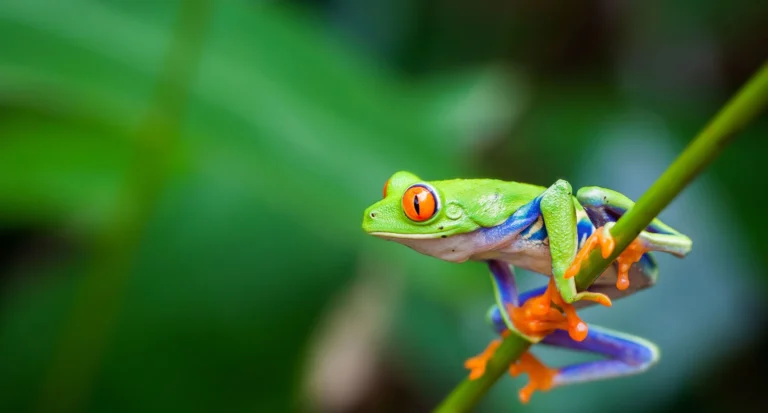
Jaguars patrol the park — particularly during turtle season when eggs and hatchlings provide easy meals. Camera traps regularly capture them on beach patrols at night. Sightings are rare, but knowing they’re there adds a genuine wildness to the experience. West Indian manatees swim the coastal waterways, and the blue jeans poison dart frog — bright red body, vivid blue legs — is common enough that you’ll see several on any guided night walk.
Where Is Tortuguero, and How Do You Get There?
Tortuguero sits on Costa Rica’s northeastern Caribbean coast, about 50 miles (80 km) north of the port city of Limón. The park and village occupy a narrow sandbar island between the Caribbean Sea and a canal system running parallel to the coast. No highways connect here, which has protected the ecosystem from development and kept wildlife populations healthy. For travelers flying in, San José’s Juan Santamaría Airport (SJO) is your gateway; Liberia Airport doesn’t make logistical sense for the Caribbean coast.
What’s the Boat Route Like?
The most common approach: drive or take a bus to the town of Cariari, continue to La Pavona dock, then board a boat for the 1–1.5 hour canal ride to Tortuguero. From San José’s airport, the drive to La Pavona takes about 2.5–3 hours through Guápiles on a paved highway. The boat fare runs approximately $8 per person each way, with departures from 6 AM to 4:30 PM.
If you have a rental car for the rest of your Costa Rica trip, the La Pavona route works cleanly — drive yourself to the dock, park in the secure lot (around $12/day), do Tortuguero, then pick up the car and continue south down the Caribbean coast. Many travelers pick up a rental car in Guápiles after the Tortuguero leg rather than backtracking to La Pavona, then head toward Cahuita National Park — this simplifies the logistics considerably.
Should You Fly Instead?
Sansa Airlines operates daily 25-minute flights from San José’s domestic terminal to Tortuguero’s small airstrip. Flying costs $100–120+ one-way but saves half a day of travel. Weather cancellations happen — morning flights are more reliable than afternoons. The luggage limit sits at about 30 lbs (14 kg), so pack light if you fly. Boat taxis meet arriving flights and ferry you to lodges and the village.
Are All-Inclusive Packages Worth It?
All-inclusive Tortuguero packages ($140–300+ per person for two nights) handle every logistic — ground transport from San José, boat transfer, accommodation, meals, canal tours, and often turtle watching in season. If planning stress concerns you, this is a smart move. The trade-off is flexibility. Packages run on fixed schedules and specific lodges. Independent travelers who arrange their own transport and stay in village accommodations get more control and can sometimes find significantly better rates. See our Costa Rica domestic flights guide for a closer look at flying versus driving tradeoffs on the Caribbean side.
What Does Tortuguero National Park Cost?
Park entry costs $17 USD for foreign adults and $5 USD for children under 12. Critical detail: Tickets are no longer sold at the park gate — you must purchase them in advance through the SINAC online system. This catches a surprising number of visitors off guard. Buy before you leave your accommodation. Note: SINAC’s servers occasionally run slow — if you have trouble, try off-peak hours or ask your lodge to assist.
Beyond entry, budget for:
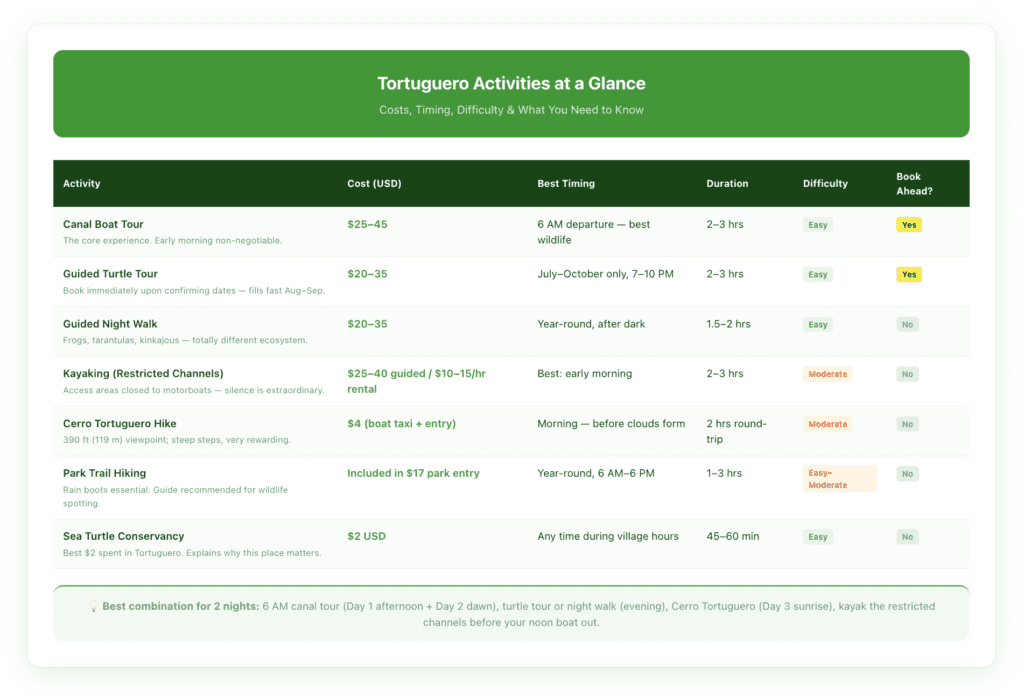
- Guided canal boat tours: $25–45 USD
- Turtle nesting tours (seasonal, July–October): $20–35 USD per person
- Night walks: $20–35 USD per person
- Kayak rentals: $10–15/hour; guided kayak tours: $25–40 USD
- Cerro Tortuguero boat taxi + entry: $4 USD total
Lodge packages typically bundle these at discounted rates, which is one reason all-inclusive options often deliver better value than they first appear. For a broader context on budget-friendly Costa Rica travel, Tortuguero actually compares favorably to more accessible parks when you factor in the all-inclusive lodge packages.

When Is the Best Time to Visit Tortuguero?
For Turtle Watching
The main event is green sea turtle nesting, which runs from July through October, with September and October delivering peak activity. During those two months, you might witness both nesting mothers and hatching babies on the same visit. Leatherback turtles — the world’s largest sea turtle at over 6 feet (1.8 m) long — nest earlier, from March through May. Fewer visitors come during leatherback season, making sightings feel more intimate. Keep in mind that Costa Rica’s dry season guide covers March–May as an excellent window for Caribbean coast travel.
For Weather
Tortuguero receives nearly 240 inches (610 cm) of rain annually, making it one of Costa Rica’s wettest spots. According to Costa Rica’s national meteorological institute (IMN), the Caribbean slope consistently receives the highest rainfall in the country year-round. September and October are a relatively dry window — rainfall decreases and sunny mornings are more common, which conveniently lines up with peak turtle season. February and March also tend toward drier conditions. The honest answer? Some rain is likely in any month. The payoff is that moisture creates and maintains the lush ecosystem that makes Tortuguero what it is.
For Avoiding Crowds
December, July, and August draw the most visitors. December coincides with holiday travel; July and August pair turtle season with summer vacation schedules in North America and Europe. For a quieter experience, consider May, June, or November — excellent wildlife viewing with lodges offering better rates. Keep in mind that Costa Rica’s green season brings lush conditions and far fewer crowds at Tortuguero — the ecosystem is equally spectacular in the rain.
What Are the Best Things to Do in Tortuguero?
Canal Boat Tours — The Core Experience
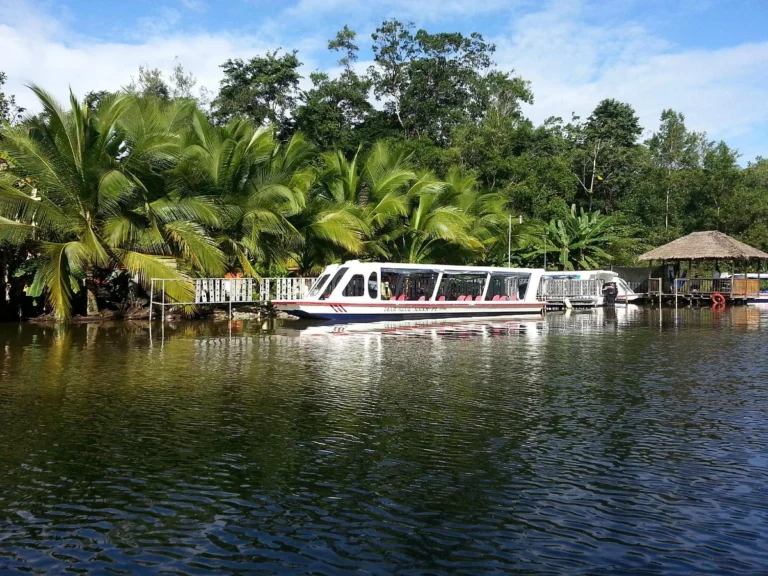
Gliding through the canal network in a covered motorboat is the defining Tortuguero activity. Local naturalist guides navigate the waterways while identifying wildlife that most visitors would walk right past. Early morning departures — 6 AM when the park opens — deliver the best sightings as the forest wakes up and animals move to feed in cooler temperatures. This is fundamentally the same immersive canal experience you’ll find described in Caño Negro Wildlife Refuge — except Tortuguero’s wildlife density and biodiversity is a level above.
Multiple canal routes exist, ranging from 1.4 miles (2.3 km) to 3.2 miles (5.1 km). Each passage gives a different perspective on the park’s habitats. The smaller channels restricted to small boats put you closer to the banks than the main waterways, and that proximity changes everything. The SINAC park management guidelines specify which channels allow motorized versus non-motorized access — your guide will know.
Guided Turtle Tours
During nesting season, certified guides lead nighttime beach patrols searching for nesting females. Tours run from 7 PM to 10 PM, with groups limited to small numbers per section of beach. The rules are strict: no flashlights, no cameras, dark clothing required (no whites or bright colors). When guides find a nesting turtle, they position visitors at a respectful distance to observe the nest-digging, egg-laying, and return to the sea. Book through your lodge or the local guide association the moment you confirm your Tortuguero dates — spots fill quickly in August and September.
The Sea Turtle Conservancy, the world’s oldest sea turtle research organization, was founded here in Tortuguero in 1959. Their visitor center ($2 USD) in the village covers the research and conservation history that transformed these beaches into one of the planet’s most important protected areas. It’s one of the best $2 you’ll spend in Costa Rica.
Kayaking the Restricted Channels
Kayaking might be Tortuguero’s most underrated activity. Certain canal sections are closed to motorized boats, meaning kayaks and canoes have access corridors that no other visitors reach. The silence is a completely different experience from motorboat tours — you hear every bird call, every splash, every branch cracking as a monkey moves overhead. Rentals run $10–15/hour; guided kayak tours cost $25–40 USD. If you’re spending three nights, this deserves at least half a morning.
Hiking Park Trails
Three trails explore different habitats:
- Gavilan Trail: Short, easy loop through swamp forest and coastal scrub — accessible, a good starting point
- Jaguar Trail (Sendero Jaguar): 1.5-mile (2.5 km) path running parallel to the beach, with beach access points every 330 feet (100 m) — used during turtle season
- La Ceiba Trail: Longer route into deeper rainforest with better wildlife spotting opportunities for patient hikers
Rain boots are essential year-round — these trails are consistently muddy. Most lodges rent boots or sell inexpensive pairs in the village. A local guide dramatically improves wildlife spotting success and adds context that no signage can provide. If you’re planning to combine Tortuguero with other top Costa Rica activities, the contrast between hiking-based parks and Tortuguero’s canal experience is one of the things that makes combining both so worthwhile.
Cerro Tortuguero Viewpoint
This 390-foot (119 m) extinct volcanic hill offers the only elevated viewpoint in the area. The steep 45-minute climb involves hundreds of steps, but the summit delivers a 360-degree panorama over canals, rainforest, beach, and Caribbean coastline. On clear days, the volcanic peaks of the Central Highlands are visible in the distance. A boat taxi ($2 USD) takes you from the village to the trailhead — go in the morning before clouds roll in.
Tortuguero Village
The 400-meter main strip connecting the boat dock to the park entrance is small but worth a few hours. About 2,500 people live on this sandbar, most working in tourism, which has replaced fishing as the primary livelihood. Colorful wooden houses, a church, restaurants, and souvenir shops line the path. The Caribbean community here has a distinctly different character from the rest of Costa Rica — similar to what you’ll find later in Puerto Viejo, but quieter and more tied to the park itself. If you’re curious about Caribbean cuisine, read our Caribbean coast food guide before you go — the flavors here are genuinely different from anything on the Pacific side.
Where Should You Stay in Tortuguero?
Village accommodations range from backpacker hostels ($15–30/night) to small hotels and cabins ($40–80/night). These put you within walking distance of the park entrance, restaurants, and the boat dock. Independent travelers and budget-conscious visitors tend to go this route. For a full breakdown of accommodation options across the Caribbean coast, our Caribbean coast accommodations guide covers pricing and what to expect in detail.
Eco-lodges along the canals outside the village are accessible only by their own boats. These properties border the park itself — wildlife literally moves through the grounds. Top options include:
- Evergreen Lodge: Swimming pool, multiple restaurants, wildlife viewing from the property — well-located near the park entrance (4.7/5 on TripAdvisor)
- Pachira Lodge: Eco-focused with strong tour programs and consistently excellent cuisine (4.6/5 on TripAdvisor)
- Mawamba Lodge: Private beach access, a highly regarded restaurant, spacious cabins in lush gardens (4.5/5 on TripAdvisor)
- Aninga Lodge: Quieter, smaller operation with a pool and strong sustainability focus (4.5/5 on TripAdvisor)
All-inclusive packages from these lodges typically cover transport from San José, accommodation, meals, canal tours, and turtle watching in season. For travelers who want every detail handled, this is the right call.
How Many Days Do You Need?
Two to three nights is the sweet spot. One night is possible but feels rushed — you arrive mid-afternoon, get one canal tour, then leave the next morning without catching the magic of dawn on the water. Here’s what a realistic 3-night itinerary looks like:
Day 1: Arrive via boat (spotting wildlife along the canal banks before you even reach the park), settle in, afternoon canal tour, evening walk through the village
Day 2: 6 AM canal tour when wildlife is most active, mid-morning park trail hike, afternoon kayak, evening turtle tour (July–October) or guided night walk
Day 3: Sunrise hike on Cerro Tortuguero, morning kayak in restricted channels, Sea Turtle Conservancy visitor center, afternoon departure
Day 4 (optional): Late morning boat tour before your noon boat back — worth it if your two-week Costa Rica itinerary allows
Four or more nights start to feel repetitive unless you have specific birding, photography, or conservation volunteering goals. The Sea Turtle Conservancy runs volunteer programs during nesting season for those who want a deeper engagement.
How Does Tortuguero Fit Into a Costa Rica Trip?
Tortuguero works best as a 2–3 day segment within a larger itinerary. The journey absorbs half a day each direction, so you want to get real mileage from the stop. If you’re building a two-week Costa Rica itinerary, Tortuguero fits cleanly as the Caribbean anchor before you head south or cut back west.
The most natural combination pairs Tortuguero with the rest of the Caribbean coast — spend 2–3 nights on the canals, then head south toward Cahuita National Park and Puerto Viejo for a completely different Caribbean experience: coral reefs, swimmable beaches, and a reggae-infused cultural scene unlike anywhere else in the country. Another common routing: arrive via La Fortuna — you can arrange shuttles directly from Arenal and La Fortuna to the La Pavona dock.
The smart logistics play for anyone renting a car: drive to La Pavona, park securely, enjoy the Tortuguero experience, pick up the car on return, and continue your SJO road trip route south along the Caribbean coast. This keeps maximum flexibility for the portions of your trip where driving makes sense, while using the boat system where roads don’t exist. If you need help working out the logistics for a multi-region itinerary that includes Tortuguero, contact our team — planning this connection correctly makes a real difference in how smoothly the rest of your trip flows.
What Should You Pack?
Tortuguero’s tropical rainforest climate demands specific preparation. Temperatures hover around 85–90°F (29–32°C) year-round, with extreme humidity — light synthetics beat cotton every time. See our Costa Rica currency guide for advice on how much cash to bring and whether to use colones or USD at local businesses.
Non-negotiables:
- Rain jacket or waterproof poncho
- Waterproof bag for phone, camera, and electronics
- Quick-dry clothing in dark neutral colors (greens, blacks, browns)
- Rain boots or waterproof hiking shoes (many lodges rent boots — ask in advance)
- Insect repellent with DEET or picaridin — mosquitoes are aggressive at dawn and dusk
- SPF 50+ sunscreen and a hat — sun reflecting off the canal water is intense
- Binoculars (borrow or buy — guides have spotting scopes, but personal binoculars help)
- Cash in Costa Rican colones — the village ATM is unreliable; bring more than you think you’ll need
For turtle tours specifically:
- Dark clothing only — no whites, no bright colors, no reflective materials
- Long pants and closed-toe shoes for beach walking at night
The humidity stays high year-round, so cotton is a poor choice. Light synthetic fabrics that dry quickly are significantly more comfortable.
Frequently Asked Questions
Is Tortuguero National Park worth visiting if I’m not going during turtle season?
Yes — the canal wildlife is exceptional 365 days a year. Turtles get the most attention, but the waterway ecosystem doesn’t care about your travel dates. Caimans, sloths, three monkey species, river otters, and hundreds of bird species live here permanently. Many experienced travelers actually prefer visiting outside peak turtle season because lodges are quieter, guides are less rushed, and rates are lower.
What’s the biggest danger in Tortuguero?
The park is safe for travelers. The remoteness and small community create a naturally low-risk environment. Practical concerns: don’t swim in the ocean (strong currents, no lifeguards) or in the canals (caimans and crocodiles). Follow the guide’s instructions on turtle tours. Bring cash since the ATM is unreliable. Mosquitoes are the most consistent nuisance — a good repellent and long sleeves at dawn and dusk solve this.
Do I need to book a boat to Tortuguero in advance?
Public boats from La Pavona run throughout the day on a set schedule and don’t require advance booking. You simply buy a ticket at the dock on arrival. What does require advance booking: turtle tours (fill quickly August–September), eco-lodge accommodations during peak season (July–October), and all-inclusive packages.
Can you drink the tap water in Tortuguero?
Bring bottled water or a filtration bottle to be safe. While some lodges have filtered water, tap water quality in the village is inconsistent. This is standard practice throughout Costa Rica’s more remote Caribbean communities.
How far is Tortuguero from Manuel Antonio?
The two parks are on opposite coasts and not practical to visit back-to-back in a day. Tortuguero sits on the northeastern Caribbean coast; Manuel Antonio is on the Central Pacific, about 3 hours from San José. If your one-week itinerary includes both, plan a night in San José between them or use an efficient shuttle connection.
What is the difference between Tortuguero village and Tortuguero National Park?
The village is a living Caribbean community of about 2,500 people with restaurants, hostels, souvenir shops, and the Sea Turtle Conservancy — no entrance fee required to explore it. The national park is a protected wilderness area accessed from the village; this is where the canal tours, hiking trails, and turtle beaches are, and it requires the $17 entry ticket purchased in advance online.
Is it worth hiring a guide at Tortuguero?
For first-time visitors, yes — a certified local naturalist guide makes a significant difference. These guides know exactly where animals are active at specific times and can identify wildlife you’d miss entirely. They carry spotting scopes for birds and can read the canals in ways that take years to develop. The cost ($25–40 for a canal tour) is one of the better investments you’ll make at the park.