
Last Updated on January 12, 2026
Arenal 1968 Reserve: What's Covered
The Arenal 1968 private reserve offers one of the best Arenal Volcano hikes in Costa Rica, combining dramatic lava field terrain with panoramic views of both the volcano and Lake Arenal. Located just 15-20 minutes from La Fortuna, this 7-kilometer trail system takes you directly through the path of the catastrophic 1968 eruption that transformed the region forever. Unlike the adjacent national park, Arenal 1968 stays open until 5 PM daily and provides more direct access to the historic lava flows. You’ll walk across volcanic boulders, through regenerating rainforest, and up to viewpoints where the volcano’s iconic cone rises dramatically overhead. Entry $25 USD adults, $15 USD children (6-11), free under 6. Hours 8 AM-5 PM daily (last entry 4 PM). Trail options include Lava Flow 1968 (2.5 km, 1.5-2 hours) and Forest 1968 (4.5 km, 2-2.5 hours)—both can be combined for full 7-km circuit. Moderate difficulty with steep sections; free walking sticks available at entrance.
Quick Facts
- Location: 15-minute drive from La Fortuna on Route 142 toward Lake Arenal—1.25 km down dirt road to entrance
- Entry: $25 adults, $15 children (6-11), free under 6; 8 AM-5 PM daily (last entry 4 PM)
- Trails: Lava Flow 1968 (2.5 km, 1.5-2 hours), Forest 1968 (4.5 km, 2-2.5 hours)—combine for 7-km circuit
- Highlights: Walk through actual 1968 lava flows, Lava Flow Summit viewpoint with 360-degree volcano and lake panoramas
- 1968 Eruption: July 29, 1968 explosion killed 87 people, buried 15+ sq km, destroyed three villages—volcano erupted continuously until 2010 (42 years)
- Vehicle: No 4×4 required—flat dirt road accessible year-round; free parking lot
- Best Time: 8 AM opening for wildlife and clear views before clouds form; March-April driest but year-round rain possible
Top 5 Arenal 1968 Tips
- Arrive at 8 AM Opening Before Clouds Form – Early morning offers cooler temperatures, most active wildlife (white-faced capuchins, howler monkeys, sloths, toucans), best chance clear volcano views before noon when clouds typically obscure summit—even dry season sees unpredictable cloud cover
- Bring Sturdy Hiking Shoes and Walking Stick – Volcanic rock terrain uneven and sometimes slippery; closed-toe hiking shoes or trail runners essential, sandals/flip-flops won’t work—free walking sticks at entrance genuinely helpful on steep lava field sections with loose rocks
- Combine Both Trails for Complete Experience – Lava Flow Trail (tour company route) provides dramatic volcano views with least physical demand; Forest Trail loops Los Patos Lake through rainforest with fewer visitors, better wildlife spotting—trails merge near observation point for customizable 7-km circuit
- Pair with La Fortuna Waterfall and Hot Springs – Perfect combination day: morning Arenal 1968 hike (finish by noon), afternoon La Fortuna Waterfall swim (10 min from town), evening Tabacón or Baldi hot springs for muscle recovery
- Plan Multiple Days if Seeking Clear Volcano Views – Arenal’s cone acts as moisture magnet creating unpredictable cloud cover year-round; spending 2-3 nights in La Fortuna increases odds of clear morning views—many travelers report best sightings on second or third consecutive morning
Arenal 1968 offers genuine volcanic landscape experiences perfect for travelers exploring the Arenal region. The reserve anchors half-day La Fortuna explorations, making it valuable for active itineraries. Many travelers combine the morning hike with afternoon La Fortuna Waterfall visits, evening hot springs, or hanging bridge tours. For building comprehensive itineraries, check our one-week and two-week plans. The July 29, 1968 eruption at 7:30 AM flung multi-ton boulders over kilometer at 600 meters/second, created three new craters on western flank, triggered 42-year continuous eruption (tenth-longest since 1750). Walking across actual lava flows from documented eruption provides geological perspective impossible to replicate elsewhere. The Lava Flow Summit viewpoint sits at highest accessible point near volcano with dual panoramas. Standard vehicles handle flat dirt road fine year-round—large parking lot with free access. Extended 5 PM closing versus national park’s 4 PM provides more flexibility. Wildlife density sits between busy Manuel Antonio and remote Monteverde—regenerating rainforest supports capuchins, howlers, coatis, three-toed sloths, toucans, mot-mots, hummingbirds.
If you need any help with a Costa Rica car rental, contact us now!
The Arenal 1968 private reserve offers one of the best Arenal Volcano hikes in Costa Rica, combining dramatic lava field terrain with panoramic views of both the volcano and Lake Arenal. Located just 15-20 minutes from La Fortuna, this 4-mile (7-kilometer) trail system takes you directly through the path of the catastrophic 1968 eruption that transformed the region forever.
Unlike the adjacent national park, Arenal 1968 stays open until 5 PM daily and provides more direct access to the historic lava flows. You’ll walk across volcanic boulders, through regenerating rainforest, and up to viewpoints where the volcano’s iconic cone rises dramatically overhead. On clear mornings, the views here rival any in the country.
Key Takeaways
- Location: 15-minute drive from La Fortuna on Route 142 toward Lake Arenal
- Entrance Fee: $25 USD adults, $15 USD children (6-11), free under 6
- Hours: 8 AM – 5 PM daily (last entry 4 PM)
- Trail Options: Lava Flow 1968 (1.5 miles/2.5 kilometers) and Forest 1968 (2.8 miles/4.5 kilometers) – both can be combined
- Difficulty: Moderate with steep sections; walking sticks available at entrance
- Vehicle: No 4×4 required as there are paved roads to entrance with large parking lot
ARENAL 1968 TRAIL
Quick Facts at a Glance
Route 142 toward Lake Arenal
Adjacent to Arenal Volcano National Park15-20 min drive • No 4x4 needed
Why Visit?
What Makes Arenal 1968 Different from the National Park?
The Arenal Volcano National Park draws larger crowds and closes earlier at 4 PM with the last entry at 2:30 PM. Arenal 1968’s extended hours until 5 PM give you more flexibility, and the trails here bring you closer to the actual 1968 lava flows.
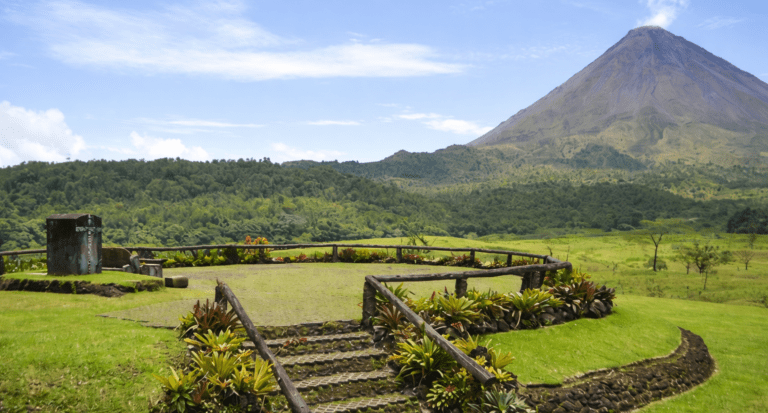
Both parks offer excellent volcano views, but Arenal 1968 provides a more intimate experience with fewer tour groups. The Lava Flow Summit viewpoint here sits at the highest accessible point near the volcano and offers 360-degree panoramas that include both the volcanic cone and the sprawling Lake Arenal in the distance.
The Arenal Observatory Lodge nearby offers an alternative experience with day passes around $12-32 USD, including pool access and hiking trails. However, for pure volcano hiking and lava field exploration, Arenal 1968 remains the top choice among experienced hikers visiting La Fortuna.
What Happened at Arenal Volcano in 1968?
At 7:30 AM on July 29, 1968, there was a sudden and violent eruption from a mountain which locals had considered dormant. For centuries, residents had called the mountain simply “Cerro Arenal” or Arenal Hill with no idea of the power sleeping beneath it.
The eruption lasted several days and buried over 5 square miles (15 square kilometers) under rocks, lava, and ash. The explosion killed 87 people and completely destroyed the three villages of Tabacón, Pueblo Nuevo, and San Luís. According to the Global Volcanism Program at the Smithsonian Institution, the volcano flung boulders weighing several tons more than a half a mile (one kilometer) away at speeds of 1,342 miles per hour (600 meters per second).
Three new craters formed on the volcano’s western flank. The eruption created lava fields which visitors to Arenal 1968 hike through making this trail both a geological wonder and a memorial to the region’s history. The volcano continued erupting until 2010, making it the tenth-longest volcanic eruption on Earth since 1750 according to Wikipedia’s comprehensive volcano documentation.
The town of La Fortuna on the eastern side escaped destruction. Contrary to popular belief, it wasn’t renamed after the eruption and residents had already chosen the name, meaning “The Fortune,” referring to the area’s fertile lands rather than their luck in avoiding the blast.
How Do You Get to Arenal 1968?
What’s the Driving Route from La Fortuna?
From downtown La Fortuna, take Route 142 west toward Lake Arenal and Tilarán. About 15 minutes later, turn left onto the dirt road leading toward Arenal Volcano National Park and El Castillo. The Arenal 1968 entrance sits about 0.75 miles (1.25 kilometers) down this road on the left and a large sign makes it impossible to miss.
The drive from San José takes approximately 3 hours via Route 702. If you’re arriving from Liberia Airport, then plan to drive roughly 2.5 hours through the scenic Guanacaste countryside.
HOW TO GET TO ARENAL 1968
Drive Times & Directions
La Fortuna
DowntownSan José (SJO)
AirportMonteverde
Cloud ForestLiberia (LIR)
AirportHead west on Route 142 toward Lake Arenal / Tilarán
After ~7.5 mi (12 km), turn left at sign for Arenal Volcano National Park / El Castillo
Continue on dirt road for 0.8 mi (1.25 km)
Arenal 1968 entrance on left – Large sign visible!
NO 4x4 REQUIRED
Paved Route 142 + flat dirt road to entrance
Free parking at reserve
Pro Tip
Arrive by 8 AM for best wildlife viewing and clear volcano views before clouds roll in!
Do You Need a 4×4 Vehicle?
No. The dirt road to Arenal 1968 is flat and only slightly bumpy so any standard rental car handles it easily year-round. The reserve has a large parking lot at the entrance with no parking fees.
Driving in Costa Rica gives you the flexibility to arrive early for the best wildlife viewing and combine Arenal 1968 with other attractions like La Fortuna Waterfall or the region’s famous hot springs.
Can You Reach Arenal 1968 Without a Car?
There’s no public bus directly to the reserve. A taxi from La Fortuna costs $10-15 USD one way, and Uber operates in the area. . However, you’ll need to coordinate return transportation since taxis don’t wait at the entrance.
For the easiest experience, consider renting a car. If you’re arriving at Juan Santamaría Airport or Guanacaste Airport, picking up a rental gives you complete freedom to explore the region at your own pace.
What Trails Does Arenal 1968 Offer?
How Long Does the Lava Flow 1968 Trail Take?
The Lava Flow 1968 Trail (Sendero Colada 1968) runs 1.5 miles (2.5 kilometers) and takes most hikers 1.5-2 hours round trip. This is the trail that tour companies use and provides the most dramatic volcano views with the least physical demand.
The path starts fairly easily through open fields before entering the rainforest where the terrain steepens. You’ll walk directly through hardened lava fields from the 1968 eruption and massive volcanic boulders line the trail as living evidence of the volcano’s power.
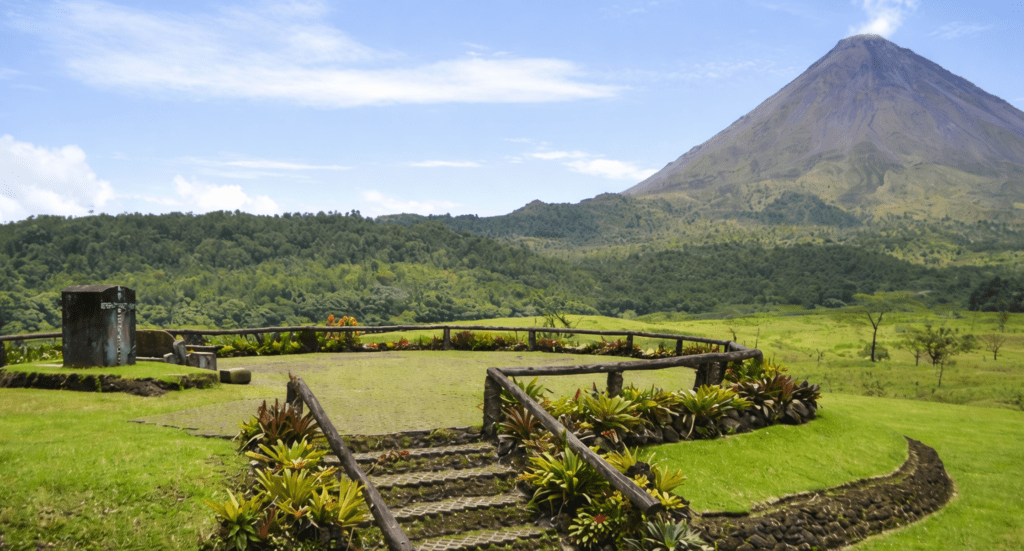
The Lava Flow Summit viewpoint at the top offers the best vistas: Arenal Volcano rising dramatically on one side and Lake Arenal stretching into the distance on the other. On clear days, this spot delivers some of Costa Rica’s most photographed volcano scenery.
What About the Forest 1968 Trail?
The Forest 1968 Trail (Sendero Bosque 1968) extends 2.8 miles (4.5 kilometers) and adds another 2-2.5 hours. This more challenging route loops around Los Patos Lake through dense rainforest with steeper ascents.
Both trails merge near the volcano observation point, so you can hike them together as a 4-mile (7-kilometer) circuit if you arrive early enough. The Forest Trail sees fewer visitors and provides a quieter experience with better wildlife spotting opportunities for the monkeys, toucans, and sloths that frequent this section.
Free walking sticks are available at the entrance near the trailhead sign. They’re genuinely helpful on the steeper lava field sections where loose rocks require careful footing.
What Wildlife Might You See?
What Species Live in the Reserve?
The regenerating rainforest around Arenal supports impressive biodiversity. Common sightings include white-faced capuchin monkeys, howler monkeys, coatis, and three-toed sloths which are often spotted lounging in cecropia trees along the trails.
Birdwatchers frequently spot toucans, mot-mots, and various hummingbird species. The area falls within the larger Arenal Conservation Area, which protects over 500 bird species and 131 mammal species according to Costa Rica’s national park system.
The cicadas create a constant background hum, but patient hikers often hear howler monkey calls echoing across the valley. Early morning visits (before 9 AM) dramatically increase your chances of wildlife encounters as animals are most active during cooler hours.
How Does This Compare to Other Costa Rica Parks?
Arenal 1968’s wildlife density sits between the busy trails of Manuel Antonio and the more remote Monteverde Cloud Forest. You’re less likely to encounter crowds here, which means less disturbance to wildlife.
For dedicated wildlife viewing, consider combining Arenal 1968 with a visit to nearby Caño Negro Wildlife Refuge or booking a guided night tour in La Fortuna. The diverse wildlife around Monteverde makes an excellent addition to any Northern Zone itinerary.
When Should You Visit Arenal 1968?
What’s the Best Season for Clear Volcano Views?
Costa Rica’s weather patterns create interesting challenges around Arenal. Unlike the Pacific coast with its predictable dry season from December through April, the Northern Zone around La Fortuna receives rain year-round due to Caribbean weather influence.
The driest months are typically March, April, and a brief window in September-October. However, Arenal Volcano’s summit frequently hides behind clouds regardless of season because the cone acts as a magnet for moisture. According to official Costa Rica tourism resources, visitors should expect cloud cover and consider themselves lucky to see the full volcano.
What Time of Day Works Best?
Arrive as close to the 8 AM opening as possible. Early morning offers three advantages: cooler hiking temperatures, more active wildlife, and the best chance of clear volcano views before afternoon clouds roll in.
By noon, clouds typically obscure the summit. If you’re determined to see the volcano clearly, plan multiple visits or extend your stay in La Fortuna. Many travelers report finally seeing the cone on their second or third day in the area.
The trail remains enjoyable even on cloudy days because the lava fields, rainforest, and lake views don’t depend on volcano visibility.
What Should You Bring and Wear?
What Clothing Works Best?
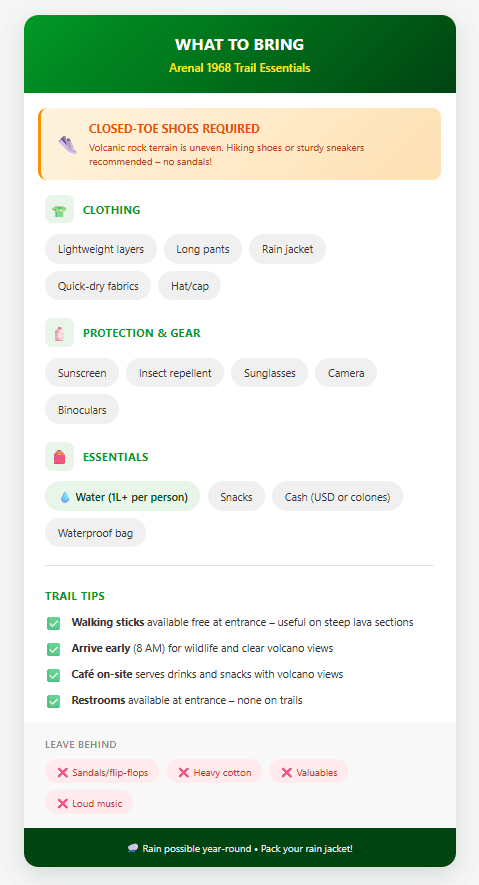
Closed-toe shoes are absolutely essential because the volcanic rock terrain is uneven and sometimes slippery. Sturdy hiking shoes or trail runners work best and sandals or flip-flops simply won’t cut it here.
Long pants protect against brush and insects on the Forest Trail. Lightweight, quick-dry fabrics are superior to cotton since you’ll likely sweat on the uphill sections. Bring a rain jacket regardless of season because afternoon showers are unpredictable in this microclimate.
What Else Should You Pack?
Beyond clothing, essential items include:
- At least 35 ounces (1 liter) of water per person
- Sunscreen and sunglasses for exposed sections
- Insect repellent, especially for the Forest Trail
- Camera with a good zoom lens for volcano photos
- Hat or cap for sun protection
- Small snacks for energy on longer hikes
A waterproof bag or rain cover protects camera equipment from sudden showers. Binoculars will significantly enhance wildlife spotting.
Should You Hire a Guide or Go Independent?
What Are the Benefits of a Guided Tour?
Guided tours typically include transportation from La Fortuna hotels, entrance fees, and an expert naturalist who knows exactly where the wildlife is hiding. Guides carry spotting scopes that let you photograph sloths and birds from impressive distances.
The historical context a guide provides about the 1968 eruption transforms the hike from a simple walk into a meaningful experience. They’ll point out volcanic features, explain the geological timeline, and share stories about how the eruption shaped modern Costa Rica.
Many tour packages combine Arenal 1968 with other Arenal volcano tours like hot springs visits, creating full-day experiences.
Is Self-Guided Hiking Worth It?
Absolutely. The trails are well-marked with clear signage, and you can explore at your own pace without schedule constraints. Independent visitors can hike both trails without rushing, spend extra time at viewpoints, and avoid large tour groups.
The entrance includes a trail map. Just stay on marked paths, never stray into long grass which is snake habitat, don’t feed wildlife, and avoid touching unfamiliar plants with bare hands.
Self-guided hiking works particularly well if you have your own transportation and want to control your timing because you can arrive early for wildlife and clear views, then combine the hike with a 1-week Costa Rica itinerary that includes other Northern Zone highlights.
How Does Arenal 1968 Fit Into a Larger Itinerary?
Can You Combine It with Other La Fortuna Attractions?
The reserve’s location makes it perfect for combination days. After a morning hike, many visitors head to La Fortuna Waterfall which is 10 minutes from the town for a refreshing swim, and then finish the day at hot springs in the evening.
For active travelers, consider pairing Arenal 1968 with hanging bridge tours or canyoning adventures. The 50 best Costa Rica activities include several Arenal-area options that complement a volcano hike.
Hot springs like Tabacon, Baldi, and more budget-friendly options provide the perfect end to an active day. The geothermally heated water soothes tired muscles while you gaze at the volcano if the cloud cover lifts.
What Multi-Day Routes Work Best?
From San José, a classic Northern Zone loop includes San José → La Fortuna (3-4 nights) → Monteverde (2-3 nights) → Pacific coast or return. This route from San José captures Costa Rica’s most iconic landscapes.
Alternatively, combine Arenal with the Caribbean coast: La Fortuna → Tortuguero → Puerto Viejo. The drive through Braulio Carrillo National Park connecting these regions offers spectacular scenery.
What Are the Practical Details?
How Much Does a Visit Cost?
Entrance fees are straightforward: $25 USD for adults, $15 USD for children ages 6-11, and free for children under 6. Tickets can be purchased on-site or in advance for guided tours.
The reserve offers good value compared to some alternatives. Tabacon Hot Springs charges $85+ for day access, while Arenal Volcano National Park costs $16.95 with more restrictive hours.
Budget travelers staying in La Fortuna can visit Arenal 1968 as a half-day activity and still have time for free attractions like the town’s central park with its volcano backdrop.
What Facilities Are Available?
The reserve includes restrooms at the entrance, a small café with volcano views near the parking area, and the aforementioned free walking sticks. The café serves drinks, snacks, and light meals. Although the prices are higher than La Fortuna town, they are reasonable for a tourist site.
Parking is free and the lot easily accommodates dozens of vehicles. There’s no need for advance reservations for self-guided visits and you can simply show up during operating hours.
Is Arenal 1968 Worth the Entrance Fee?
For anyone interested in Costa Rica’s volcanic history, absolutely. Walking across actual lava flows from a documented eruption provides a perspective you can’t replicate elsewhere. The combination of geological significance, scenic viewpoints, and manageable difficulty makes this one of the best half-day hikes in the Northern Zone.
Compared to El Silencio Mirador which costs approximately $9 USD with arguably better immediate volcano views, Arenal 1968 is pricier but delivers a more comprehensive experience with longer trails and direct access to historic lava fields.
If you only have one morning for volcano hiking and want to maximize both views and geological interest, Arenal 1968 delivers. The 10-foot-tall (3-meter-tall) grass sections, the volcanic boulder fields, and the dual volcano-lake panoramas create memories that justify the entrance fee.
For safety precautions around Arenal Volcano, the reserve maintains clear trail boundaries and rangers monitor conditions. The trails stay well outside any potential danger zones.
Frequently Asked Questions
What is Arenal 1968?
Arenal 1968 is a private ecological reserve located adjacent to Arenal Volcano National Park which is named for the catastrophic 1968 eruption that created its distinctive lava field landscapes. The reserve offers two hiking trails totaling 4 miles (7 kilometers), with viewpoints overlooking both Arenal Volcano and Lake Arenal. It’s considered one of the best places near La Fortuna to hike through actual volcanic terrain and witness the regenerating rainforest that’s reclaiming the eruption zone.
How long does the Arenal 1968 hike take?
The Lava Flow Trail is 1.5 miles (2.5 km) and takes 1.5-2 hours for most hikers at a moderate pace. The longer Forest Trail 2.8 miles (4.5 km) adds 2-2.5 hours. Plan to hike for a total of 3-4 hours to complete both trails as a combined circuit. The trails merge near the main viewpoint, so you can customize your route based on available time and energy.
How much does it cost to visit Arenal 1968?
Entrance costs $25 USD for adults and $15 USD for children ages 6-11. Children under 6 enter free. Prices are in US dollars although payment in Costa Rican colones is accepted. Guided tours that include Arenal 1968 typically range from $50-85 USD per person with transportation and hot springs visits included.
Is Arenal Volcano still active today?
Arenal Volcano has been in a resting phase since October 2010 when 42 years of continuous activity that began with the 1968 eruption ended. Scientists classify it as dormant rather than extinct because the magma chamber remains active underground, and future eruptions are considered likely based on geological studies. You won’t see lava flows today, but the volcano still releases occasional steam and gases from its summit.
Why can’t you climb Arenal Volcano?
Climbing to Arenal’s summit is prohibited for safety reasons. Even in its current dormant state, the volcano releases toxic gases and hot steam near the crater. The upper slopes also remain unstable with loose volcanic material that can give way without warning. Park rangers strictly enforce a safety perimeter, and attempting unauthorized climbs carries significant legal and physical risks.
What is the best time to see Arenal Volcano without clouds?
Early morning between 6-8 AM offers the best chance for clear views before clouds form around the summit. The dry season months of March and April typically provide more clear days overall although cloud cover remains unpredictable year-round. Many visitors report their best views occurred early on consecutive mornings rather than during any specific season. Spending multiple days in La Fortuna significantly increases your odds of seeing the volcano.