
Last Updated on January 12, 2026
Peñas Blancas Border Crossing: What's Covered
The Peñas Blancas border crossing sits about 90 minutes north of Liberia on the Pan-American Highway, making it Costa Rica’s only land crossing into Nicaragua. You’ll need your passport (valid for at least six months), small USD bills for various fees totaling around $25-27, and proof of onward travel if you’re returning to Costa Rica. The entire process takes 1-3 hours depending on crowds, and the border operates daily from 6 AM to 10 PM (closing at 8 PM on Sundays). Whether you’re doing a quick visa run, exploring Granada’s colonial architecture, or catching waves in San Juan del Sur, understanding this border crossing saves you time, money, and frustration. Budget $25-27 USD total for all border fees (Costa Rica exit + Nicaragua entry/exit + municipality taxes). Bring small bills ($1, $5, $10) since border officials rarely have change. Costa Rican rental cars cannot cross into Nicaragua—leave yours at the border or arrange alternative transportation. The border is about 4.5 hours from San José and 1.5 hours from Liberia Airport.
Quick Facts
- Location: 90 minutes north of Liberia on Pan-American Highway; 4.5 hours from San José, 1.5 hours from Liberia Airport
- Hours: Daily 6 AM-10 PM (Monday-Saturday), 6 AM-8 PM Sundays
- Total Fees: $25-27 USD round-trip—Costa Rica exit ($8-10), Nicaragua entry ($12 + $1 municipality), Nicaragua exit ($3 + $1 municipality)
- Documents: Passport valid 6+ months, proof of onward travel (re-entering Costa Rica), small USD bills ($1, $5, $10 denominations)
- Duration: 1-3 hours depending on crowds; arrive before 9 AM for shortest lines, cooler temps
- Rental Cars: Cannot cross—Costa Rican rentals not permitted into Nicaragua; return at Liberia Airport or leave at border parking ($5/day)
- Popular Destinations: San Juan del Sur (30 min from border), Granada (2 hours), Ometepe Island (4-5 hours with ferry)
Top 5 Peñas Blancas Border Tips
- Arrive Before 9 AM for Smooth Crossing – Early morning means shorter lines, cooler temperatures during exposed walk between immigration offices (no shade), maximum time in Nicaragua—weekdays less busy than weekends, avoid crossing near closing time risking stuck if process takes longer than expected
- Bring Exact Small USD Bills for All Fees – Border officials rarely have change; prepare $8-10 (Costa Rica exit, pay online via Banco de Costa Rica or at border), $13 (Nicaragua entry + municipality), $4 (Nicaragua exit + municipality)—$25-27 total round-trip in $1, $5, $10 denominations
- Handle Rental Cars Before Border – Costa Rican rentals cannot cross into Nicaragua under any circumstances (all companies); return rental at Liberia Airport before continuing by bus/shuttle, or leave at border parking with local families ($5/day)—some travelers rent separate vehicles each country
- Have Proof of Onward Travel Re-Entering Costa Rica – Immigration officers consistently request this—printed flight confirmation, bus ticket out of Costa Rica, or screenshot showing departure within 180 days works; officers have become stricter about requirement, so have documentation ready
- Do Yourself to Avoid Scams – People approach offering “help” inflating difficulty to charge unnecessary fees; process straightforward enough to do yourself—never hand passport to anyone except uniformed immigration officers, watch for fake form sellers or claims about unnecessary documents, all legitimate fees paid directly to officers or clearly marked official booths
Peñas Blancas border crossing offers strategic Nicaragua access perfect for travelers exploring Guanacaste’s Pacific coast. The crossing anchors extended Central America itineraries, making it valuable for visa runs or destination additions. Many travelers structure trips ending in Guanacaste before crossing Nicaragua, then flying home from Managua avoiding backtracking. For building comprehensive itineraries, check our one-week and two-week plans. The crossing process: exit Costa Rica (pay $8-10 exit tax at office on right before main immigration building, hand passport + receipt to officer for exit stamp, 5-15 minutes unless queued); walk through no man’s land (few hundred meters, officers verify exit stamp, vendors sell snacks/drinks, money changers operate with poor rates); enter Nicaragua (checkpoint verifies Costa Rica exit stamp, modern air-conditioned immigration building, pay $12 entry to officer presenting passport, luggage through X-ray scanner, pay $1 municipality fee near exit). Most Western passport holders receive 90-day tourist stamp without advance visa. From Liberia bus terminal, Grupo Transbasa departs for Peñas Blancas every 45 minutes 5 AM-6:30 PM (1.5 hours, ~$2.50). From San José Terminal 7-10, Caribenos buses run hourly 3:20 AM-7 PM (5 hours, $8-10). Day trip to San Juan del Sur from Guanacaste beaches possible but tight—5 AM depart, 8:30 AM arrive after crossing, 3 PM depart, 7 PM return leaves only 6 hours in Nicaragua; overnight trips more rewarding.
If you need any help with a Costa Rica car rental, contact us now!
The Peñas Blancas border crossing sits about 90 minutes north of Liberia on the Pan-American Highway and is Costa Rica’s only land crossing into Nicaragua. You’ll need your passport (valid for at least six months), small USD bills for various fees totaling around $25-27, and proof of onward travel if you’re returning to Costa Rica. The entire process takes 1-3 hours depending on crowds, and the border operates daily from 6 AM to 10 PM (closing at 8 PM on Sundays).
Whether you’re doing a quick visa run, exploring Granada’s colonial architecture, or catching waves in San Juan del Sur, understanding this border crossing saves you time, money, and frustration. Here’s everything you need to know to cross smoothly.
Key Takeaways
- Budget $25-27 USD total for all border fees (Costa Rica exit + Nicaragua entry/exit + municipality taxes)
- Bring small bills ($1, $5, $10) since border officials rarely have change
- Costa Rican rental cars cannot cross into Nicaragua so arrange toleave yours at the border or arrange alternative transportation
- The border is about 4.5 hours from San José and 1.5 hours from Liberia Airport
- Passport must have at least 6 months validity and Nicaragua strictly enforces this rule
- Arrive early morning for shortest lines and to avoid midday heat
What Documents Do You Need for the Peñas Blancas Border?
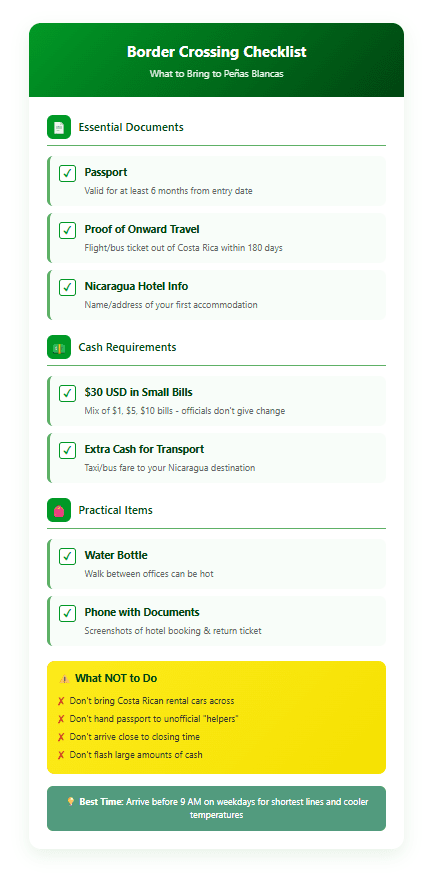
Crossing at Peñas Blancas requires more preparation than hopping on a flight, but nothing complicated. Here’s your checklist:
Essential Documents
Your passport needs at least six months of validity from your entry date. Nicaragua enforces this rule strictly and they will turn you away if your passport expires within six months. If yours is close to expiring, contact your embassy before attempting to cross.
You’ll also need proof of onward travel when re-entering Costa Rica. Immigration officers ask for this consistently. A printed flight confirmation, bus ticket out of Costa Rica, or even a screenshot on your phone showing your departure within 180 days works. Some travelers use services that provide temporary flight reservations specifically for this purpose.
Cash Requirements
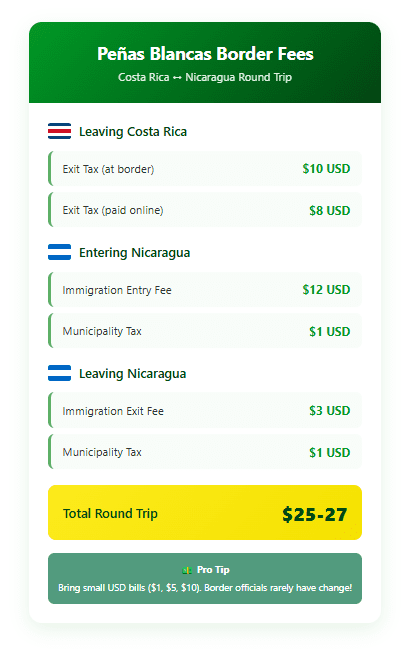
Bring USD in small denominations. All border fees must be paid in US dollars, and officials typically don’t have change. Here’s what you’ll pay:
Leaving Costa Rica:
- Exit tax: $8 USD (paid online via Banco de Costa Rica) or $10 USD at the border
Entering Nicaragua:
- Entry tax: $12 USD (paid to immigration officer)
- Municipality fee: $1 USD
Leaving Nicaragua:
- Exit tax: $3 USD (paid to immigration officer)
- Municipality fee: $1 USD
Total round-trip cost: approximately $25-27 USD depending on where you pay the Costa Rica exit tax.
How Do You Get to Peñas Blancas from Costa Rica?
Getting to the border depends on where you’re starting and how much flexibility you want.
From Liberia
The Guanacaste region offers the easiest access to Nicaragua. From Liberia’s bus terminal at Calle 12 and Avenida 7, Grupo Transbasa buses depart for Peñas Blancas every 45 minutes from 5 AM to 6:30 PM. The ride takes about 1.5 hours and costs around $2.50 USD.
If you’re flying into Liberia Airport, you can arrange a private shuttle directly to the border for approximately $80-90 USD. This option makes sense if you’re short on time or traveling with a group.
From San José
For door-to-door service, shuttle companies offer private transfers from San José starting around $180 USD. International bus services like Ticabus and TransNica also operate routes from San José to Managua and beyond, handling the border crossing process with you.
Can You Drive to the Border?
Yes, but with an important caveat. You can drive your rental car to Peñas Blancas, but Costa Rican rental vehicles cannot cross into Nicaragua. This restriction applies to all rental companies without exception.
If you’re driving to the border, you have three options: return your rental at Liberia Airport before continuing by bus or shuttle, arrange to have your rental vehicle picked up at the border or leave your car at one of the informal parking areas near the border. Local families offer secure parking for about $5 USD per day. Don’t leave any valuables inside.
What’s the Step-by-Step Process for Crossing?
The Peñas Blancas crossing can feel chaotic if you don’t know what to expect. Here’s exactly how it works.
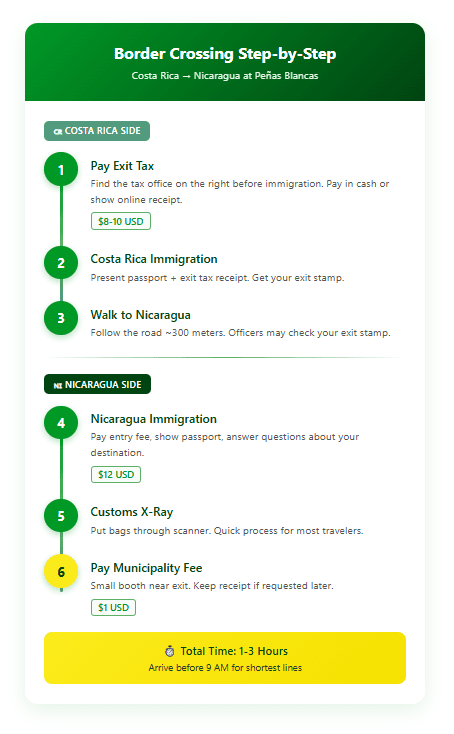
Exiting Costa Rica
When you arrive at the border, you’ll see a long line of cargo trucks because Costa Rica is the only Central American country that didn’t sign the regional customs agreement, so commercial traffic backs up significantly. Pedestrians can bypass this line.
First, look for the exit tax office on your right side before reaching the main immigration building. Pay your $10 USD (or show your online payment receipt) and keep this receipt because you’ll need it at immigration.
Next, head to the Costa Rican immigration office. Hand over your passport and exit tax receipt. The officer will check your documents and stamp you out of Costa Rica. They may ask where you stayed in Costa Rica or where you’re headed in Nicaragua. The process typically takes 5-15 minutes unless there’s a queue.
Walking Through No Man’s Land
After getting your Costa Rica exit stamp, walk toward Nicaragua. It’s a few hundred meters along the main road. Officers may stop you to verify your exit stamp which is normal sokeep your passport accessible.
You’ll pass vendors selling snacks, drinks, and souvenirs. Money changers also operate here, though their rates aren’t great. If you need Nicaraguan córdobas, wait until you reach an ATM in your destination city.
Entering Nicaragua
As you approach the Nicaraguan side, you’ll first encounter a checkpoint where officers verify your Costa Rica exit stamp. Continue to the modern, air-conditioned immigration building to pay the $12 USD entry fee to the immigration officer when you present your passport. They’ll ask about your destination in Nicaragua and length of stay. Have a hotel name ready even if you haven’t booked yet, as knowing you’re heading to “Granada” or “San Juan del Sur” answers the question.
After receiving your entry stamp, put your luggage through the X-ray scanner for customs inspection. Finally, pay the $1 USD municipality fee to a booth near the exit and you’re now officially in Nicaragua.
Where Do People Go After Crossing into Nicaragua?
Most travelers heading to Nicaragua from Costa Rica target three main destinations, all easily accessible from the border.
San Juan del Sur
This beach town sits about 30 minutes south of Rivas by taxi (approximately $30 USD). It’s Nicaragua’s main Pacific coast tourist hub, popular for surfing, beach bars, and the famous Christ of the Mercy statue overlooking the bay. Visit Nicaragua highlights it as the country’s surfing capital.
From the border, take a taxi to Rivas first (about $15 USD), then another taxi or bus to San Juan del Sur or negotiate a direct taxi from the border for $30-35 USD.
Granada
Nicaragua’s colonial gem lies about 2 hours from the border. Founded in 1524, Granada offers beautiful Spanish architecture, the nearby Masaya Volcano, and boat trips to Las Isletas in Lake Nicaragua.
Buses run from the Nicaraguan side of the border to Rivas, where you can transfer to Granada in 2-3 hours by public transport. Private shuttles offer more direct routes.
Ometepe Island
This volcanic island in Lake Nicaragua requires a ferry from San Jorge (near Rivas). Allow 4-5 hours total from the border including waiting time for the ferry. The island offers hiking, beaches, and a slower pace than mainland destinations.
Can You Do a Day Trip to Nicaragua from Costa Rica?
Technically yes, but it’s tight. A day trip to San Juan del Sur from Guanacaste beaches like Tamarindo is possible if you leave early and accept you’ll spend significant time at the border and on the road.
Here’s a realistic day trip timeline:
- 5:00 AM: Depart Tamarindo
- 6:30 AM: Arrive Peñas Blancas border
- 8:00 AM: Complete crossing (assuming minimal lines)
- 8:30 AM: Arrive San Juan del Sur
- 3:00 PM: Depart San Juan del Sur
- 3:30 PM: Begin return border crossing
- 5:00 PM: Back in Costa Rica
- 7:00 PM: Return to Tamarindo
This schedule leaves only about 6 hours in Nicaragua and requires everything to go smoothly. For most travelers, an overnight trip makes more sense.
If you’re doing a visa run simply to reset your Costa Rica tourist stamp, you don’t need to go far into Nicaragua. Spending a few hours or overnight in Rivas,the nearest city, accomplishes the same goal with less travel time.
What Should You Know About Safety at the Border?
The Peñas Blancas crossing has a reputation for being confusing and occasionally chaotic, but it’s generally safe when you know what to expect.
Avoiding Scams
People will approach offering to “help” you through the crossing. While some are legitimate fixers, many inflate the difficulty to charge unnecessary fees and the process is straightforward enough to do yourself.
Never hand your passport to anyone except uniformed immigration officers. Scammers have been known to offer to fill out now largely obsolete forms for a fee, or claim they can expedite your crossing.All legitimate fees are paid directly to immigration officers or clearly marked official booths.
General Safety Tips
Keep your passport secure but accessible because you’ll show it multiple times during the crossing. Don’t flash large amounts of cash when paying fees and try to bring exactly what you need in small bills.
Travel with minimal luggage if possible because dragging heavy bags in the heat between offices adds unnecessary stress. If you’re carrying valuables, keep them on your person rather than in checked bags during the crossing.
The border area itself is busiest midday. Arriving early morning (before 9 AM) typically means shorter lines, cooler temperatures, and a smoother experience overall.
How Does the Return Crossing Work?
Coming back to Costa Rica follows a similar but reversed process.
Exiting Nicaragua
Head to the exit side of the Nicaraguan immigration building and pay the $1 USD municipality fee at the small booth, then the $3 USD exit tax to the immigration officer who stamps your passport. Put any luggage through the scanner on your way out.
Re-Entering Costa Rica
Walk back through no man’s land toward the Costa Rican side. Officers will check your Nicaraguan exit stamp along the way.
At Costa Rica immigration, join the entrance queue. This is where having your proof of onward travel matters. The officer will ask:
- Where are you going in Costa Rica?
- How long will you stay?
- Do you have a flight/bus out of Costa Rica?
Show your return ticket or proof of onward travel within 180 days. Officers have become stricter about this requirement, so have documentation ready. A bus ticket sometimes works, but a flight confirmation is more reliable.
Once stamped in, put your bags through the customs X-ray, and you’re back in Costa Rica. From here, you can catch a bus to Liberia or wherever your Costa Rica adventure continues.
Planning Your Costa Rica Itinerary Around a Nicaragua Trip
Adding Nicaragua to your Costa Rica itinerary works best when you’re already in the Guanacaste region. The border’s proximity to Liberia makes it a natural side trip during a Pacific coast vacation.
Consider structuring your trip to end in Guanacaste before crossing to Nicaragua, then flying home from Managua. This avoids backtracking and lets you see more of Central America. Alternatively, make Nicaragua an overnight excursion before continuing to Monteverde or Arenal.
Having your own transportation in Costa Rica gives you flexibility to reach the border on your own schedule. While rental cars can’t cross into Nicaragua, dropping your vehicle at Liberia Airport before the border crossing, then picking up another car when you return, keeps your Costa Rica exploration seamless.
Frequently Asked Questions
Can I cross the border from Costa Rica to Nicaragua?
Yes, the Peñas Blancas border crossing is open daily from 6 AM to 10 PM (Monday-Saturday) and 6 AM to 8 PM on Sundays. Citizens of the United States, Canada, UK, and most European countries don’t need a visa to enter Nicaragua and you’ll receive a 90-day tourist stamp on arrival. Just bring your passport with at least six months validity, small USD bills for fees, and proof of accommodation in Nicaragua.
What are the requirements to cross the border?
You need a passport valid for at least six months, approximately $25-27 USD in small bills for various taxes and fees, and proof of where you’re staying in Nicaragua. When returning to Costa Rica, you’ll also need proof of onward travel which is either aflight or bus ticket out of Costa Rica within 180 days. No advance visa is required for most Western passport holders.
Can you drive a rental car from Costa Rica into Nicaragua?
No. Costa Rican rental cars are not permitted to cross land borders under any circumstances. This applies to all rental companies. If you’re driving to the border, you must either return your rental at Liberia Airport before continuing by bus or shuttle, or leave your car with a local parking attendant near the border (approximately $5/day). Some travelers rent separate vehicles in each country through agencies that operate on both sides of the border.
Can you do a day trip to Nicaragua from Costa Rica?
It’s possible but tight. From Guanacaste, you can reach San Juan del Sur and spend 5-6 hours there before returning the same day. However, you’ll spend significant time at the border and in transit. Most travelers find an overnight stay more rewarding, allowing time to actually explore destinations like Granada’s colonial center or enjoy San Juan del Sur’s beaches and restaurants without rushing.
What documents do I need to enter Nicaragua?
Your passport (valid 6+ months) and approximately $13 USD cash for the entry fee and municipality tax. Immigration officers will ask your destination and length of stay so have a hotel or hostel name ready. Unlike Costa Rica, Nicaragua doesn’t typically require proof of onward travel for tourists, although having a general plan helps answer questions at immigration.
Is it safe to go to Nicaragua now?
Nicaragua is generally safe for tourists visiting main destinations like Granada, San Juan del Sur, and León. The Peñas Blancas border crossing area is busy but manageable when you know the process. Exercise normal travel precautions: don’t flash valuables, keep your passport secure, and be aware of your surroundings. Check your government’s current travel advisories before your trip, as political situations can change.
Do you need a yellow fever card to enter Nicaragua from Costa Rica?
Only if you’ve traveled to a yellow fever endemic country within the past few years. Travelers coming directly from Costa Rica or the United States don’t need yellow fever vaccination proof. However, if you’ve been to certain African or South American countries recently, bring your vaccination certificate. When in doubt, carry your yellow card as it takes no space and avoids potential issues.
What’s the best time to arrive at the border?
Early morning, ideally before 9 AM. This timing helps you avoid the midday heat as the walk between immigration offices is exposed with no shade, beat the crowds that build throughout the day, and gives you maximum time in Nicaragua. Weekdays are typically less busy than weekends or holidays. Avoid crossing near closing time as if the process takes longer than expected, you could end up stuck.