
Last Updated on June 19, 2026
Cocos Island National Park: What's Covered
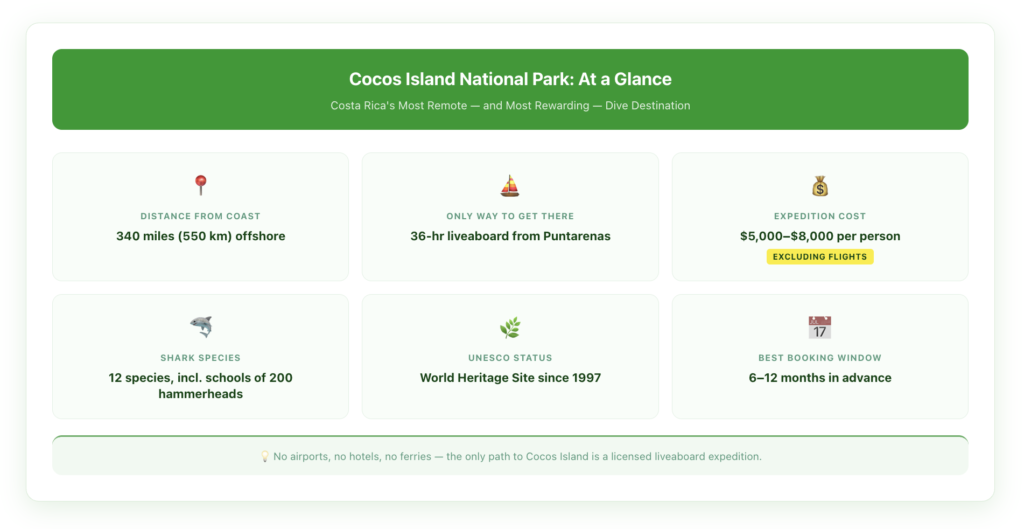
Cocos Island National Park sits 340 miles (550km) off Costa Rica’s Pacific coast, reachable only by a 36-hour liveaboard from Puntarenas. Expeditions cost $5,000–$8,000 per person for 8–11 days and require Advanced Open Water certification with 50+ logged dives. This UNESCO World Heritage Site delivers the world’s densest hammerhead shark encounters — schools of 100–200 at cleaning stations.
Quick Facts:
- Location: 340 miles (550km) offshore; no airports or ferries — liveaboard only
- Access: Aggressor Adventures or Undersea Hunter; 1–2 trips/month year-round
- Cost: $5,000–$8,000 base; total $7,000–$12,000 per person with flights and fees
- Best time: Dry season (Dec–May) calmer seas; rainy season (Jun–Nov) peak sharks
Top 3 Reasons Divers Make the Trip:
- Hammerhead schools — Schools of 100–200 at Bajo Alcyone; peak July–September
- Wild marine life — 12 shark species, manta rays, whale sharks, 350+ fish — zero manipulation
- Endemic ecosystem — 3 endemic bird species, world’s lowest-elevation cloud forest
Not ready for a full expedition? Caño Island near the Osa Peninsula offers Costa Rica’s best accessible shark diving. Add a 1-week itinerary around your trip dates.
If you need any help with a Costa Rica car rental, contact us now!
Cocos Island National Park sits 340 miles (550km) off Costa Rica’s coast, reachable only by a 36-hour liveaboard from Puntarenas. No airports, no hotels, no ferries. Just open ocean between you and the UNESCO World Heritage Site, Jacques Cousteau called the most beautiful island in the world.
For most travelers, Cocos Island represents the pinnacle of adventure diving rather than a standard vacation. Advanced scuba divers spend $5,000–$8,000 on 8–11 day liveaboard expeditions for the chance to swim with some of the largest concentrations of hammerhead sharks on Earth. Non-divers have almost no options, though occasional research expeditions do accept visitors focused on the island’s remarkable terrestrial ecosystem.
Key Takeaways
- Location: 340 miles (550km) southwest of Costa Rica, accessible only by a 36-hour boat from Puntarenas.
- Getting there: No airports or ferries — liveaboard dive boats only (Aggressor Adventures or Undersea Hunter).
- Cost: $5,000–$8,000 per person for 8–11-day expeditions, not including flights and equipment.
- Best for: Advanced scuba divers with 50+ logged dives seeking world-class shark encounters.
- UNESCO status: World Heritage Site since 1997, one of four in Costa Rica.
- Wildlife: 12 shark species, schools of 100–200 hammerheads, 350+ fish species, 3 endemic bird species.
- Best time: Dry season (December–May) for calmer seas; rainy season (June–November) for peak hammerhead activity.
Where Is Cocos Island, and Why Is It So Remote?
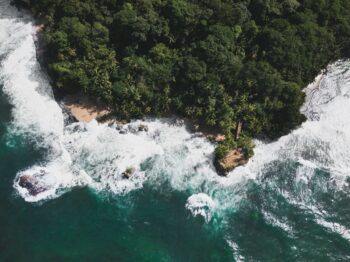
Cocos Island occupies an isolated position in the Eastern Tropical Pacific, roughly halfway between Costa Rica’s mainland and the Galápagos Islands. It’s where several deep-sea currents converge, creating nutrient-rich upwellings that fuel a marine ecosystem unlike anything on the Pacific coast. The island covers approximately 10 square miles (24 square kilometers) of dense tropical rainforest, with Cerro Iglesias — the highest point — rising 1,900 feet (575 meters) above sea level.
One unusual geographic fact: Cocos Island hosts the world’s lowest-elevation cloud forest, sitting at just 1,475 feet (450 meters). Compare that to Monteverde’s cloud forests, which form above 4,500 feet (1,400 meters), and you get a sense of just how unusual this island is.
Why Does Remoteness Make Cocos Island Special?
The 340-mile (550-kilometer) distance from the mainland isn’t just a logistical challenge — it’s the reason the island’s ecosystem remains so intact. That isolation has created conditions similar to the Galápagos, with numerous endemic species found nowhere else on Earth: three endemic bird species (the Cocos cuckoo, Cocos finch, and Cocos Island warbler), 27 endemic saltwater fish species, and two endemic reptiles. It’s also why visiting requires serious commitment — there are no roads, no restaurants, and no infrastructure beyond a few ranger stations.
How Do You Get to Cocos Island National Park?
There’s exactly one practical way: by licensed liveaboard boat from the port of Puntarenas, departing 130 miles (210 kilometers) west of San José. No commercial airlines serve the island. No cruise ships stop there. Private vessels need advance permits from Costa Rica’s SINAC (Sistema Nacional de Áreas de Conservación), a process that takes months and isn’t designed for casual tourism.
Which Liveaboard Operators Run Expeditions?
Two licensed operators run regular trips year-round:
Aggressor Adventures operates the Okeanos Aggressor I and II, with 8 and 11-day itineraries accommodating up to 20 guests. Cabins, all meals, dive guides, tanks, and weights are included. Their vessels are large enough to handle open ocean crossings comfortably.
Undersea Hunter runs the Sea Hunter and Argo — similarly equipped, similar trip lengths. Both operators have decades of experience at Cocos and know the best dive sites intimately.
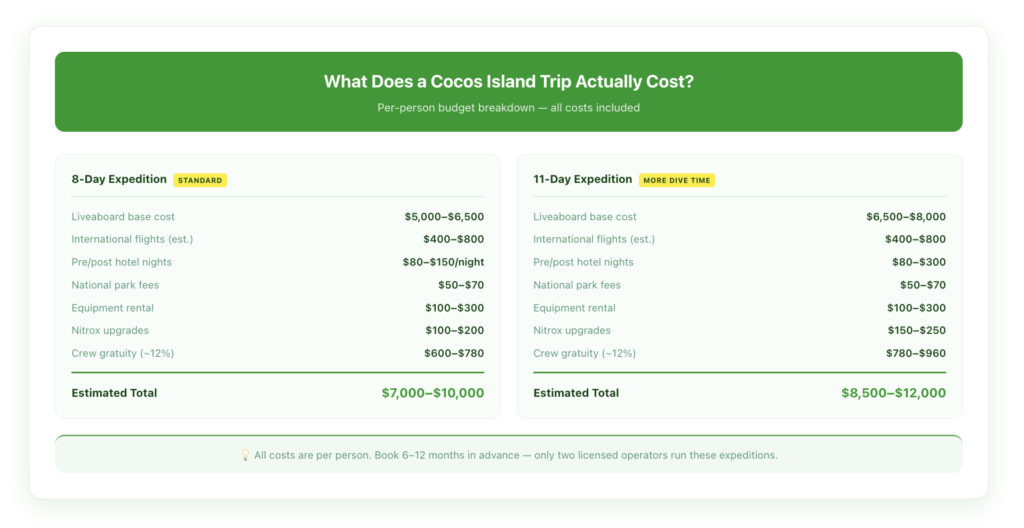
An 8-day expedition runs $5,000–$6,500 per person. Eleven-day trips cost $6,500–$8,000. These prices include accommodation, meals, guide services, tanks, and weights. They don’t include airfare to San José International Airport (SJO), pre-departure hotel nights, national park fees ($50–$70), dive equipment rental, Nitrox upgrades ($100–$200), or crew gratuities (typically 10–15% of trip cost). Budget $7,000–$12,000 total per person for a complete trip.
Spaces book out 6–12 months in advance, especially for the July–September peak hammerhead season. If Cocos Island is on your bucket list, planning well ahead isn’t optional.
What If You Don’t Scuba Dive?
Options are limited, but not zero. In recent years, the national park has allowed a small number of non-diving visitors to join research and nature expeditions. These trips — which involve hiking, birdwatching, and sometimes assisting with scientific research — are organized by certified guides who negotiate space aboard liveaboard vessels. They aren’t regularly scheduled, and finding a spot requires contacting conservation organizations like Friends of Cocos Island well in advance.
If non-diving ocean wildlife is what you’re after, Caño Island Biological Reserve near Drake Bay provides excellent shark and ray encounters without any overnight commitment — and at a fraction of the cost.
What Makes the Diving at Cocos Island World-Class?
Cocos Island consistently ranks among the top five dive destinations globally. The island’s position at the convergence of major Pacific currents creates a marine ecosystem with biodiversity numbers that are genuinely hard to believe.
How Many Sharks Will You Actually See?
The island earned the nickname “Shark Island” for good reason. Twelve shark species inhabit these waters, but it’s the scalloped hammerhead that steals the show. At sites like Bajo Alcyone and Dirty Rock, divers regularly encounter schools of 100–200 hammerheads circling cleaning stations — where small fish remove parasites from the sharks’ skin. It’s a natural behavior that happens nowhere else at this scale.
Whitetip reef sharks rest in groups of 30 or more on the seafloor. Whale sharks appear from May through August, drawn by plankton blooms. Tiger sharks, Galápagos sharks, silky sharks, and silvertip sharks round out the roster. Critically, none of this wildlife has been conditioned by feeding or manipulation — every encounter is completely wild behavior, which is what separates Cocos from most popular dive destinations.
What Else Lives in These Waters?
Beyond sharks, the marine diversity at Cocos is extraordinary. Giant Pacific manta rays, spotted eagle rays, marbled rays, and mobula rays are regular sightings. Green, hawksbill, and olive ridley turtles nest on the beaches. Humpback whales pass through on migration. Dolphins are constant boat companions.
The 350+ fish species include massive schools of bigeye trevally, yellowfin tuna, wahoo, and sailfish. For underwater photographers, the endemic rosy-lipped batfish — a strange creature that appears to walk along the seafloor on modified fins — is an unforgettable subject. The Osa Peninsula’s coastal waters and Marino Ballena National Park offer some of these same species in more accessible conditions, though at nothing close to Cocos Island’s density.
What Dive Experience Do You Actually Need?
Cocos Island diving is not for beginners. Most operators require Advanced Open Water certification with a minimum of 50 logged dives. Strong currents, surges, and depths regularly exceeding 100 feet (30 meters) are standard conditions. Many sites require hooking into rocks and holding position against powerful currents while sharks pass by overhead. If you’re still building experience, Costa Rica’s 50 best activities include several excellent dive options along the mainland Pacific coast that serve as solid preparation.
When Is the Best Time to Visit Cocos Island?
Cocos Island offers year-round diving, but conditions and wildlife encounters vary significantly between seasons. Your choice depends on what matters most.
What Happens During the Dry Season (December–May)?
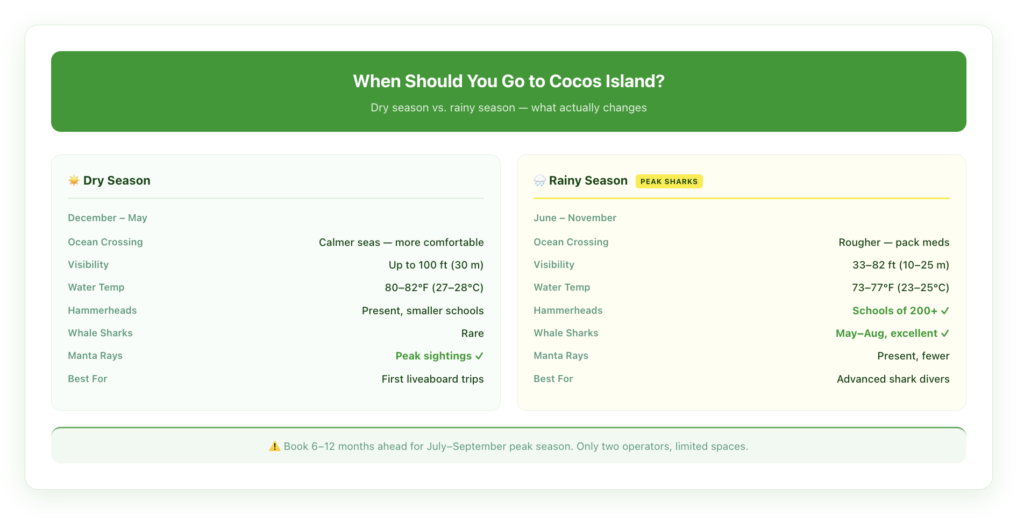
Calmer seas make the 36-hour crossing considerably more comfortable, and underwater visibility often exceeds 100 feet (30 meters). Water temperatures hover around 80–82°F (27–28°C). Manta ray sightings are more frequent. If this is your first liveaboard experience or you’re prone to seasickness, the dry season provides more forgiving ocean conditions for the journey.
Peak booking demand hits January through April, which aligns with Costa Rica’s overall peak travel season. Plan 6–12 months out.
What Changes During the Rainy Season (June–November)?
The crossing gets rougher, and the island receives 190–240 inches (4.8–6 meters) of annual rainfall, making everything dramatically lush and green. But this is when hammerhead sharks gather in their largest schools — peak activity typically runs from July through September. Whale sharks concentrate from May through August. Visibility drops to 33–82 feet (10–25 meters), but for divers chasing maximum shark encounters, that trade-off is worth it. Bring seasickness medication regardless.
What's on Land at Cocos Island?
Scuba diving dominates most itineraries, but the island’s terrestrial side rewards those willing to explore above the waterline. Two main landing areas — Chatham Bay and Wafer Bay — provide access to hiking trails, waterfalls, and historical sites. All land excursions require daily approval from park rangers.
What’s Waiting in Chatham Bay?
This was the primary anchorage during the Age of Exploration, and countless treasure legends trace back to its shores. The most famous — the Treasure of Lima — was supposedly buried here in 1821. Worth an estimated $1 billion today, it’s never been found. Treasure hunting is now illegal, so don’t arrive with a shovel.
The Bahia Trail connects Chatham Bay to Wafer Bay via nearly 2 miles (3 kilometers) of forest hiking. Along the route, you’ll find rocks carved with inscriptions from centuries of visitors, including Jacques Cousteau’s 1987 expedition.
What Can You See from Wafer Bay?
The main national park sector houses ranger stations and access to more demanding terrain. The hike to Cerro Iglesias summit covers approximately 6.8 miles (11 kilometers) round-trip through tropical rainforest and the island’s cloud forest zone. The Gissler Caves mark the excavation attempts of German treasure hunter August Gissler, who spent 17 years searching for the Treasure of Lima in the late 1800s.
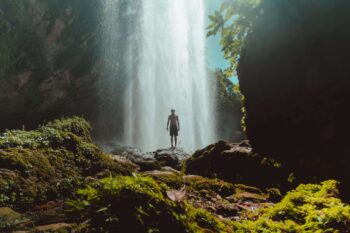
Catarata Wafer offers a swimming opportunity after a sweaty hike, with the cascade pool home to the endemic Cocos Blue-Banded Goby — a small fish with sucker-like fins designed for clinging to rocks in rushing water.
The island’s bird life draws dedicated birdwatchers specifically for the three endemic species: the Cocos cuckoo, Cocos finch, and Cocos Island warbler. Red-footed boobies, magnificent frigatebirds, and white terns nest on the cliffs. It’s the kind of terrestrial diversity that makes visiting Cocos worthwhile even on the days when the weather keeps divers on the boat.

What Does a Typical Cocos Expedition Look Like?
Understanding the logistics before you book helps set realistic expectations.
All expeditions depart from Puntarenas — about a 2-hour drive from San José along well-traveled coastal roads. Arrive in Costa Rica at least one day before your scheduled departure to account for flight delays. Most operators arrange group transfers from designated San José hotels. A rental car is useful if you’re adding mainland exploration before or after your expedition.
The 36-hour crossing covers open ocean with no land in sight for most of the journey. Boats typically depart in the afternoon, and breakfast is served at sea the following morning. Pack seasickness medication even if you don’t usually need it — open ocean swells are a different experience from coastal conditions. The return journey takes 30–33 hours depending on currents.
Once anchored at Cocos, expect three to four dives daily. Morning dives typically target cleaning stations where hammerheads gather. Afternoon dives explore different sites. Night dives reveal the island’s nocturnal marine life. Certain activities, including snorkeling and some night dives, have ranger-imposed restrictions that change based on conditions and conservation priorities.
Is Cocos Island Worth the Investment?
For the right traveler, absolutely. Cocos delivers underwater experiences that don’t exist anywhere else at this concentration and with this level of ecosystem health. The hammerhead schools at Bajo Alcyone are on a different level from anything reachable by day trip.
Cocos Island makes sense if you’re an advanced diver with 50+ logged dives seeking bucket-list shark encounters, an underwater photographer wanting truly iconic images, or a marine conservation enthusiast drawn to one of the healthiest marine ecosystems on the planet. It’s worth reconsidering if you’re a beginner or intermediate diver, if seasickness significantly affects your ability to function, or if your budget doesn’t stretch to $7,000+ per person.
Costa Rica has excellent shark and marine life encounters at far more accessible locations. The Catalina Islands and Bat Islands in Guanacaste offer great diving, while Caño Island near the Osa Peninsula delivers the closest mainland equivalent to Cocos Island diving. Tortuguero National Park on the Caribbean coast provides another boat-access-only adventure with exceptional wildlife viewing at a fraction of the cost and commitment.
How Did Cocos Island Get Protected?
Costa Rica designated Cocos Island a national park in 1978. UNESCO World Heritage Site recognition followed in 1997, acknowledging both the marine and terrestrial ecosystems’ global significance. In 2021, Costa Rica dramatically expanded protections by creating the Bicentennial Marine Managed Area, enlarging the original park boundaries by 27 times — the combined protected zone now covers over 61,500 square miles (159,290 square kilometers) of ocean.
Park rangers maintain a permanent presence on the island to combat illegal fishing that has historically threatened shark populations. Conservation organizations like the Turtle Island Restoration Network and Friends of Cocos Island support this work. For divers who make the journey, responsible behavior and conservation donations help maintain the conditions that make Cocos worth visiting in the first place.
The island’s historical significance extends well before its protected status. French explorer cartography from 1541 marks the first official maps of Cocos. Costa Rica claimed sovereignty in 1869. Pirates and buccaneers used the island as a freshwater resupply stop for centuries — Cocos has more freshwater springs than almost any other island of its size in the Pacific — and it was widely believed to hold buried treasure from at least three major historical hoards, including the Treasure of Lima. None have been officially recovered.
One final pop culture note worth addressing: despite what you may have heard, Jurassic Park was not filmed at Cocos Island. Director Steven Spielberg based Isla Nublar’s visual appearance on Cocos Island and showed it in the opening sequence of the original film, but no production crews ever set foot on the actual island.
How Do You Make the Most of Your Costa Rica Trip Around a Cocos Expedition?
Cocos expeditions consume most of your time — 8 to 11 days total — but a few days before or after are worth planning thoughtfully. Most departures from Puntarenas align naturally with a night or two in San José, which gives you time to adjust to the time zone and prepare gear before the crossing.
If you’re building a two-week Costa Rica itinerary around a Cocos trip, consider adding a few days in Arenal and La Fortuna for hot springs and volcano hiking, or Manuel Antonio National Park for a lower-intensity beach and wildlife finish. Both are accessible with a standard rental car on paved roads — no need for expedition logistics. Travelers flying out of Liberia Airport instead of San José should coordinate carefully with their liveaboard operator, since most pickups are San José-based.
For those not ready for Cocos but wanting a similarly immersive marine experience, the Pacific coast activities available through the Southern Zone — particularly around Drake Bay — are the best mainland preparation you can get.
Frequently Asked Questions
Can anyone visit Cocos Island, Costa Rica?
Cocos Island is technically open to the public, but practically accessible to almost no one outside of licensed liveaboard diving expeditions. The 36-hour boat journey, $5,000+ expedition cost, and requirement for Advanced Open Water certification with 50+ logged dives make casual tourism impossible. Non-divers can occasionally join research-focused nature expeditions, but these trips are rare, unscheduled, and require months of advance arrangement through certified guides or conservation organizations.
How long does the boat ride to Cocos Island take?
The crossing from Puntarenas takes approximately 36 hours each way across 340 miles (550 kilometers) of the open Pacific Ocean. No faster option exists — no flights serve the island, and helicopters lack the range. Return journeys typically take 30–33 hours depending on currents and conditions. Total trip length, including transit, ranges from 8 to 11 days.
Was Cocos Island in Jurassic Park?
Cocos Island inspired the look of Isla Nublar in the original 1993 Jurassic Park film, but no filming took place on the island itself. Director Steven Spielberg used Cocos Island’s appearance in the opening sequence’s aerial footage, but actual production used locations in Hawaii and sound stages. The island is uninhabited except for park rangers and has no infrastructure that could support a film crew.
What sharks live around Cocos Island?
Twelve shark species inhabit Cocos Island waters. Scalloped hammerhead sharks are the main draw, appearing in schools of 100–200 at cleaning stations between July and September (peak). Whitetip reef sharks rest in large groups on the seafloor year-round. Tiger sharks appear most frequently from December to May. Other species include Galápagos sharks, silky sharks, silvertip sharks, blacktip sharks, and whale sharks — best seen May–August when plankton blooms draw them to the surface.
Why does Cocos Island have such strict visit policies?
The strict visitation protocols protect an ecosystem that took centuries of isolation to develop. Limiting visitors to licensed liveaboard expeditions prevents uncontrolled access, reduces anchor damage to coral, and ensures all human activity on the island is supervised by certified guides and park rangers. Treasure hunting — historically a major driver of illegal visits — has been prohibited since the park’s establishment in 1978. The Bicentennial Marine Managed Area expansion in 2021 further strengthened these protections.
Is Cocos Island the same as the Cocos (Keeling) Islands?
No — they’re completely different places. Cocos Island National Park belongs to Costa Rica in the Eastern Pacific Ocean. The Cocos (Keeling) Islands are an Australian territory in the Indian Ocean, more than 8,500 miles (14,000 kilometers) away, with a small resident population. The shared name is coincidental.
What is the best time of year to see hammerhead sharks at Cocos Island?
Peak hammerhead activity runs from June through November, with July through September typically delivering the largest schools. During this period, nutrient-rich currents concentrate hammerheads at cleaning stations where divers observe them at close range. Hammerheads are present year-round, but dry season schools tend to be smaller. Booking 6–12 months ahead is essential for peak season trips.