
Last Updated on July 24, 2026
Playa Grande, Costa Rica: Quick Guide
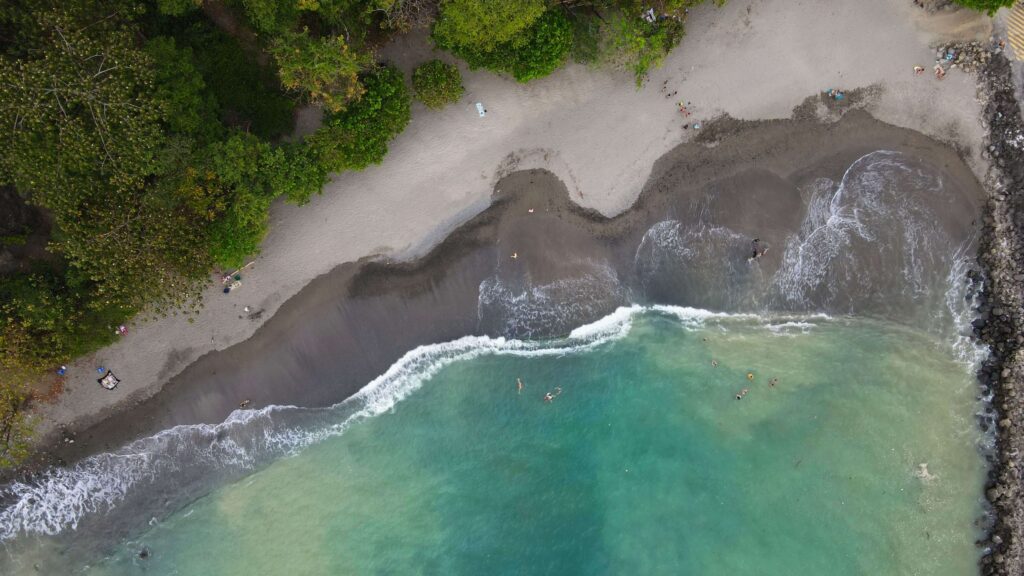
Playa Grande is a wide Pacific surf beach inside Marino Las Baulas National Marine Park in Guanacaste, 40 miles (64 km) from Liberia Airport on fully paved roads — no 4×4 needed. It’s one of the Pacific coast’s most significant leatherback sea turtle nesting sites and a top Guanacaste surf destination year-round. A rental car is the only practical way to get around.
Quick Facts:
- 40 miles (64 km) from Liberia Airport; ~30 min from Tamarindo
- Beach closes at 5:00 PM during nesting season (Oct–Feb); 6:00 PM year-round
- Turtle tours require a guide; ~$25/person, groups capped at 15
- Best surf 2 hrs before high tide; dry season for sun, green season for bigger swells
Top 3 Experiences:
- Leatherback Turtle Nesting (Oct–Feb) — Guided night tours through the Las Baulas ranger station
- Consistent Surf Breaks — Multiple breaks for all levels; Casitas Point is ideal for longboarders
- Uncrowded Beach — National park protection keeps development and crowds minimal
Pairs well with Rincón de la Vieja inland or a 20-min drive to Playa Conchal for calmer water.
If you need any help with a Costa Rica car rental, contact us now!
Playa Grande is Guanacaste’s best-kept open secret, which is a long, wide Pacific beach inside Marino Las Baulas National Marine Park that draws serious surfers, leatherback turtle watchers, and anyone who wants a proper beach without the crowds. It sits about 40 miles (64 km) from Liberia Airport (LIR), the road is fully paved, and no 4×4 is needed to get there.
Tamarindo is 30 minutes away, which is close enough for dinner, but far enough to feel like a different world. What you’ll find is a beach that earns its name as “grande” means big, and when a swell hits, this place delivers.
Key Takeaways
- Playa Grande sits inside Marino Las Baulas National Marine Park, which is one of the world’s most significant leatherback sea turtle nesting sites on the Pacific coast of the Americas.
- The beach is separated from Tamarindo by a protected estuary, keeping it quieter and less developed by design.
- Surf ranges from beginner-friendly longboard breaks to powerful reef breaks; best conditions hit 2 hours before high tide.
- Swimming is possible, but rip currents are real, and this beach is better suited to surfing than casual swimming.
- Turtle nesting season runs from October through February; certified guides are required for night tours, and groups are capped at 15 people.
- A car is essential because no public buses serve Playa Grande directly, and the area is very spread out.
- The beach closes at 5:00 PM during nesting season (October–February), and rangers enforce this without exception.
What Makes Playa Grande Different from Other Guanacaste Beaches?
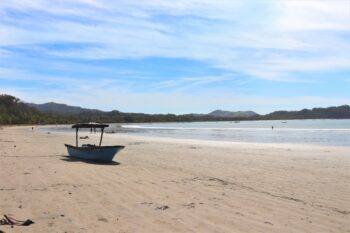
Most Guanacaste beach towns land somewhere between “fully developed tourist infrastructure” and “completely off-grid.” Playa Grande occupies its own category. It’s not undiscovered, but it’s protected in a way that prevents the development you see in Tamarindo or Flamingo. Because the beach falls within national park boundaries, it stays wide, undeveloped, and free of vendors and beach chairs. That’s a deliberate tradeoff, and most people who choose Grande do so precisely because of it.
The estuary separating Grande from Tamarindo isn’t just a geographic quirk. It forms part of a Ramsar-designated wetland of global conservation importance, and also makes the drive between the two beaches roughly 30 minutes, even though they’re only a short boat ride apart. Surfers staying in Tamarindo often pay $1–3 USD one way to take a local boat across — and access the Grande breaks directly.
The surrounding dry forest ecosystem adds another layer. Guanacaste’s distinct climate pattern means the hills behind the beach turn golden brown in the dry season and surge back to green in May. That seasonal transformation gives the beach a noticeably different look depending on when you visit and is something you won’t find at most Costa Rica beach destinations.
If you’re planning a budget-conscious trip, this combination of free national park beach access and lower accommodation prices compared to Tamarindo makes Grande especially worth considering. Check our budget travel guide for Costa Rica for more context on how to keep costs reasonable in Guanacaste.
How Do You Get to Playa Grande?
From Liberia Airport (LIR), it’s approximately 40 miles (64 km), which is about 1 hour and 30 minutes on fully paved roads. Enter “Hotel Las Tortugas” or “Parque Nacional Marino Las Baulas” in Waze or Google Maps, and you’ll see signs the whole way. For anyone comparing Liberia vs San José airports, Liberia is the obvious choice for this part of Guanacaste because SJO adds roughly 3+ additional driving hours.
If you’re planning your routes from Liberia Airport and want to stop for supplies before heading to the coast, grab groceries at the Walmart or Peri Mart in Plaza Santa Rosa, which is about 10 minutes from the terminal before you turn south toward the beach.
Parking at the main park entrance costs around 2,500 CRC. The lot fills on high-season weekends. Lock the car, roll up the windows, and don’t leave valuables visible because there are only informal parking attendants watching over vehicles.
The Tamarindo boat option: Many surfers skip the 30-minute drive entirely by taking the estuary boat from the north end of Tamarindo beach. Local operators charge $1–3 USD one way and drop you near the Casitas break. It’s quick and the obvious move if you’re already based in Tamarindo. Do not attempt to wade or swim across because the estuary is home to crocodiles.
Is It Safe to Swim at Playa Grande?
The honest answer: with caution. Playa Grande has rip currents, and the waves are built for surfboards, not casual swimmers. When the surf is up, these waves are fast, powerful, and can knock people off their feet. There is no lifeguard on duty at any point.
Families with small children should consider other options. Playa Conchal and Playa Ocotal near Playas del Coco offer much calmer water. Snorkeling isn’t viable at Grande either because surf visibility is limited, and conditions don’t allow it.
If you want snorkeling, the Catalinas Islands off the Guanacaste coast are a significantly better option.
For context on beach safety, Costa Rica’s Instituto Costarricense de Turismo advises watching for rip current indicators before entering any Pacific surf beach: discolored water channels, foam lines moving seaward, or waves breaking only on either side of a gap. If you see those signs, stay out or stay in the shallow white water.
Why Do Surfers Love Playa Grande?
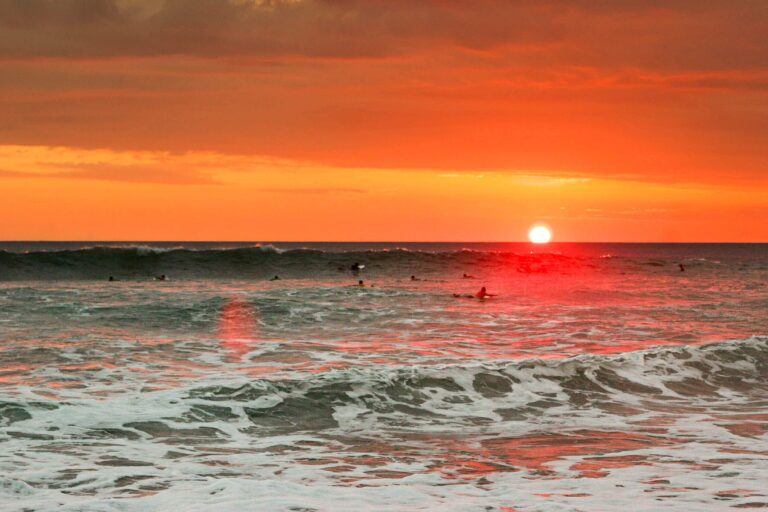
The name says everything. When a swell rolls in, Grande goes big. Multiple breaks scatter along the beach’s full length, producing both left and right-hand tubes that keep experienced surfers returning year after year. Costa Rica’s surf season runs year-round, but green season from May through November tends to bring bigger, more consistent swells, which is why you’ll see more committed surfers during months that casual tourists skip.
Best conditions hit roughly 2 hours before high tide, but during the green season, low tide can expose rocks, limiting activities to experienced surfers only. The north end near the main parking lot works well for intermediates. The Casitas point at the south end is the longboarder’s favorite. For tide charts, Surf Forecast tracks Playa Grande conditions with useful wave height and period data.
To reach Casitas, drive to Palm Beach Estates (search “Playa Grande parking for walk to south beach access at river” in Google Maps) or take the estuary boat from Tamarindo. Surf lessons are available locally at around $60 USD per person for a group session.
If you’re debating where to base yourself, Tamarindo puts Avellanas, the Tamarindo main break, and Grande all within 30 minutes. With a car, you can work the tide chart daily and chase optimal conditions across multiple breaks. Vamos has rental options at Liberia Airport with free shuttle service, transparent pricing, and no hidden fees.
What Is Playa Grande Known for Besides Surfing?
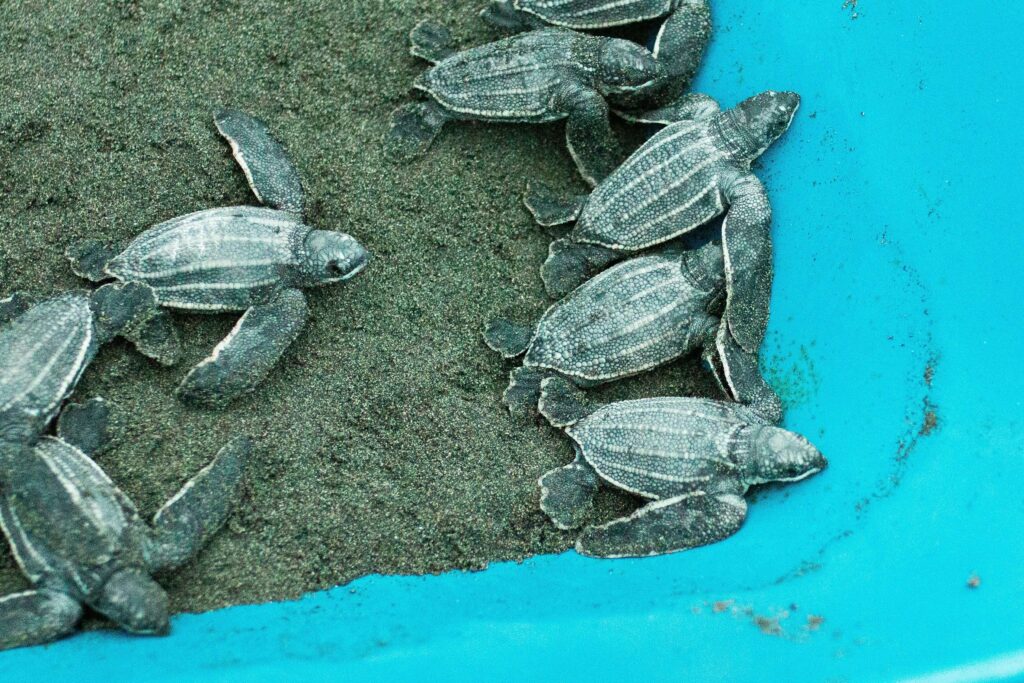
The other reason people make the trip is the leatherback sea turtles. Marino Las Baulas was created specifically to protect these animals, which are listed as critically endangered by the IUCN and rank among the largest reptiles on Earth. Leatherbacks weigh up to 1,500 lbs (680 kg) and can measure up to 6 feet (1.8 m) in length. Playa Grande hosts one of the most significant nesting colonies on the Pacific coast of the Americas.
Nesting season runs from October through February, with peak activity in December and January. Witnessing a nesting event requires a certified local guide: tours are organized at the Las Baulas ranger station, limited to groups of 15, and cost around $25 per person, including the guide and park entrance. SINAC manages park access and protocols: no photography, no white light, red-filtered flashlights only, and no touching.
Worth knowing upfront: nesting numbers have declined significantly over the decades. Conservation organizations monitoring the population document fewer nesting events per season compared to historical highs. Tours still run, and turtles do nest, but it’s not a guaranteed sighting, so arrive with realistic expectations.
Outside turtle season, the estuary is worth exploring. Boat tours through the Tamarindo estuary mangroves give you crocodile sightings, wading birds, and monkeys at close range for around $40 USD per person from Tamarindo operators.
What Are the Best Day Trips from Playa Grande?
Playa Grande works well as a home base for exploring northern Guanacaste. Here’s what’s worth the drive from here:
Playa Ventanas and Playa Carbon are both accessible by walking north along the beach or a short drive. Carbon has tide pools and some light snorkeling at low tide.
Playa Conchal is about 20 minutes south. Park in Brasilito and walk 15 minutes along the beach. This shell-sand beach consistently ranks among Costa Rica’s most beautiful, with turquoise water that earns every photo.
Flamingo Beach is about 35 minutes north. With calm white-sand swimming, a marina with fishing charters, and upscale restaurants, it’sgood for a change of pace.
Rincón de la Vieja National Park is about 1.5 hours inland. This is Guanacaste’s volcano experience with bubbling mud pots, a turquoise waterfall, and excellent dry forest hiking. No 4×4 required for the Las Pailas sector. Entry is $16.95 and requires an advance SINAC booking.
Rincon Thermals & Adventures is the all-day adventure combo near Rincón de la Vieja: hot springs, ziplining, a 1,300-foot waterslide, mud baths, and cultural experiences. It’s about 45 minutes from Liberia and an Explorer Pass runs around $95/adult.
Tamarindo is 30 minutes by road. Offering restaurants, nightlife, ATMs, surf shops, and Thursday markets, it’s an easy dinner-and-back option.
Playas del Coco is about 1 hour north. Coco is the hub for Guanacaste diving and the departure point for Catalinas Islands scuba trips. It’s a great option if you want to combine underwater exploration with surfing!
When Is the Best Time to Visit Playa Grande?
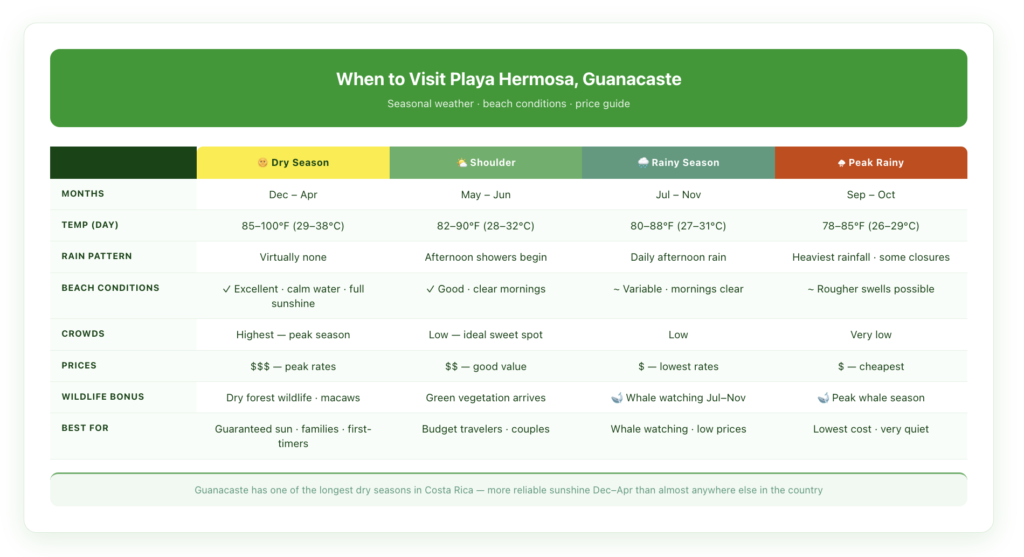
Dry season (December through April) delivers reliable beach weather with sunny mornings, temperatures around 85–95°F (29–35°C), and a low chance of afternoon rain. December through February also overlaps with turtle nesting season, making it the most interesting time to visit if catching a nesting event matters to you.
The green season (May through November) brings afternoon rain and bigger surf swells, so experienced surfers often prefer this window. Accommodation prices drop noticeably, crowds thin, and mornings before 1 PM are typically clear and usable. November is worth considering for anyone flexible on timing, as early nesting season starts, there are lush landscapes, and pricing is pre-peak.
The beach closes at 5:00 PM during turtle nesting season (October through February). Year-round, the park gates shut at 6:00 PM, so there are no evening beach walks or bonfires. Rangers enforce closure, and it’s central to the turtle protection mission.
Where Should You Stay in Playa Grande?
Playa Grande has modest but functional accommodation. The area is spread out, and the distance between your room and the nearest restaurant can mean a 20–30 minute walk in Guanacaste heat. A car isn’t optional here; it’s essential.
Properties worth knowing:
- RipJack Inn is a surf-focused hotel with an on-site restaurant, consistently well-reviewed.
- Hotel Las Tortugas is the most established property near the main park entrance and historically tied to turtle conservation work in the area.
- Playa Grande Surf Camp is simple, functional, and convenient to the breaks.
For families and groups, vacation rentals in the Palm Beach Estates and Las Ventanas de Playa Grande neighborhoods are often a better fit with more space, kitchen access, and proximity to the Casitas break. Check Airbnb or VRBO.
For a small supermarket, The Store is on the road into Grande. For a full grocery run, head to Tamarindo or Huacas (Super Compro or Pali). If you want to stock up properly, the Walmart and Peri Mart near Liberia city are the most complete options to grab everything you need before turning toward the coast.
Is Playa Grande Walkable?
If you’re near the main entrance, you can walk from your hotel to the beach. As a town, you can navigate r restaurants, groceries, and daily needs on foot, but Playa Grande doesn’t have a walkable town core. Businesses are spread along a long road with real distances between them in the open Guanacaste heat with no shade.
For anyone staying more than a single day, a rental car changes the experience completely. You can chase surf conditions across multiple breaks, day-trip to Conchal or Nosara, and reach Tamarindo in 30 minutes for dinner.
If you’re visiting Guanacaste for the first time, Playa Grande plus a rental car makes for an excellent low-key base that still gives you quick access to the entire northern Guanacaste circuit.
How Does Playa Grande Fit Into a Guanacaste Itinerary?
Playa Grande works best as 2–4 nights within a larger Guanacaste trip rather than your only base. The limited restaurants and services get old quickly for most travelers. But as part of a one-week Guanacaste itinerary that mixes beach time with a volcano day trip, it’s ideal as it’s quiet enough to reset but conveniently close to everything. If you’re renting from Vamos, checking our Costa Rica car rental vehicle guide can help you decide whether a standard car or 4×4 makes more sense for your full itinerary.
A natural pairing: 2 nights in Playa Grande for surf and turtles (if in season), then 2 nights in Tamarindo for restaurants and nightlife, then a day trip to Rincón de la Vieja before heading back toward the airport. That loop covers the core Guanacaste circuit without overextending. If you’re planning a two-week Costa Rica trip, building from Liberia south through the Guanacaste coast and eventually toward Manuel Antonio or Arenal gives you excellent variety.
Grande also pairs well with Nosara for surfers doing a north-to-south coastal run. Nosara is 3+ hours south of Grande, but both sit within Guanacaste’s dry climate zone and share the same seasonal patterns.
The Guanacaste Tourism Board has good regional maps if you’re planning independently.
For practical trip logistics, the Tico Times is a useful English-language reference for current beach conditions and regional updates.
Frequently Asked Questions
What is Playa Grande known for in Costa Rica?
Playa Grande is known for two things: consistent surf breaks that work for beginners through advanced surfers, and leatherback sea turtle nesting inside Marino Las Baulas National Marine Park. It’s one of the largest leatherback nesting sites on the Pacific coast of the Americas, which is why the park was created.
How crowded does Playa Grande get?
It’s much less crowded than Tamarindo, which is partly by design, since national park status prevents large-scale beach development. High-season weekends in December through April bring day-trippers from Tamarindo, but the beach is long enough that it rarely feels packed. Weekday mornings in the green season can feel almost empty.
Is there a town in Playa Grande?
There’s a small community, not a proper town center. The area has a handful of restaurants, a small supermarket, a surf shop, and a medical clinic. For anything beyond basic needs, drive to Tamarindo (30 min) or Huacas. The limited development is part of the appeal.
How far is Playa Grande from the airport?
About 40 miles (64 km) from Liberia Airport (LIR) and roughly 1 hour 30 minutes on fully paved roads. No 4×4 required. From San José (SJO), add 3+ more hours.
Are there turtles at Playa Grande year-round?
Leatherback turtle nesting happens October through February, with December and January being peak months. Off-season nestings have occasionally been recorded but aren’t predictable. For a planned viewing experience, book during peak season through the Las Baulas ranger station.
What should I know about visiting during turtle season?
The beach closes at 5:00 PM from October through February. All turtle viewing requires a certified guide, and independent beach access at night is not allowed. Groups are capped at 15 people and there’sno photography, no white light, and no touching the turtles. Reserve in advance as demand exceeds availability on peak nights.
Can I reach Playa Grande by boat from Tamarindo?
Yes. Local operators run small boats across the estuary for $1–3 USD one way, dropping you near the Casitas surf break. Popular with surfers who prefer not to drive the 30-minute road loop. Do not wade or swim across because the estuary has crocodiles.