
Last Updated on March 18, 2026
Manuel Antonio National Park: What's Covered
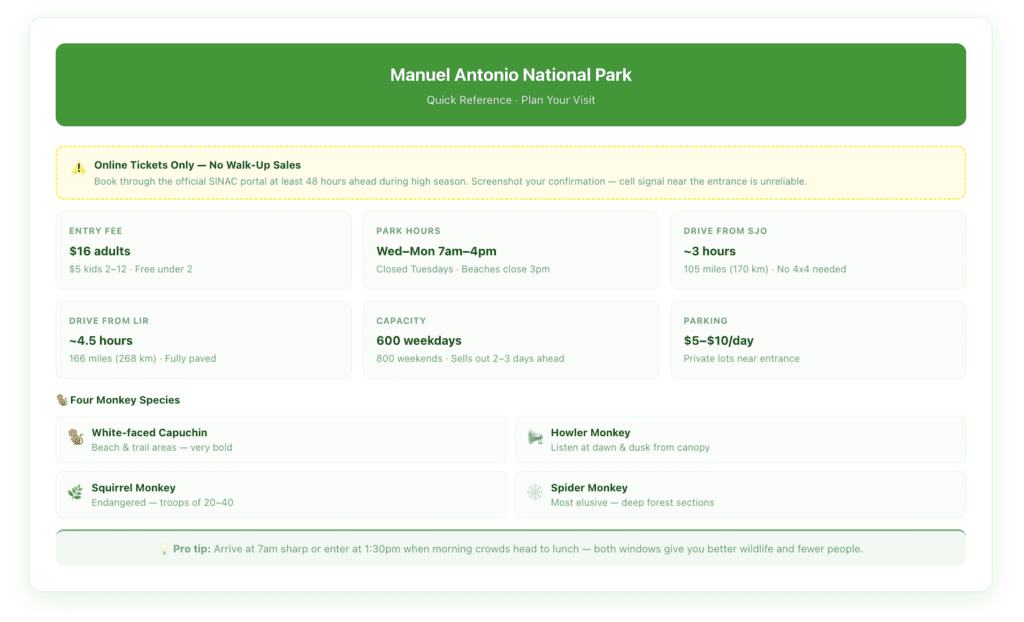
Manuel Antonio National Park sits on Costa Rica’s Central Pacific coast, 3 hours (105 miles) from San José Airport (SJO) on fully paved roads — no 4×4 needed. Entry is $16 adults, online-only through SINAC, and tickets sell out 2–3 days ahead during the dry season. All four monkey species live here alongside reliable sloth sightings and four beaches. Your rental car gives you the flexibility to arrive at 7 am and beat the tour buses.
Quick Facts:
- Entry: $16 adults, $5 kids 2–12, free under 2 — purchase online at SINAC only, no walk-up sales
- Hours: Wed–Mon 7 am–4 pm (closed Tuesdays); beaches close 3 pm
- Capacity: 600 weekday visitors, 800 weekends — sells out aheadof time during peak season
- Guides: $25–40/person for a 2-hour group tour; boosts sightings from ~25% to ~75%
- Vehicle: Standard sedan handles this route year-round from SJO
Top Park Experiences:
- Punta Catedral Trail — 0.86-mile (1.4 km) coastal loop with panoramic Pacific views; best before 10 am before tour groups arrive
- Sloth Spotting on Sendero Perezoso — A universally accessible trail through peak sloth habitat; focus on cecropia trees, rent binoculars ($10) at the entrance
- Playa Espadilla Sur — Longer, less crowded beach with wave action; better than the main beach for space during peak season
- Whale Watching — July–November and December–April from Punta Catedral viewpoints during humpback migration seasons
Pair Manuel Antonio with Carara National Park (1 hour north, scarlet macaws) and the Tárcoles Bridge crocodile viewing on Route 34 for a full Central Pacific road trip.
If you need any help with a Costa Rica car rental, contact us now!
Manuel Antonio National Park packs more wildlife encounters per square kilometer than almost anywhere else in Costa Rica — four monkey species, reliable sloth sightings, and postcard beaches, all accessible on a fully paved road with a standard rental car. At just 3 hours from San José’s SJO airport, it’s Costa Rica’s most accessible national park. But there’s a short list of things most guides skip — ticket rules that will turn you away, timing windows that double your wildlife sightings, and trail choices that’ll define your whole visit.
Key Takeaways
- Online tickets are the only option — no walk-up sales, no exceptions; high season tickets sell out 2–3 days ahead.
- Arriving at 7 am or re-entering at 1:30 pm gives you dramatically better wildlife sightings and smaller crowds.
- A certified guide boosts your spotting odds from roughly 25% to 75% — worth it for a first-timer.
- The Punta Catedral Trail beats the main beach for most visitors: better views, better wildlife, far fewer people before 10 am.
- Standard sedans handle this route year-round; no 4×4 needed.
- September and October bring the heaviest rains — manageable if you go in with the right expectations.
What Makes Manuel Antonio Worth the Trip?
Why Does This Small Park Have Such a Big Reputation?
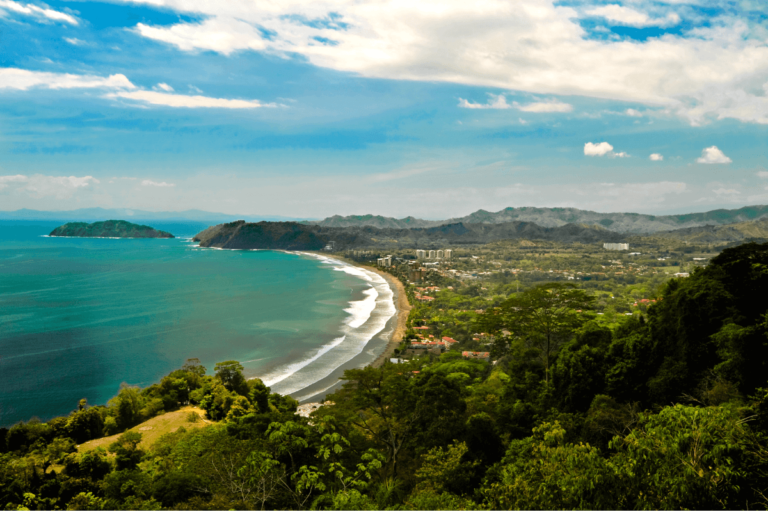
Costa Rica’s smallest national park at 1,983 acres (803 hectares) somehow manages to deliver what visitors to much larger parks often don’t get: guaranteed wildlife. The reason comes down to location. Manuel Antonio sits where the Central Pacific coast meets a protected peninsula, creating a concentrated strip of biodiversity sandwiched between pristine beaches and dense primary rainforest. Animals have nowhere else to go — and that works in your favor.
The park protects four pristine beaches and a network of trails where you’ll genuinely encounter animals within the first 30 minutes, not at the two-hour mark after a sweaty hike. That combination — beach and wildlife in one compact package accessible from San José in under 3 hours — is why Manuel Antonio draws more visitors than any other park in Costa Rica.
How Does the Park Handle That Volume of Visitors?
By 2016, uncapped visitor numbers were actively damaging the ecosystem that tourists came to see. The park responded with daily capacity limits — 600 on weekdays, 800 on weekends — and mandatory online-only ticketing. Monday closures give the park a full day for trail maintenance and wildlife recovery.
It sounds restrictive, but it works. The Costa Rica Tourism Board (ICT) considers this model a benchmark for sustainable ecotourism, and the wildlife counts have actually improved since the limits were introduced. What it means for you practically: buy tickets through the official SINAC portal at least 48 hours ahead during December through April, screenshot your confirmation because the cell signal near the entrance is unreliable, and show up during your designated time slot.
Do You Actually Need a Guide?
What’s the Difference in Wildlife Sightings?
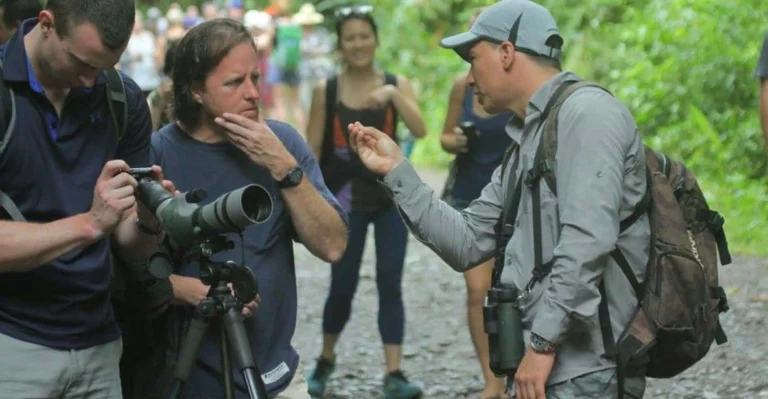
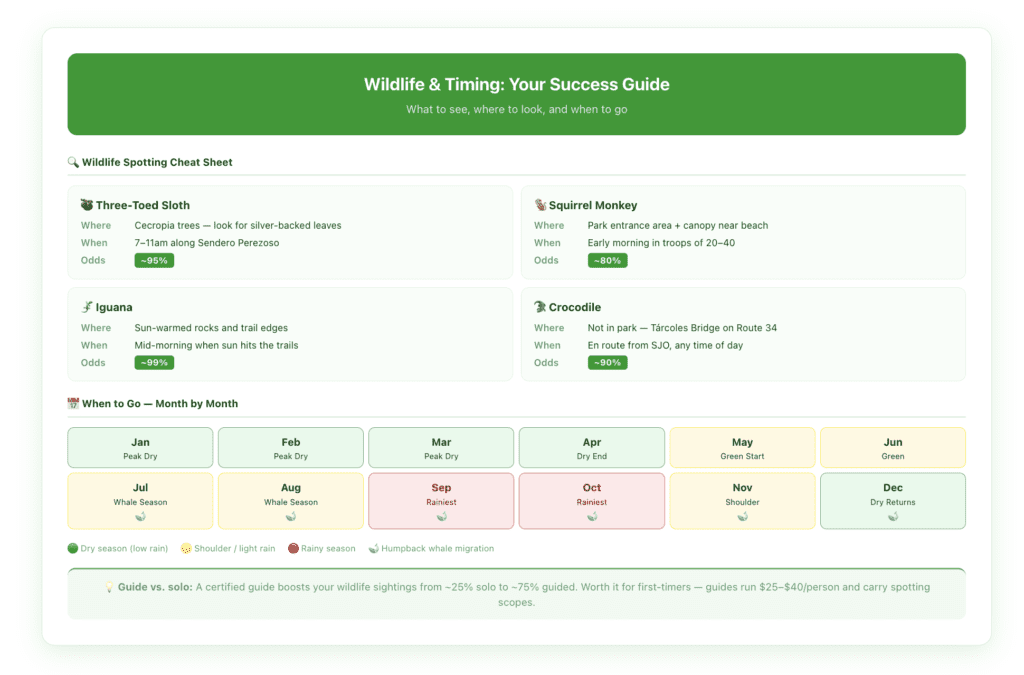
Solo visitors typically spot about 20–30% of the wildlife actually present. A certified guide with a spotting scope pushes that to 70–75%. The math is that simple. Guides know the exact cecropia trees where sloths are feeding that week, the rocky ledges where eyelash vipers sleep in plain sight, and the trail sections where spider monkeys pass through at predictable times.
If your priority is beaches and hiking over wildlife, skip the guide and explore at your own pace. But for first-timers or anyone traveling with kids, a 2-hour guided walk transforms the experience from “nice tropical forest” to something closer to a wildlife documentary. Official ICT-certified guides charge $25–40 per person for group tours; private tours run $80–120. They’re stationed right at the park entrance — look for the official badge and a spotting scope.
Can You Just Walk In?
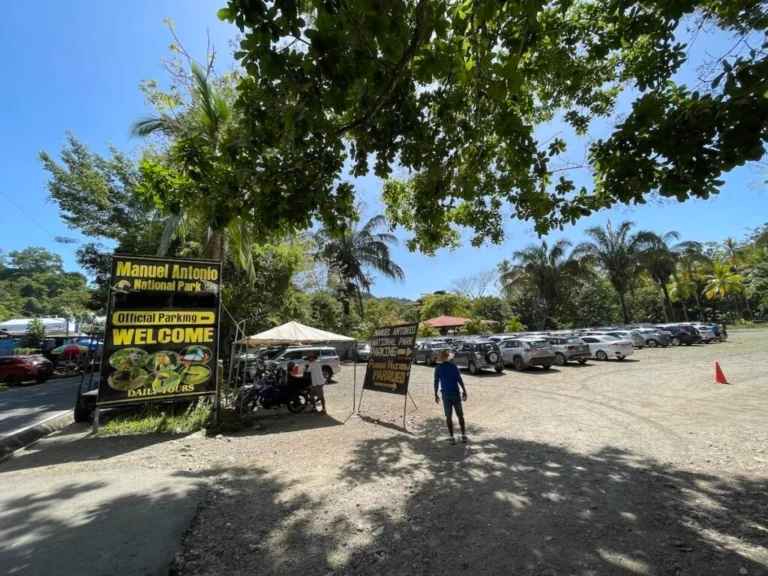
No — and this trips up a surprising number of visitors every week. The park switched to mandatory online-only advance ticket sales through SINAC with zero exceptions. No cash at the entrance, no “maybe they’ll fit me in,” no workarounds. Bring your passport or a clear photo of the ID page along with your confirmation barcode. The park assigns entry time slots, and showing up late can mean being turned away, even with a valid ticket.
What Are the Best Trails in Manuel Antonio?
Which Trail Is Worth Your First Hour?
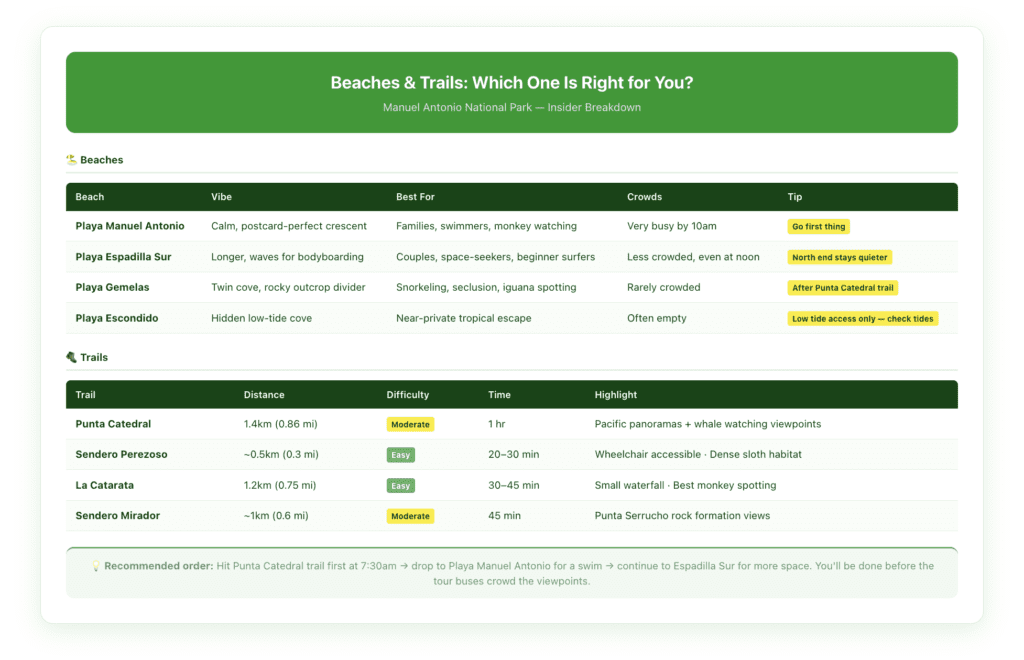
Start with the Punta Catedral Trail before anything else. This 0.86-mile (1.4 km) coastal loop was once a separate island before sediment connected it to the mainland — you’re essentially circling a forested peninsula with the Pacific Ocean on both sides. The viewpoint halfway through delivers panoramic views across turquoise water all the way to the Nicoya Peninsula on a clear morning, with howler monkeys announcing themselves from the canopy overhead.
Start by 7:30 am, and you’ll have the viewpoints to yourself. Tour groups hit this section after 10 am, creating bottlenecks at the photo spots. The trail takes 45–90 minutes, depending on how long you spend watching wildlife, and you’ll spend time watching wildlife. Three-toed sloths regularly hang in the cecropia trees along this section, similar to what you’d encounter in Monteverde’s cloud forest, but in a coastal setting that feels completely different.
What Other Trails Are Worth Your Time?
The Sendero Perezoso (Universal Trail) is the park’s accessible flat boardwalk, and don’t let the easy gradient fool you — it winds through some of the densest sloth habitat in the park. The Sloth Institute estimates Manuel Antonio holds about 1 sloth per hectare, and this trail passes right through the highest-density zones. It connects to the beach, which makes it a natural morning route even if you’re not using the accessible features.
La Catarata trail is a 0.75-mile (1.2 km) round-trip to a small waterfall through primary forest, with the best consistent monkey sightings of any trail in the park. Sendero Mirador climbs to a viewpoint overlooking Punta Serrucho’s saw-shaped rock formation — worth the extra effort if you want photos beyond the standard beach shots.
Which Beach Should You Head To?
What’s the Difference Between the Park’s Beaches?
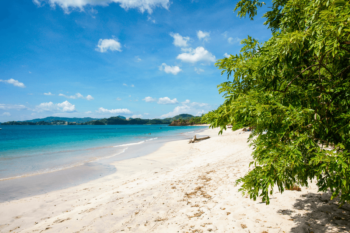
Playa Manuel Antonio — the main beach — forms a perfect crescent of white sand with calm, turquoise water protected by the surrounding headlands. It’s beautiful, and it fills up. By 10 am on a peak-season weekend, you’re looking at a beach that’s fully packed. Come here first thing, and it feels like paradise; arrive late morning, and it feels like a popular resort beach.
Playa Espadilla Sur stretches longer and catches more wave action, making it better for bodyboarding and anyone who wants actual space. The northern end stays quieter even on busy days. Couples and solo travelers consistently prefer this one once they discover it. Families with young kids tend to prefer the calm, protected waters of Playa Manuel Antonio.
Playa Gemelas is the twin cove separated by a rocky outcrop past Punta Catedral — good snorkeling and far fewer people. Playa Escondido requires timing your visit to low tide, but the reward is a cove that often feels entirely private. Check the Weather Underground tide charts the night before — most hotel reception desks also post daily tide schedules.
What Wildlife Will You Actually See?
How Many Monkey Species Are in the Park?
Four species live here, and you’ll realistically encounter at least three on a typical visit. White-faced capuchins dominate the beaches and trails — they’re bold, organized, and have genuinely learned to unzip backpacks. Use the free lockers at the park entrance. Howler monkeys provide the soundtrack from well before sunrise through sunset, their calls carrying for miles; you’ll hear them before you spot their dark shapes moving through the canopy in groups of 5–10.
Squirrel monkeys are the stars. Manuel Antonio protects one of Costa Rica’s last stable populations of this endangered species, and you’ll often see troops of 20–40 bouncing through the canopy with the kind of energy that makes you want to keep watching. Spider monkeys — the fourth species — prove most elusive, sticking to remote forest sections and relying on their prehensile tails to move through the high canopy. Spotting one is luck as much as skill, even with a guide.
Where Do You Find Sloths?
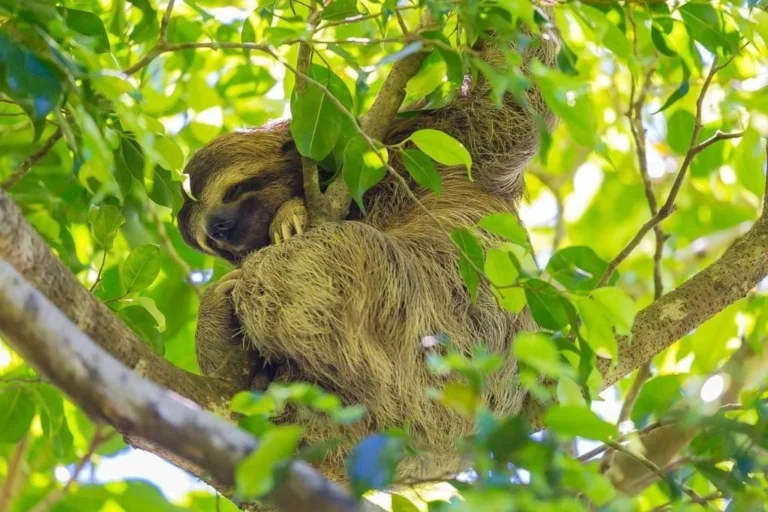
Stop scanning every tree and focus specifically on cecropia trees — the ones with distinctive silver-backed leaves and open, spreading branches. Sloths favor these trees because the leaves are easy to digest and the open structure lets them move without burning much energy. The Sloth Conservation Foundation notes that three-toed sloths are significantly easier to spot than two-toed ones because they’re active during daylight hours rather than primarily nocturnal.
Both species live in Manuel Antonio, but three-toed sloths are what most visitors encounter. They move an average of just 40 meters per day, so the sloth a guide spots at 8 am will almost certainly be in the same tree at noon. Rent binoculars at the entrance ($10) — sloths rarely descend below the canopy, and naked-eye spotting from trail level without optics is genuinely difficult. The Sendero Perezoso and Punta Catedral trails have consistent cecropia clusters where guides spot sloths multiple times per week.
When Is Whale Watching Season?
July through November brings southern hemisphere humpback whales migrating from Antarctica through Costa Rica’s warm Pacific waters. December through April sees a second wave of northern hemisphere humpbacks. From the elevated viewpoints on the Punta Catedral Trail, you can sometimes spot spouts, breaches, and tail slaps with binoculars — particularly from August through October at peak migration. The Costa Rica Cetacean Association operates boat tours out of nearby Quepos if you want to get closer than the park’s viewpoints allow.
This whale calendar also ties into the broader Central Pacific wildlife season — the overlap between green season wildlife activity and whale migrations makes July through October a genuinely excellent time to visit, despite the rain.
When Is the Best Time to Go?
Why Does Arrival Time Matter More Than the Date?
The park opens at 7 am, and those first two hours deliver genuinely different conditions than midday. Wildlife activity peaks before the heat builds, tour buses from San José haven’t arrived, and trail sections that feel crowded at 10 am feel quiet at 7:30 am. Temperature at opening is typically 75°F (24°C) with a sea breeze; by noon, you’re looking at 88–92°F (31–33°C) with full humidity.
There’s a second window that most visitors miss: entering at 1:30 pm when the morning crowd heads to lunch. You’ll miss peak wildlife activity, but beaches empty out dramatically, and you can actually swim without navigating around tour groups. The Costa Rica dry season guide covers this in more detail, but the timing logic applies year-round at Manuel Antonio.
What Are the Best and Worst Months?
December through April delivers reliable sunshine, ideal beach conditions, and peak wildlife visibility. The tradeoff is crowds and prices — Easter week (Semana Santa) fills the park to capacity for days, and booking accommodation near Manuel Antonio months ahead is standard practice during this period. Tickets sell out 2–3 months ahead of time during Christmas and New Year’s weeks.
May and November hit a genuine sweet spot: decent weather, dramatically lower crowds, green season prices, and active wildlife. September and October bring the heaviest rains and are the only months that require genuine flexibility — afternoon downpours can last hours rather than the typical 45 minutes, and rough seas make swimming risky some days. But even during peak rainy season, morning visits before noon typically offer dry conditions and exceptional wildlife activity, since animals move more in the cooler, post-rain forest.
What Do You Need to Know Before You Go?
What Should You Pack?
Function beats fashion here. Lightweight, quick-dry shorts and a moisture-wicking shirt handle forest trails and beach time equally well. Sturdy sandals or water shoes work better than flip-flops on the trail sections — the roots and uneven surfaces reward something with a heel strap. A wide-brimmed hat protects your neck better than a baseball cap, which matters when you’re spending 4–6 hours between forest and white-sand beach reflection.
Reef-safe sunscreen is required — the park enforces this to protect the marine ecosystem. Pack at least 1 liter of water per person; outside food isn’t permitted except water and fruit. A dry bag or waterproof phone case proves invaluable if you’re visiting during the green season, when afternoon showers can arrive quickly. Given Costa Rica’s driving conditions and the general coastal climate, anything you’d rather not get wet belongs in a bag.
Is Manuel Antonio Safe?
Manuel Antonio town and the park itself are among Costa Rica’s most heavily visited tourist areas, with infrastructure and safety standards to match. The US State Department maintains a Level 1 advisory for Costa Rica, the lowest possible risk category. Standard precautions apply: use the park’s free lockers for valuables, don’t leave anything visible in your parked car, and stick to private lots with attendants rather than roadside options.
The capuchin monkeys are the most consistent “threat” — they’re opportunistic and quick. Any unattended bag within reach is fair game. Keep your belongings close, use the entrance lockers, and you’ll be fine.
What’s Around Manuel Antonio Beyond the Park?
Your own car unlocks the broader Central Pacific region without the schedule constraints of tour buses. Carara National Park is 1 hour north on Route 34 and offers the country’s largest scarlet macaw population — macaw pairs fly between feeding areas at predictable morning and evening times, and the $10 entrance fee is among the best values in Costa Rica’s national park system.
The Tárcoles Bridge on Highway 34 sits between SJO and Jacó and delivers Costa Rica’s easiest wildlife viewing — pull into the roadside parking area and look down to find 20+ American crocodiles basking on the riverbanks below. It’s legitimately impressive and completely free. Further south, the coast continues to Dominical and Uvita with increasingly uncrowded beaches, and Marino Ballena National Park’s famous whale tail sandbar at low tide.
If Manuel Antonio sparks a deeper interest in Costa Rica’s wildlife, Corcovado National Park on the Osa Peninsula is the logical next trip — it delivers a significantly wilder experience with jaguars, tapirs, and all four monkey species in primary rainforest where human infrastructure is deliberately minimal. The comparison between the two parks is instructive: Manuel Antonio optimizes for accessibility and consistency, Corcovado optimizes for raw, untouched biodiversity.
Is Manuel Antonio National Park Worth It?
Manuel Antonio isn’t Costa Rica’s most remote park, most challenging trail, or most dramatic landscape. What it does deliver — consistently, regardless of your experience level — is the combination of accessible wildlife, genuinely beautiful beaches, and manageable logistics that makes Costa Rica worth the trip for most visitors. You can spot three monkey species before lunch, swim in calm Pacific water, and drive back to San José on fully paved roads the same afternoon.
The park is worth it for families, first-timers, beach lovers, photographers, and anyone who wants their Costa Rica wildlife experience to be reliable rather than speculative. Skip it if solitude and pristine wilderness are your primary goals — the park’s popularity is also its trade-off. For a 1-week Costa Rica itinerary or a 2-week trip that starts with SJO, Manuel Antonio typically belongs in the first three days before the longer drives to Arenal or Monteverde.
Book your Costa Rica rental car at least 2–3 months ahead during dry season — having your own wheels lets you beat the tour buses to the park entrance, explore the surrounding region on your own schedule, and make the spontaneous detours (Tárcoles crocodiles, roadside fruit stands, a sunset viewpoint you noticed on the drive in) that define the best Costa Rica trips.
Frequently Asked Questions
Can you swim at Manuel Antonio Beach?
Yes — Playa Manuel Antonio has calm, protected waters that are safe for swimming year-round under normal conditions. It’s one of the few beaches in the park suitable for young children because the headlands block the open ocean swell. September and October occasionally bring rougher conditions; check with park staff at the entrance if you’re visiting during the peak rainy season.
What is the best time of day to see sloths in Manuel Antonio?
Early morning, between 7 and 10 am, gives you the best odds. Three-toed sloths are diurnal (daytime active), and they tend to move and feed in the cooler morning hours before settling into motionless digestion mode for most of the afternoon. Focus on cecropia trees along the Sendero Perezoso and Punta Catedral Trail, and consider renting binoculars at the entrance for $10 — spotting from trail level without optics is genuinely difficult.
How many days do you need in Manuel Antonio?
One full day covers the park thoroughly if you arrive at opening and stay through early afternoon. Two days is ideal if you want unhurried wildlife watching, time on multiple beaches, and a chance to explore Quepos or nearby attractions. Three days makes sense if you want to combine park visits with day trips — Carara National Park and the Tárcoles crocodile bridge are both within an hour and worth adding.
Can I wear sandals to Manuel Antonio National Park?
On the beach, yes. On the trails, we’d recommend against basic flip-flops. The Punta Catedral loop has rooted sections and some uneven footing, and sandals with a secure heel strap (like Tevas or Chacos) handle it much better than flip-flops. The Sendero Perezoso universal trail is fully accessible and flat — sandals work fine there. If you’re only spending time on the beach, any footwear is fine.
Is it safe to walk around Manuel Antonio at night?
The park closes at 4 pm, so nighttime visits aren’t possible. The surrounding Manuel Antonio town is generally safe for evening dining and walking along the main road. Standard precautions apply — don’t carry large amounts of cash, leave valuables secured at your accommodation, and stick to well-lit areas. The town has a visible tourist infrastructure and is among the more developed and secure beach destinations in Costa Rica.
Do you need to book a guide in advance, or can you hire one at the entrance?
You don’t need to pre-book — certified guides are stationed at the park entrance every morning and available on a first-come basis. That said, arriving right at 7 am and grabbing a guide immediately is smart during high season, when popular guides fill up fast. If you want a private guide for a specific time slot, booking 24–48 hours ahead through your hotel or a local tour operator in Quepos is worth the small extra effort.
What should you do if a monkey approaches you?
Stay calm and don’t feed them — this is the most important rule in the park. White-faced capuchins are bold enough to grab food directly from your hands, and feeding them disrupts their natural behavior and makes them more aggressive toward future visitors. If one approaches, hold your bag close, avoid direct eye contact, and move away slowly. The park’s free lockers at the entrance exist specifically for this reason — leave snacks and loose food items there before hitting the trails.
Is Manuel Antonio National Park accessible to people with mobility limitations?
Yes — the Sendero Perezoso (Universal Trail) is a fully paved, flat boardwalk with Braille signage and benches spaced throughout. It winds through prime sloth habitat and connects directly to the beach, making it one of the better accessible wildlife trails in Costa Rica’s national park system. The main beach is also reachable on flat terrain. The Punta Catedral loop and Sendero Mirador involve uneven roots and elevation, so those are less suitable for limited mobility.