
Last Updated on January 9, 2026
Museo Finca 6 Stone Spheres: What's Covered
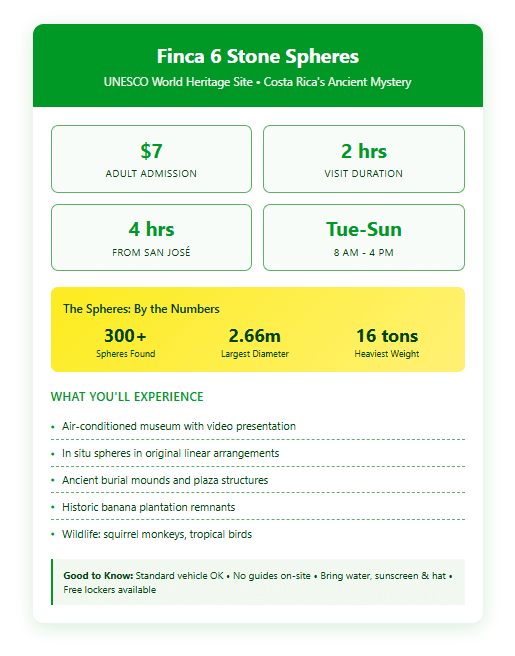
Over 300 perfectly round stone balls scattered across southern Costa Rica—some weighing up to 16 tons—remain one of archaeology’s most puzzling mysteries. The Diquís stone spheres have baffled researchers since the 1930s, and the best place to encounter them is Finca 6, a UNESCO World Heritage Site tucked away on the road to Sierpe in the Osa Peninsula region. Finca 6 is the only archaeological site where you can still see these ancient spheres in their original linear arrangements, exactly as the indigenous Diquís culture positioned them over a thousand years ago. The site combines an air-conditioned museum with outdoor trails through a former banana plantation, where spheres ranging from basketball-sized to over two meters in diameter sit half-buried in the earth—right where archaeologists discovered them. Admission $7 USD adults, open Tuesday-Sunday 8 AM-4 PM, located 7 km from Palmar Norte on road to Sierpe—about 4 hours from San José. Plan approximately 2 hours for museum and outdoor trails. Standard vehicles can reach the site on paved roads.
Quick Facts
- UNESCO Status: One of four sites comprising Costa Rica’s first World Heritage cultural designation (2014)
- Entry: $7 USD adults, $5 USD students; open Tuesday-Sunday 8 AM-4 PM (closed Mondays)
- Location: Palmar Sur, 7 km from Palmar Norte on Sierpe road—4 hours from San José via Costanera Sur
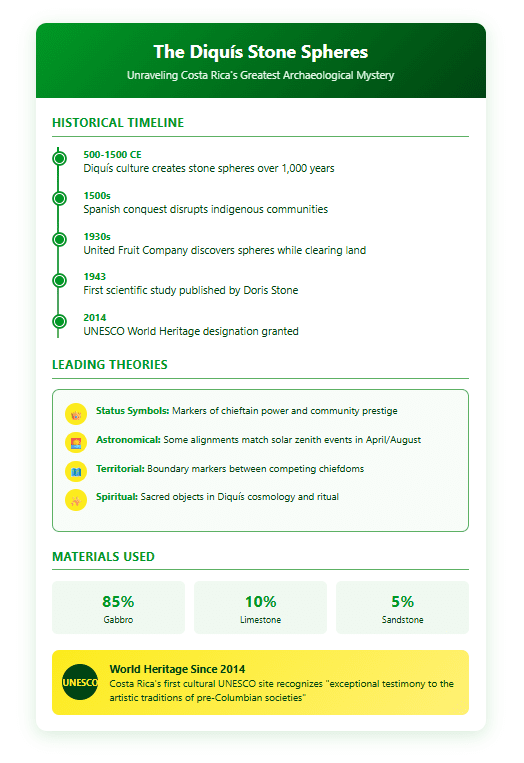
- The Spheres: Created by Diquís culture 500-1500 CE using stone tools; largest documented 2.66 meters diameter (24 tons)
- What You’ll See: Air-conditioned museum (English/Spanish displays), outdoor trails with in situ spheres, linear arrangements spanning 77 meters
- Time Needed: 1.5-2 hours minimum for complete site (museum + trails)
- Vehicle: Standard cars handle paved Costanera Sur fine; 4×4 only needed for deeper Osa Peninsula exploration
Top 5 Finca 6 Tips
- Visit as Strategic Stopover Between Destinations – Perfect 2-hour break between Uvita and Sierpe/Drake Bay, or Manuel Antonio and Osa Peninsula—breaks up long southern drive with meaningful cultural experience
- Arrive Before 10 AM for Cooler Temperatures – Diquís Delta lowlands routinely hit 90°F (32°C); early arrival (8 AM opening) offers comfortable museum exploration, outdoor trail walking before midday heat, better wildlife spotting (squirrel monkeys, Barred Antshrike)
- Combine with Sierpe Mangrove Boat Tour – Just down road from Finca 6, Sierpe launches boat tours through Terraba-Sierpe wetlands (Central America’s largest mangrove system) with crocodiles, monkeys, birdlife—excellent pairing for full day
- Pack for Tropical Lowlands – Bring sunscreen, hat, insect repellent (mosquitoes present), water bottle, comfortable walking shoes for unpaved trails—cash for $7 entry though US dollars accepted; restrooms and free lockers available
- Understand What Makes This Unique – Only archaeological site showing spheres in original linear arrangements; two distinct groups (three spheres over 77 meters, two spheres 11 meters apart) demonstrate purposeful positioning versus moved spheres at National Museum San José or Palmar Sur park
Museo Finca 6 offers genuine archaeological experiences perfect for travelers exploring Costa Rica’s Southern Pacific coast. The site anchors cultural exploration days, making it valuable for understanding pre-Columbian Costa Rica beyond wildlife and beaches. Many travelers visit as mid-journey stop between Uvita whale watching and Osa Peninsula adventures, or combine with Sierpe mangrove tours and Drake Bay boat launches. For building comprehensive itineraries, check our one-week and two-week plans. The Diquís spheres were created between 500-1500 CE by sophisticated chiefdom societies inhabiting fertile Sierpe and Térraba river delta—gabbro stone originated in hills several kilometers away, meaning ancient craftspeople transported 24-ton masses without wheeled vehicles or draft animals. Purpose remains debated: territorial markers, chieftain status symbols, astronomical alignments (one Finca 6 group aligns with solar zenith events April/August), or spiritual/religious significance. Standard vehicles handle paved Costanera Sur (Route 34) through Jacó, Quepos, Manuel Antonio, Dominical, Uvita to Palmar Norte fine—no 4×4 required unless continuing to remote Osa Peninsula areas like Drake Bay. The dry season (December-April) provides most comfortable conditions though region receives year-round rainfall.
If you need any help with a Costa Rica car rental, contact us now!
Over 300 perfectly round stone balls scattered across southern Costa Rica, some weighing up to 16 tons,remain one of archaeology’s most puzzling mysteries. The Diquís stone spheres have baffled researchers since the 1930s, and the best place to encounter them is Finca 6, which is a UNESCO World Heritage Site tucked away on the road to Sierpe in the Osa Peninsula region.
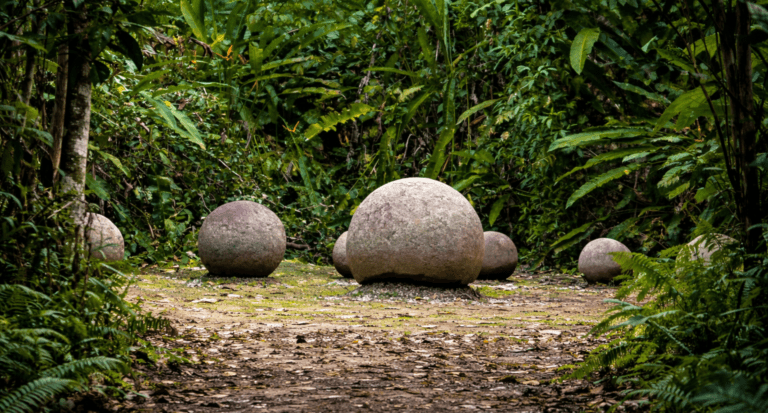
Finca 6 is the only archaeological site where you can still see these ancient spheres in their original linear arrangements, exactly as the indigenous Diquís people positioned them over a thousand years ago. The site combines an air-conditioned museum with outdoor trails through a former banana plantation, with spheres ranging from basketball-sized to over two meters in diameter sitting half-buried in the earth where archaeologists originally discovered them.
Key Takeaways
- Finca 6 is one of four sites comprising Costa Rica’s first UNESCO World Heritage cultural designation (2014)
- Admission is $7 USD for adults, open Tuesday through Sunday from 8 AM to 4 PM
- The spheres were created by the populations of the Diquís Delta between 500-1500 CE using stone tools and sand polishing
- Located 7 kilometers from Palmar Norte on the road to Sierpe which is about 4 hours driving from San José
- Plan approximately 2 hours for the museum and outdoor trails
- Standard vehicles can reach the site on paved roads; no 4×4 required
What Makes the Stone Spheres So Mysterious?
The Diquís spheres are an archaeological puzzle which continues to generate debate among researchers worldwide. Created without metal tools, these granite and gabbro spheres achieve near-perfect roundness through a process of controlled fracture, pecking with stone implements, and meticulous sand polishing.
The largest documented sphere measures 8.7 feet (2.66 meters) in diameter and weighs approximately 24 tons (22 tonnes). What makes this remarkable isn’t just the precision,it’s the logistics. The gabbro stone originated in hills several miles from where finished spheres were found which means that ancient craftspeople transported these massive stones over significant distances without wheeled vehicles or draft animals.
Theories about their purpose range from practical to mystical. Some archaeologists suggest they marked territorial boundaries or denoted the status of chieftain settlements. Others propose astronomical alignments and interestingly, one group of spheres at Finca 6 aligns with the sun during solar zenith events in April and August. The Metropolitan Museum of Art houses one Diquís sphere in their collection and notes that these monumental sculptures were clearly prestige objects that marked the landscape around ancient communities.
What we know for certain is that the Diquís culture, which flourished in the fertile delta formed by the Sierpe and Térraba rivers, possessed sophisticated social organization and artistic capabilities that rival any pre-Columbian civilization. Their goldwork was equally remarkable and gold deposits from the Osa Peninsula provided materials for intricate metallurgical creations.
Where Is Finca 6 and How Do You Get There?
Finca 6 sits in Palmar Sur, in the Puntarenas Province of Costa Rica’s Southern Pacific region. The drive from San José takes approximately 4 hours via the Costanera Sur highway (Route 34) which is one of Costa Rica’s most scenic coastal routes.
What’s the Best Route from San José?
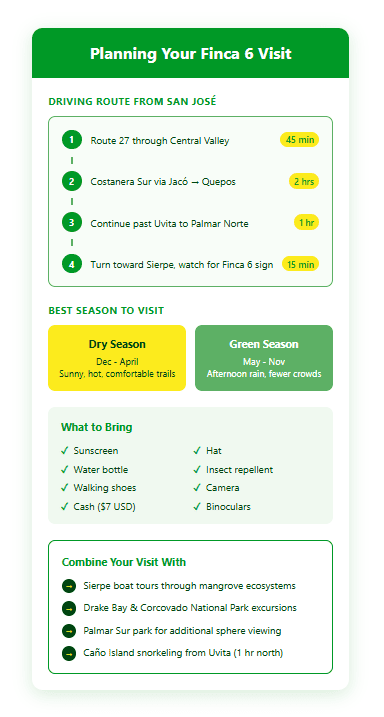
Head south on Route 27 through the Central Valley, connecting to the Costanera Sur at Jacó. This well-maintained highway continues through Quepos and Manuel Antonio then passes through Dominical and Uvita before reaching Palmar Norte. From the Costanera, follow signs toward Sierpe and the museum sits 4 miles (7 kilometers) down this road, just before a blue bridge. Turn left at the Finca 6 sign onto a short dirt access road leading to the parking area.
The good news for visitors is that the entire route to Finca 6 is paved and accessible with a standard rental vehicle. Unlike destinations in Monteverde or the Nicoya Peninsula, a 4×4 isn’t needed to reach this UNESCO site. That said, if you’re combining Finca 6 with exploration of more remote Osa Peninsula areas like Drake Bay or Puerto Jiménez, then a vehicle with higher clearance becomes worthwhile.
Can You Visit as a Day Trip?
Yes, but it requires an early start. Leave San José by 5:00 AM to arrive around 9:00 AM when the museum opens. This gives you time to explore the site, grab lunch in Palmar, and return before dark. Alternatively, many travelers visit Finca 6 as a stop on their way to or from the Osa Peninsula as the museum makes an ideal 2-hour break to break up the long southern drive.
If you’re heading to Sierpe to catch a boat to Drake Bay, Finca 6 is literally on your route and worth the detour.
What Will You See at Finca 6?
The site consists of two main areas: the modern museum building and the outdoor archaeological trails. Plan at least two hours to experience both properly.
What’s Inside the Museum?
The air-conditioned museum is a welcome relief in this tropical lowland climate and houses informative displays in both English and Spanish about the Diquís culture, their daily life, and the spheres’ discovery. An excellent video provides context about the region’s human habitation spanning from the Archaic Period (10,000-1,500 BCE) through the complex tribal societies that created the spheres.
Exhibits showcase pottery, sculpture, and other artifacts that help paint a picture of this sophisticated pre-Columbian civilization. You’ll learn how the spheres were likely created which was a process requiring immense skill, resources, and social coordination. The museum also displays several recovered spheres whose original locations were disturbed over the decades.
The National Museum in San José also houses several Diquís spheres if you want to see additional examples although nothing compares to encountering them in their original setting at Finca 6.
What About the Outdoor Trails?
Outside, marked trails wind through the former banana plantation which is now transformed into an open-air archaeological exhibit. The flat, easy terrain makes walking comfortable for all fitness levels so just bring sun protection and water, as this lowland area gets hot.
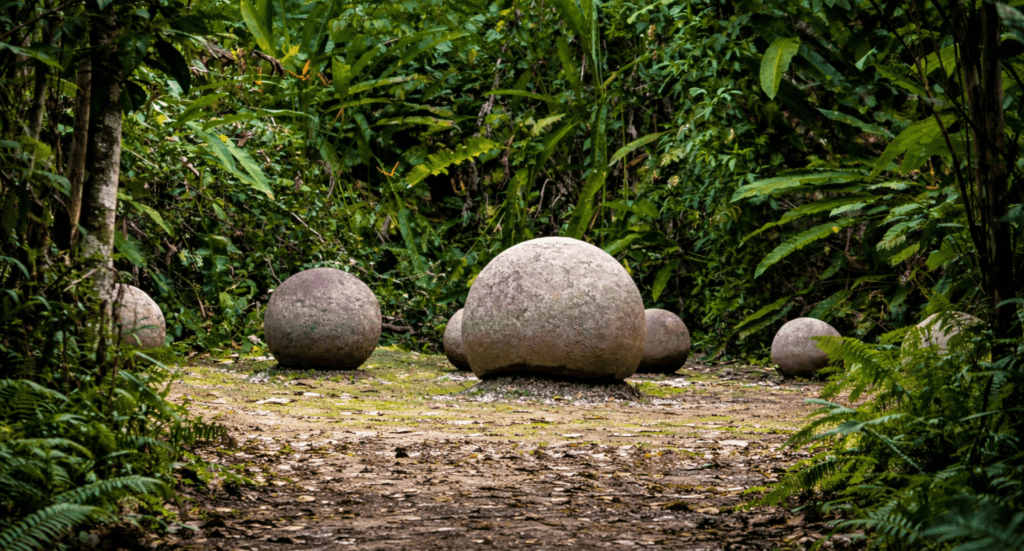
The highlight is the in situ spheres where the spheres remain exactly where ancient inhabitants placed them. Two distinct linear arrangements of spheres demonstrate purposeful positioning and not random placement. One group of three spheres extends over a 253 feet (77-meter) span whereas a second group of two spheres sit 36 feet (11 meters) apart and are among the few remaining spheres that haven’t been moved from their original locations.
You’ll also see circular elevated mounds which are burial structures and remnants of the old United Fruit Company banana infrastructure providing an interesting juxtaposition of pre-Columbian and 20th-century history. Keep your eyes on the trees: visitors frequently spot squirrel monkeys and various bird species, including the Barred Antshrike and Black-bellied Wren.
When Should You Visit Finca 6?
The museum operates Tuesday through Sunday, 8:00 AM to 4:00 PM. Closed Mondays. Arriving early (before 10:00 AM) offers cooler temperatures and potentially better wildlife sightings.
Which Season Works Best?
The dry season (December through April) provides the most comfortable conditions, though the Diquís Delta receives rainfall year-round. The Southern Pacific experiences Costa Rica’s most intense weather patterns and if you’re visiting during green season (May through November), bring rain gear and be prepared for afternoon showers.
Unlike beach destinations where weather significantly impacts your experience, Finca 6’s combination of indoor museum and short outdoor trails works reasonably well regardless of conditions. Just be aware that September and October bring the heaviest rainfall to this region.
How Much Time Do You Need?
Most visitors spend 1.5 to 2 hours exploring the complete site. History enthusiasts and archaeology buffs might linger longer, especially if they take time to read all the signage along the trails.
What Should You Know Before Going?
Practical Details
- Admission: $7 USD for foreign adults, $5 USD for students (Costa Rican colones accepted)
- Hours: 8:00 AM – 4:00 PM, Tuesday through Sunday
- Closed: Mondays
- GPS Coordinates: 8.911047, -83.477297
- Facilities: Restrooms, free lockers for bags, informational brochures in English and Spanish
What Should You Bring?
The Diquís Delta sits in tropical lowlands with temperatures routinely hitting 90°F (32°C). Pack accordingly:
- Sunscreen and a hat
- Insect repellent (mosquitoes are present)
- Water bottle
- Comfortable walking shoes (trails are flat but unpaved)
- Camera and/or binoculars for wildlife
- Cash (though US dollars are accepted)
Are Guides Available?
Finca 6 does not have guides available for hire on-site. The museum provides detailed maps and informative brochures that make self-guided visits straightforward. The displays and trail signage effectively communicate the site’s history and significance. If you have intermediate Spanish reading skills, you’ll be able to access even more information from the artifact labels.
What Else Can You Do Near Finca 6?
The location makes Finca 6 an ideal addition to broader Southern Pacific itineraries. Several worthwhile experiences sit within easy reach.
Where Can You See More Spheres?
Stone spheres have been moved to various locations throughout Costa Rica over the decades, though the practice is now prohibited. The public park in Palmar Sur displays several spheres alongside an old locomotive from the banana plantation era and it’s worth a quick stop to see spheres in a different setting. You’ll also notice spheres decorating government buildings and private properties throughout the region.
For the complete picture, the three other UNESCO-designated sites, Batambal, El Silencio, and Grijalba-2, remain less developed for tourism but represent different aspects of Diquís settlement patterns. El Silencio contains the largest single sphere ever found.
What About Wildlife and Nature?
From Finca 6, you’re positioned to explore some of Costa Rica’s most biodiverse regions. The boat tours departing from nearby Sierpe cruise through mangrove ecosystems teeming with crocodiles, monkeys, and birdlife which is an excellent pairing with Finca 6 for a full day of exploration.
Corcovado National Park, often called the most biologically intense place on Earth, sits on the Osa Peninsula accessible from Puerto Jiménez or Drake Bay. The Guardian has described this park as harboring 2.5% of the world’s biodiversity in just 164 square miles.
Heading north, Caño Island offers exceptional snorkeling with sea turtles and vibrant reef fish with tours departing from Uvita about an hour from Finca 6. Interestingly, stone spheres were also discovered on Caño Island which adds another layer to the mystery of how the Diquís transported these massive objects.
What Towns Are Worth Exploring?
Palmar Norte and Palmar Sur serve as the main population centers in this region. While not tourist towns per se, they offer authentic glimpses of Costa Rican agricultural life as sugar cane, pineapple, and oil palm plantations dominate the landscape.
Sierpe, at the end of the road past Finca 6, is the launching point for boat trips into Drake Bay and the Terraba-Sierpe wetlands, one of Central America’s largest mangrove systems. The small village has a few restaurants serving fresh seafood and cold drinks which are perfect for refueling after your museum visit.
How Does Finca 6 Fit Into a Broader Costa Rica Trip?
For travelers planning a Costa Rica itinerary, Finca 6 works best when integrated into a Southern Pacific route or an Osa Peninsula adventure.
Sample Itinerary: Pacific Coast Exploration
Day 1: Fly into San José Airport (SJO), pick up your rental vehicle, and drive to Uvita or Dominical (3-4 hours)
Day 2: Whale watching at Marino Ballena National Park (best July-October for humpbacks) or explore waterfalls near Uvita
Day 3: Morning visit to Finca 6 (2 hours), continue to Sierpe for afternoon mangrove boat tour
Day 4: Journey to the Osa Peninsula or loop back north toward Manuel Antonio
This approach minimizes backtracking while maximizing diverse experiences. The Costanera Sur highway connecting these destinations is one of Costa Rica’s most pleasant drives with ocean views, roadside fruit stands, and scarlet macaws flying overhead at Carara.
What Vehicle Do You Need?
A standard rental car handles all paved routes to and around Finca 6 perfectly well. If your itinerary includes only the Costanera Sur corridor and established tourist destinations, you don’t need a 4×4. However, if you’re venturing deeper into the Osa Peninsula, driving conditions change dramatically because roads become unpaved, and higher clearance proves valuable, especially during green season.
Vamos Rent-A-Car can help match your vehicle choice to your specific itinerary to ensure that you have the right wheels for every destination on your list.
Why Should Finca 6 Be on Your Costa Rica List?
Costa Rica isn’t known for ancient ruins as it lacks the grand pyramids of Mexico or Guatemala. But the Diquís stone spheres represent something equally compelling as an artistic and engineering achievement that defies easy explanation even today.
Standing beside a sphere at Finca 6, you’re gazing on something that has puzzled researchers for nearly a century. How did people without metal tools create such perfect roundness? Why did they invest such enormous effort into objects whose purpose remains unclear? What did these spheres mean to the communities that created them?
The UNESCO World Heritage designation recognizes what Costa Ricans have long understood, which is that these spheres represent an exceptional testimony to the artistic traditions and technical capabilities of pre-Columbian societies. They’ve become a national symbol which appears on currency and decorates government buildings throughout the country.
For travelers looking beyond Costa Rica’s spectacular wildlife and beaches, Finca 6 offers something different which is a chance to connect with the country’s pre-Columbian past and ponder one of archaeology’s enduring mysteries. At just $7 admission and 2 hours of your time, it’s one of the best cultural value propositions in the entire country.
Frequently Asked Questions
What is the largest stone sphere in Costa Rica?
The largest documented Diquís sphere measures about 8.7 feet (2.66 meters) in diameter and weighs approximately 24 tons (22 tonnes). This sphere is located at El Silencio, which is one of the four UNESCO World Heritage archaeological sites in the Diquís Delta. At Finca 6, you’ll find spheres ranging from about 2.3 to 6 feet (0.7 to 1.9 meters) in diameter which are still impressively massive when you encounter them in person.
What are the great balls of Costa Rica?
The “great balls” or “bolas de piedra” are stone spheres created by the Diquís between approximately 500-1500 CE. Over 300 spheres have been discovered, primarily in the Diquís Delta region of southern Costa Rica. They’re made mostly from gabbro which is a granite-like volcanic rock, although some use limestone or sandstone. The spheres were crafted using stone tools, controlled fracturing, and sand polishing to achieve remarkable roundness.
Who made the stone spheres?
The stone spheres were created by the people of the Diquís Delta which were a pre-Columbian civilization that inhabited the southern Pacific region of Costa Rica. These tribes developed sophisticated agricultural, metallurgical, and stone-working traditions. The spheres were produced over roughly a thousand years, from approximately 500 CE until the Spanish conquest in the 1500s disrupted indigenous communities in the region.
What is the purpose of stone spheres?
Researchers continue debating this question. Leading theories suggest they served as status symbols for tribal settlements, markers of territorial boundaries, or objects with astronomical significance as some alignments at Finca 6 correspond with solar zenith events. Others propose they held spiritual or religious meaning within Diquís cosmology. The most honest answer is that we don’t definitively know their purpose, which adds to their mystique.
Are there stone spheres elsewhere besides Costa Rica?
While stone spheres exist in other parts of the world (notably in Bosnia and certain Pacific islands), the Diquís spheres of Costa Rica are unique in their quantity, precision, size range, and archaeological context. No other location has produced hundreds of near-perfect stone spheres in the same concentrated area with similar cultural associations. The Costa Rican spheres remain the most significant collection of prehistoric stone spheres anywhere on Earth.
Can you take stones from Costa Rica?
Absolutely not. Costa Rican archaeological heritage is protected by law (Law No. 6703), and removing stone spheres or any archaeological artifacts is illegal and punishable by fines and imprisonment. The spheres are considered a national symbol of Costa Rica and are protected at the highest legal level. Even spheres on private property cannot be legally moved without authorization from the National Museum. The best way to appreciate these artifacts is to visit protected sites like Finca 6 where they’re preserved for everyone to experience.