
Last Updated on March 27, 2026
Palo Verde National Park: What's Covered
Palo Verde National Park is Costa Rica’s premier wetland sanctuary in Guanacaste province, protecting 45,000 acres of tropical dry forest with 279 bird species and the country’s highest concentration of American crocodiles. Just 60 km from Liberia Airport, the 1.5-hour Tempisque River boat tour practically guarantees wildlife sightings without a single challenging hike.
Quick Facts:
- Boat tours run 1.5–2 hours on covered motorboats accommodating 20–25 passengers; crocodile, monkey, and iguana sightings are essentially guaranteed
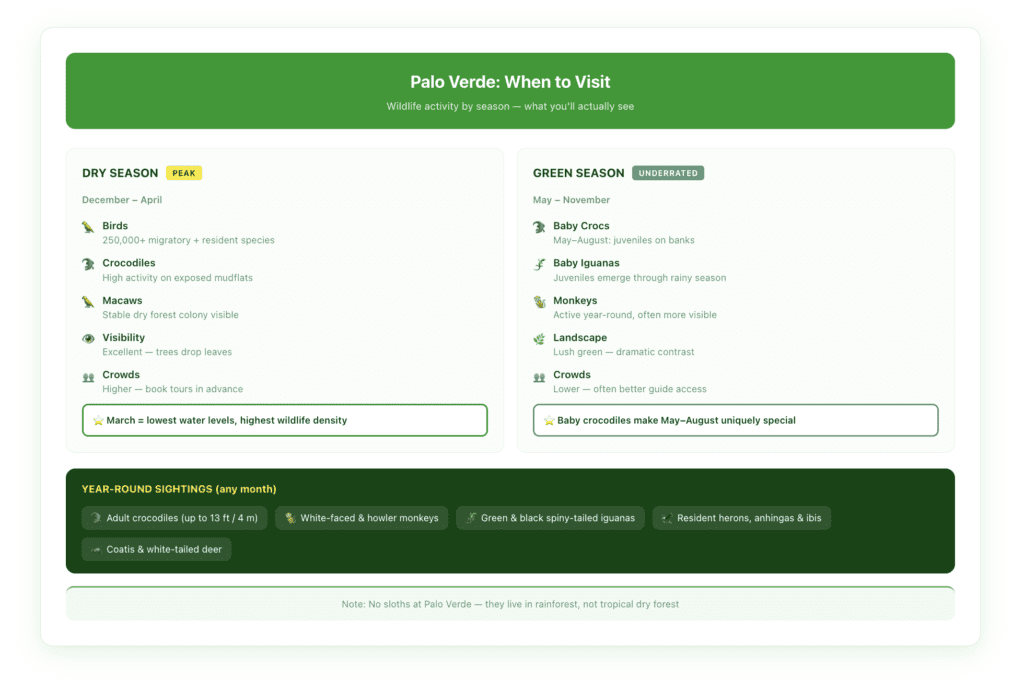
- December–April: peak birdwatching with 250,000+ migratory birds; March is the single best month
- May–November: baby crocodiles, fewer crowds, lush landscape
- No sloths — they live in a rainforest, not a tropical dry forest
- 4×4 recommended May–November if driving yourself from Bagaces
Top 3 Palo Verde Wildlife Experiences:
- Crocodile Watching — Adults up to 13 ft (4 m) sun on mudflats at low tide; May–August brings baby crocodiles alongside adults on the riverbanks.
- Migratory Bird Spectacle — Up to 250,000 birds concentrate in the dry season; roseate spoonbills, jabiru storks, and herons at the Isla de los Pájaros nesting colony.
- Monkey & Iguana Encounters — White-faced and howler monkeys in the canopy year-round; green iguanas draped over riverside branches throughout every month.
Perfect half-day add-on from Tamarindo, Playas del Coco, or Flamingo. Combine with Barra Honda’s caves for a full-day dual experience in the same conservation area.
If you need any help with a Costa Rica car rental, contact us now!
Palo Verde National Park is the one Guanacaste wildlife experience that actually delivers what the brochures promise. Tucked into the Tempisque River basin in Guanacaste province, this 45,000-acre wetland protects tropical dry forest—one of the most endangered ecosystems in Central America—and holds Costa Rica’s largest concentration of American crocodiles. The boat tour here practically guarantees sightings: howler monkeys, green iguanas the size of your arm, and crocodiles that stretch longer than your boat. It’s a half-day trip from almost every Guanacaste beach town, and it doesn’t require a single challenging hike. Just 37 miles (60 km) from Liberia International Airport, Palo Verde slots neatly into almost any Guanacaste itinerary.
Key Takeaways
- Palo Verde protects 15 distinct habitats—mangroves, swamps, seasonal pools, limestone ridges—and has been designated a Ramsar Wetland of International Importance.
- Boat tours on the Tempisque River last 1.5–2 hours on a covered motorboat; crocodile, monkey, and iguana sightings are essentially guaranteed.
- The dry season (December–April) is peak birdwatching; the green season (May–November) brings baby crocodiles and far fewer tourists.
- Organized tours depart from Tamarindo, Playas del Coco, Flamingo, and the Gulf of Papagayo—making this a natural half-day add-on to beach time.
- No real hiking required; it’s one of the most accessible wildlife experiences in the country for families, seniors, and anyone with mobility considerations.
What Animals Will You Actually See at Palo Verde?
The wildlife list here is unusually honest. Palo Verde doesn’t tease you with “if you’re lucky” species—it delivers. The Tempisque River holds Costa Rica’s highest concentration of American crocodiles, and during low tide, they sunbathe on exposed mudflats in numbers you genuinely won’t expect. Some exceed 13 feet (4 meters) and sun themselves close enough to the boat that you can see the ridges of their scales.
Beyond the crocodiles, the riverside trees are full of white-faced capuchin monkeys and howler monkeys. The howlers are almost comically large, and their morning calls carry for over a mile. Green iguanas and black spiny-tailed iguanas drape over branches like decorations. Coatis—those raccoon-relative mammals with the long striped tails—forage along the banks, and during Costa Rica’s dry season, you’ll often spot white-tailed deer near the water’s edge.
One thing worth noting upfront: there are no sloths at Palo Verde. Sloths live in a rainforest, and Palo Verde is a tropical dry forest—a completely different ecosystem. Don’t let this surprise you mid-tour.
What Birds Can You See on the Palo Verde Boat Tour?
Palo Verde is one of Central America’s most important birdwatching sites. BirdLife International has designated it an Important Bird Area for good reason: 279 documented species live here, and the Isla de los Pájaros (Bird Island) in the middle of the Tempisque River holds nesting colonies for dozens of wading bird species.
The roseate spoonbill alone is worth the trip—that unlikely pink plumage against green mangroves is genuinely striking. Jabiru storks stand nearly 5 feet (1.5 meters) tall. Wood storks circle overhead. You’ll also see great egrets, boat-billed herons, anhingas spreading their wings on branches to dry, white ibis in flocks, and the occasional scarlet macaw—one of the only stable dry forest populations of scarlet macaws in the country.
From December through April, migratory waterfowl from North America arrive: northern shovelers, blue-winged teal, and black-bellied whistling ducks. The historical peak count has exceeded 250,000 individual birds during this season. March is when it all converges—lowest water levels, highest wildlife density, peak croc activity, and the full migratory influx all at once.
Does Palo Verde Have Jaguars or Big Cats?
Technically, yes, but you almost certainly won’t see one on a boat tour. Palo Verde has a healthy population of jaguarundis—smaller wild cats, roughly house-cat-sized, brownish-gray, and active during daylight. Ocelots and margays exist here, too. Most visitors explore by boat, which keeps the forest interior undisturbed; the cats thrive partly because of that. If seeing a wild cat is on your list, your real shot involves staying overnight at the OTS Biological Station and hiking forest trails at dawn.

Where Is Palo Verde, and How Do You Get There?
Palo Verde sits in the lowlands of the Tempisque River basin, about 37 miles (60 km) east of Liberia and roughly 125 miles (200 km) northwest of San José. It’s part of the larger Arenal Tempisque Conservation Area, which also includes Barra Honda National Park and the Lomas Barbudal Biological Reserve. The park was added to the Ramsar List of Wetlands of International Importance in the 1990s—a designation that reflects its global significance as a migratory bird habitat.
Most visitors arrive via organized boat tours that pick up from beach towns throughout Guanacaste. The boats typically launch from near the town of Ortega or from Puerto Humo on the Nicoya Peninsula side. If you’re staying at Nosara or Samara, Palo Verde is a realistic morning trip with beach time in the afternoon. Departures are also available from Playas del Coco and Liberia for those based in northern Guanacaste.
Can You Drive to Palo Verde Yourself?
Yes. The park has a land entrance accessible from the town of Bagaces on the Interamerican Highway. Take the turnoff across from the gas station in Bagaces and follow the gravel road about 17 miles (28 km) through dry forest and farmland to the park entrance. From there, another 5–6 miles (8–10 km) leads to the ranger station.
The road gets muddy during the green season—a 4×4 is strongly recommended from May through November. Understanding which vehicle you actually need for a given Costa Rica destination becomes relevant here: during the dry season, a standard SUV can often manage, but don’t chance it with a sedan in June. That said, the boat tour experience genuinely beats self-driving into the park from a wildlife perspective—you cover more ground and get much closer to animals.
What Does the Palo Verde Boat Tour Look Like?
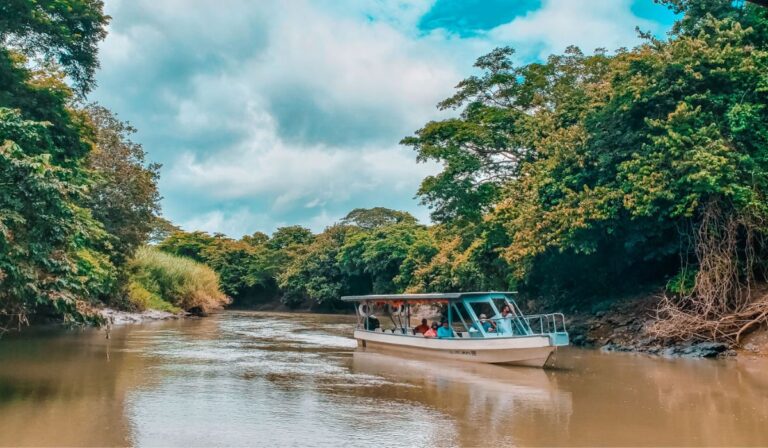
The boat tour is the definitive Palo Verde experience—and for most visitors, it’s the entire visit. You’re on a covered motorboat holding 20–25 passengers, cruising the Tempisque River for 1.5–2 hours. The river has a 13-foot (4-meter) tidal range, which means conditions shift during the day. Low tide exposes mudflats where American crocodiles congregate; high tide brings the boat closer to the canopy where monkeys and birds perch.
Most organized tours include round-trip transportation from your Guanacaste hotel, a bilingual naturalist guide, the boat excursion, and often a traditional Costa Rican lunch at a nearby hacienda afterward. Some add cultural stops—the Guaitil pottery village, where Chorotega artisans demonstrate pre-Columbian ceramic techniques, or a sugar cane hacienda where you can sample freshly pressed cane juice. These extras can turn a half-day excursion into a genuinely full cultural experience.
Can You Visit Palo Verde Without a Tour?
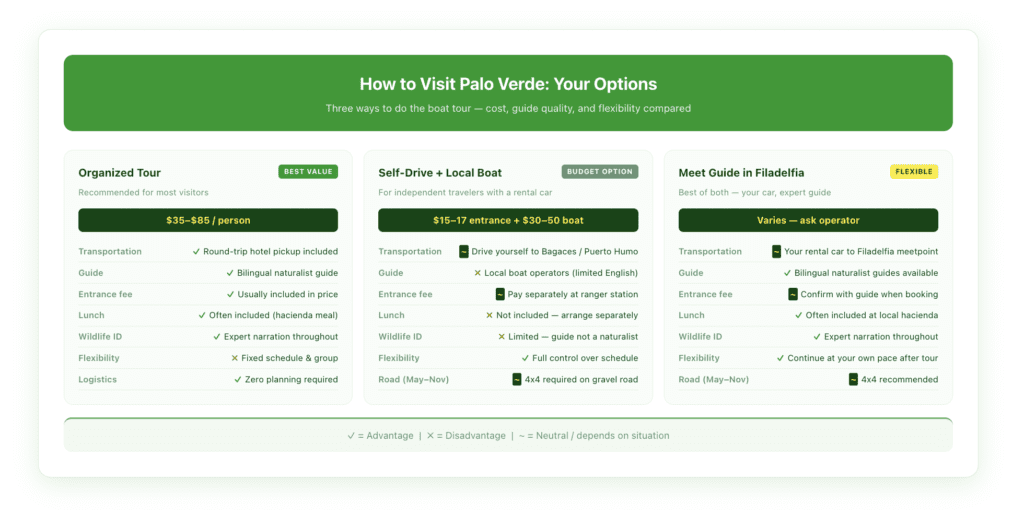
You can, but there are trade-offs. The park doesn’t run its own guided boat tours. Boat owners at local docks—particularly Puerto Humo—can take you on the river independently, but many speak limited English and aren’t naturalist guides. You’ll still see wildlife; you just won’t know half of what you’re looking at. The guided experience meaningfully improves species identification and general understanding.
One practical middle option: if you have your own rental car, you can meet a guide in Filadelfia, travel together to the boat launch, take the tour, and then go your separate ways after. This gives you the flexibility of your own transportation while still getting an expert interpreter. Another option for deep immersion: stay overnight at the OTS (Organization for Tropical Studies) Biological Station inside the park, which offers dormitory-style accommodation, guided activities including boat tours, night hikes, and photography workshops.
What's the Best Time to Visit Palo Verde?
When Is Dry Season Birdwatching at Its Peak?
The dry season—December through April—delivers Palo Verde’s most spectacular wildlife viewing. As water sources across the landscape dry up, birds and animals concentrate around what remains. Trees drop their leaves in this deciduous forest, opening up the canopy and dramatically improving visibility. Migratory waterfowl from North America arrive and join the resident species. Historically, counts have reached 250,000 birds during the peak dry season.
March is the standout month. Water levels hit their annual low, crocodiles gather in impressive numbers at remaining water sources, and the full complement of migratory birds is still present. If you’re primarily a birder and you have flexibility in your dates, aim for late February or March.
Is It Worth Visiting Palo Verde During Green Season?
Absolutely—just with different expectations. Green season (May–November) brings one wildlife highlight you simply can’t get during dry season: baby crocodiles. From roughly May through August, juvenile crocodiles emerge alongside adults on the riverbanks. They’re smaller, more active, and genuinely adorable in that prehistoric-creature way. Baby iguanas appear, too.
The forest turns intensely green, crowds drop significantly, and tour prices often decrease. You’ll see fewer bird species overall, but the experience doesn’t disappoint. And fewer tourists on the boat means guides can spend more time at each sighting without rushing through.
What Should You Bring on the Palo Verde Boat Tour?
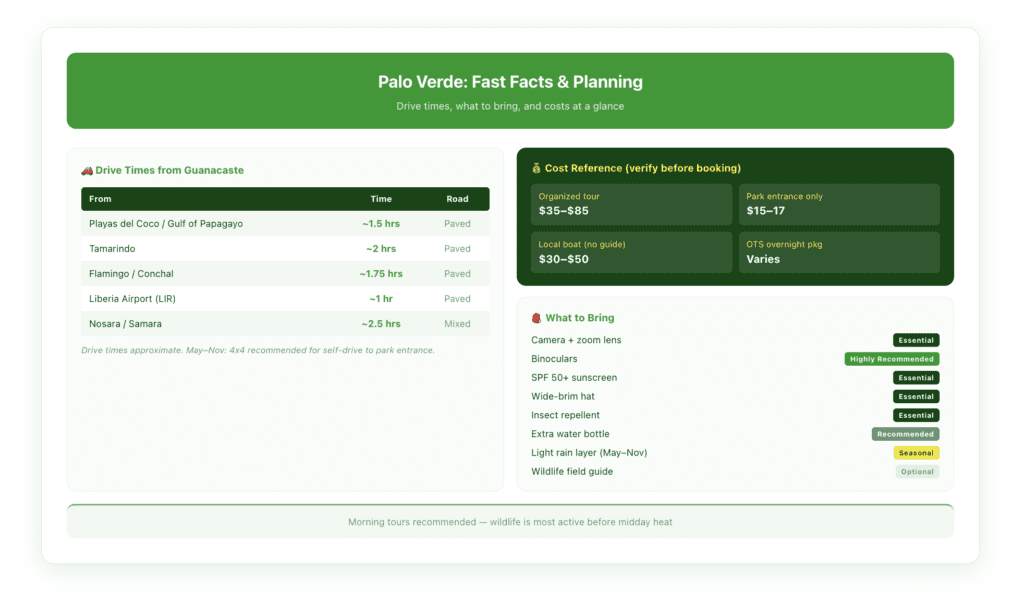
Your camera matters more here than at most Costa Rica destinations. The boat approaches wildlife closely enough that telephoto shots are genuinely achievable—you’ll get crocodile portraits and bird-in-flight photos that would require professional guides and much more effort elsewhere. Bring a DSLR or mirrorless camera with a zoom lens if you have one; even a quality smartphone with zoom performs well at Palo Verde’s distances.
Binoculars transform the birdwatching. While guides often bring spotting scopes, personal binoculars let you follow individual birds across the waterline and identify species your guide hasn’t pointed out yet. The Tico Times has covered Palo Verde’s wetland conservation efforts extensively—the park faces ongoing pressure from upstream agriculture, making your visit part of supporting active conservation work.
For comfort: SPF 50+ sunscreen (the Guanacaste sun is legitimately intense), a wide-brimmed hat, and insect repellent. Bring a light jacket or rain layer during the green season—passing showers are brief but can feel cool on the river. Most tours provide water, but bringing extra is never wrong in this heat.

How Much Does Palo Verde Cost?
Organized tour packages typically run $35–$85 per person, depending on what’s included. Basic boat-only tours from nearby launch points come in at the lower end. Full packages—hotel pickup from Tamarindo or similar, lunch, cultural stops, bilingual guide—sit toward the higher range. For the experience you get, it’s solid value compared to many Costa Rica activities.
If you’re driving to the park independently, the park entrance fee is approximately $15–17 for foreign adults. (Verify current fees via SINAC’s official website before visiting—national park prices occasionally adjust.) Parking is available at the ranger station. You’ll then negotiate boat transportation separately at local docks; expect $30–$50 per person depending on group size.
The OTS Biological Station offers accommodation packages including meals, dormitory-style lodging, and guided activities. It’s the right choice for serious naturalists or anyone wanting more than a half-day.
How Does Palo Verde Compare to Other Costa Rica Wildlife Parks?
Palo Verde fills a specific niche that other parks don’t. Unlike the rainforests of Tortuguero or Manuel Antonio, where dense vegetation often hides animals, Palo Verde’s open wetlands make wildlife remarkably visible. The boat-based format means you cover significant territory without physical exertion—no hiking required for excellent sightings.
For sheer crocodile volume, nothing in Costa Rica competes with Palo Verde. For wading birds in a single location, it similarly stands alone. Compare this to Caño Negro Wildlife Refuge near the Nicaraguan border, which offers similar boat-based wildlife watching but is considerably farther from Guanacaste—roughly 90 minutes north of La Fortuna. Palo Verde is the Guanacaste version of that experience, and arguably more accessible.
The tradeoff: dry forest doesn’t support sloths, quetzals, poison dart frogs, or toucans. Those require rainforest or cloud forest. Palo Verde complements rather than replaces Arenal or Monteverde. For a Guanacaste-based trip, it’s the wildlife piece that most beach vacations are missing.
What Else Is Worth Combining with Palo Verde?
Barra Honda National Park sits about 30 minutes away and is the natural companion visit—it features Costa Rica’s most extensive limestone cave system, where stalactites and stalagmites fill underground chambers. Morning river cruise plus afternoon underground exploration creates a genuinely full-day dual experience within the same conservation area. Some operators offer combination packages.
The Lomas Barbudal Biological Reserve, adjacent to Palo Verde, protects additional dry forest habitat with excellent trails for birding. Species like the long-tailed manakin, turquoise-browed motmot, and black-headed trogon inhabit this area—dry forest specialists you won’t find in Costa Rica’s rainforests.
For a contrast of volcanoes and hot springs, Rincón de la Vieja National Park is about 90 minutes from Palo Verde. The bubbling mud pots, steaming fumaroles, and waterfall hikes feel completely different from the wetland experience—good if you’re spending several days in the Guanacaste interior.
For travelers routing between Guanacaste beaches and Arenal/La Fortuna, Palo Verde sits roughly midway along a logical route. Book a morning boat tour, then continue toward your next destination in the afternoon. It’s one of those stops that takes minimal detour but delivers disproportionate value.
Who Is Palo Verde Best For?
Palo Verde is legitimately ideal for families with children, seniors, and anyone with mobility limitations. The boat requires only a short, gentle walk from the shuttle to the dock, with guides and captains ready to assist. The covered boat seats comfortably. The 1.5–2 hour duration doesn’t exhaust young kids. And the wildlife density keeps everyone engaged throughout.
Birdwatchers from casual to serious will find the species count here impressive. The dry season concentration makes identification possible even for beginners—when 40 roseate spoonbills are roosting in a single tree, you don’t need advanced skills to appreciate them. Wildlife photographers get some of the most accessible close-approach shots available anywhere in Costa Rica.
For travelers staying in Liberia near the airport before or after flights, Palo Verde makes a particularly clean fit: a meaningful wildlife morning before you head to the airport, or an easy arrival-day adventure before checking into your beach hotel.

Frequently Asked Questions
Why visit Palo Verde National Park instead of other Guanacaste wildlife experiences?
Palo Verde is the only place in Costa Rica where boat-based wildlife viewing practically guarantees crocodile sightings in significant numbers. Other Guanacaste wildlife experiences—zip lines, horseback rides, volcanic hike tours—don’t have the same wildlife density in an accessible format. The half-day boat tour also requires no physical fitness, making it a rare wildlife experience that works for literally everyone in a travel group.
Does Palo Verde have trails for hiking?
Yes, the park has forest trails accessible from the ranger station and OTS Biological Station, but most day visitors never set foot on them. The trail system is better suited to overnight guests or researchers. If you’re a day visitor wanting to explore on foot, plan to stay overnight at the OTS station, which offers guided trail hikes as part of its program. For a typical day trip, the boat tour is the experience—not the trails.
What is Isla de los Pájaros at Palo Verde?
Isla de los Pájaros (Bird Island) is a small island in the middle of the Tempisque River inside the park. During breeding season, it hosts thousands of nesting wading birds—roseate spoonbills, wood storks, herons, and ibis raising their young in dense colonies. It’s the largest nesting colony of wading birds in Costa Rica. Most boat tours pass close enough for excellent viewing; a few actually circle the island.
Is Palo Verde National Park safe to visit?
Yes. The wildlife encounters happen from a boat, maintaining a safe distance from crocodiles and other animals. Guides are experienced and brief passengers on conduct. The main safety considerations are heat and sun on the open river—hence the recommendations for SPF 50+ sunscreen and a hat. Standard water safety applies near the river, but guided tours handle all of this appropriately.
Do you need to book Palo Verde in advance?
For organized tours from beach towns, yes—book at least a day or two ahead, longer during peak dry season (January–March) when spots fill up. If you’re driving independently to the park entrance, you generally don’t need advance reservations for Palo Verde itself (unlike some higher-traffic parks like Manuel Antonio). However, always verify current SINAC requirements before visiting, as park reservation policies can change.
What’s the difference between touring Palo Verde from Tamarindo versus Playas del Coco?
The wildlife experience is identical—same river, same animals, same guide quality. The difference is the drive time to the launch point. From Tamarindo, it’s roughly 2 hours each way. From Playas del Coco, it’s about 90 minutes. If you’re based in Coco or the Gulf of Papagayo area, the tour fits more easily into your day. From Tamarindo, you’ll want a morning departure to get back by early afternoon. Either way, the half-day format generally works—you’re back at the beach in time for a late lunch.