
Last Updated on June 19, 2026
The Sloth Institute, Costa Rica: What's Covered
The Sloth Institute, Costa Rica, is a research and conservation center in Manuel Antonio — not a public sanctuary — that rescues, rehabilitates, and releases orphaned and injured sloths back into the wild. It sits about 97 miles (157 km) south of San José.
Quick Facts
- Not open to the public: TSI minimizes human contact, so rescued sloths can thrive back in the wild
- Ethical viewing: guests at partner Tulemar Resort can join guided walks to observe released sloths
- Over 90% of rehabilitated sloths survive and return to the wild
- Location: Manuel Antonio, about 3 hours south of San José (SJO) on Route 27
- Support options: symbolic adoptions from $35, donations, and limited volunteer roles
Top Ways to Experience It Ethically
- Guided walks in Manuel Antonio National Park — naturalists spot camouflaged wild sloths in cecropia trees
- Tulemar sloth walks — observe released sloths while learning the conservation challenges they face
- Pacific wildlife road trip — pair it with Carara for macaws or the Osa Peninsula for more wildlife
A rental car lets you explore Manuel Antonio on your own schedule.
If you need any help with a Costa Rica car rental, contact us now!
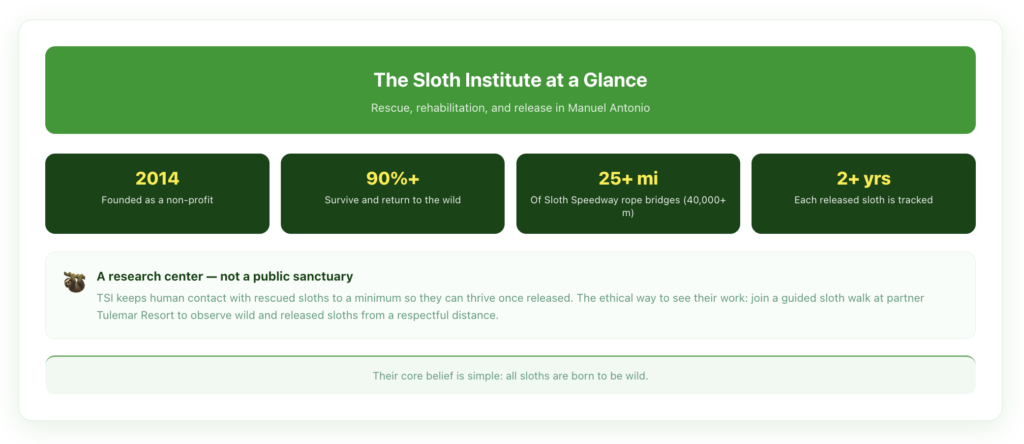
The Sloth Institute (TSI) in Manuel Antonio is a research and conservation organization that’s completely changed how Costa Rica approaches sloth rehabilitation. Founded in 2014, this non-profit focuses on rescuing orphaned and injured sloths, rehabilitating them through their innovative “Sloth School” program, and releasing them back into the wild where they belong. If you’re planning to visit Manuel Antonio and want to see sloths ethically, understanding what The Sloth Institute does and doesn’t do is helpful.
Key Takeaways
- The Sloth Institute is a research and conservation organization rather than a public sanctuary, and the sloths under their care aren’t available for tourist visits to minimize human contact.
- Guests staying at Tulemar Resort can join educational sloth walks to observe released sloths in their natural habitat.
- TSI has one of the most successful rehabilitation programs in Costa Rica, with over 90% of their patients surviving and being released back into the wild.
- Both Costa Rican sloth species—the brown-throated three-toed sloth and Hoffmann’s two-toed sloth—can be spotted in the Manuel Antonio area.
- You can support their work through symbolic sloth adoptions, donations, or their volunteer program.
What Makes The Sloth Institute Different From a Sloth Sanctuary?
Here’s something that surprises a lot of travelers: The Sloth Institute isn’t open to the public. Unlike traditional sanctuaries where visitors can view captive animals, TSI operates as a research center focused on minimizing human contact with the rescued sloths. They take this approach because sloths that become too comfortable around humans have a harder time surviving in the wild.
Their philosophy centers on one core belief: all sloths are born to be wild. Before TSI’s program, many people in Costa Rica believed hand-raised sloths couldn’t successfully reintegrate into the wild. TSI proved that assumption wrong by developing protocols that prepare rescued sloths for independent life in the rainforest.
The organization partners with Tulemar Resort, a vacation rental property in Manuel Antonio, where rehabilitated sloths are released. This partnership gives the sloths access to protected rainforest habitat while allowing researchers to track their progress. Guests at Tulemar can join guided sloth walks, which are educational experiences that focus on observing wild and released sloths from a respectful distance.
What Programs Does The Sloth Institute Run?
TSI takes a comprehensive approach to sloth conservation through several interconnected programs. Their rescue and rehabilitation work forms the core of their work, but they’ve expanded into research, education, and habitat protection.
How Does Sloth School Work?
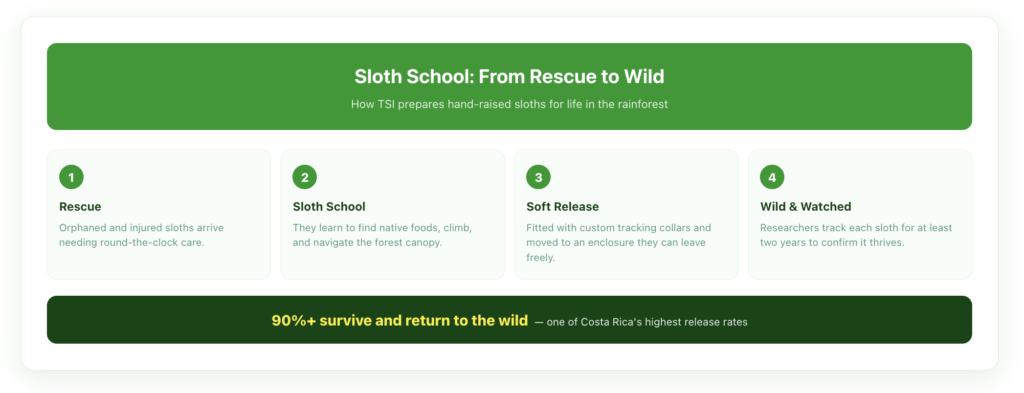
“Sloth School” is TSI’s innovative rehabilitation program designed to prepare hand-raised sloths for life in the wild. Orphaned baby sloths arrive needing round-the-clock care, but the goal is to teach them the skills they’ll need to survive independently.
The program moves sloths through stages of increasing independence. The sloths learn to find and eat native foods rather than depending on human-provided meals. They develop climbing skills and learn to navigate the forest canopy. Eventually, they’re fitted with custom tracking collars and moved to a soft-release enclosure where they can come and go freely.
Once released, TSI researchers track each sloth for at least two years to
document their movements, behavior, and health. This long-term monitoring has provided valuable data about sloth behavior, which has helped improve rehabilitation protocols across Costa Rica.
What Are Sloth Speedways?
One of TSI’s most creative conservation projects addresses a problem many visitors don’t think about: habitat fragmentation. When forests are broken up by roads, power lines, and development, sloths lose the continuous canopy they need to travel safely.
Sloth Speedways are rope bridges strategically placed to reconnect fragmented forest areas. These simple solutions give sloths safe passage over roads, which is important as slowly crossing on the ground is one of the most dangerous activities for these arboreal animals. TSI has installed over 40,000 meters of these wildlife bridges in the Manuel Antonio area.
The project addresses a grim reality because electrocution from power lines is the number one cause of adult sloth injuries in Manuel Antonio. By providing alternative routes through the trees, Sloth Speedways keeps sloths away from electrical hazards.
Where Can You See Sloths Near Manuel Antonio?
If you’re driving to Manuel Antonio from San José, you’re heading into prime sloth territory. The Central Pacific coast supports healthy populations of both sloth species, and with some patience (and ideally a guide), you’ll have good chances of spotting them.
Which Sloth Species Live in Costa Rica?
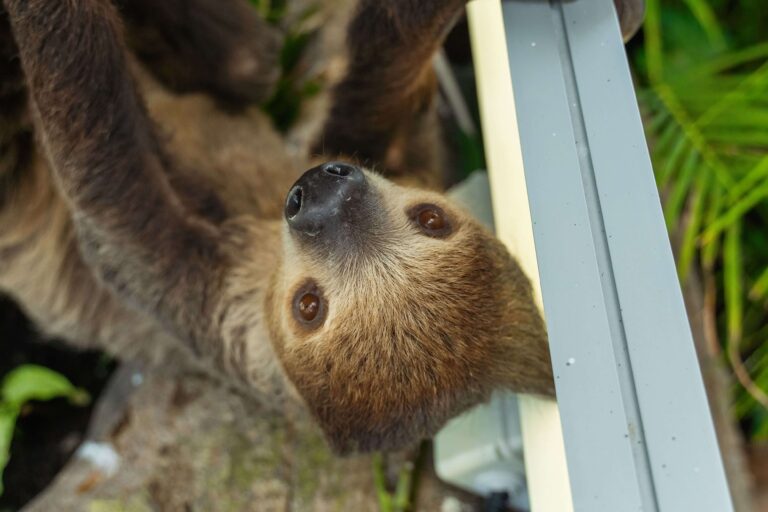
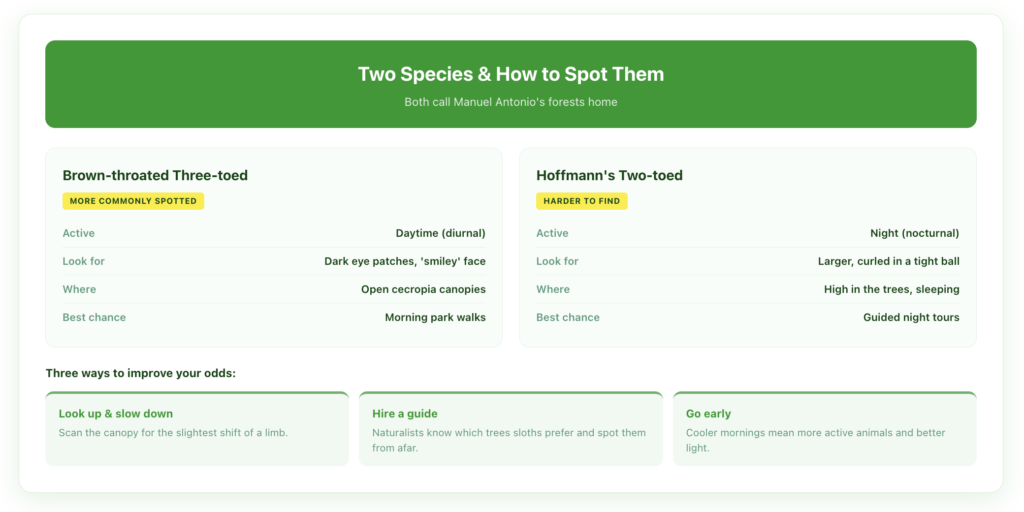
Costa Rica is home to two of the world’s six sloth species. The brown-throated three-toed sloth is the more commonly spotted variety. They’re active during the day and have distinctive dark eye patches for a constant smiley look. You’ll often spot them in the open canopies of cecropia trees.
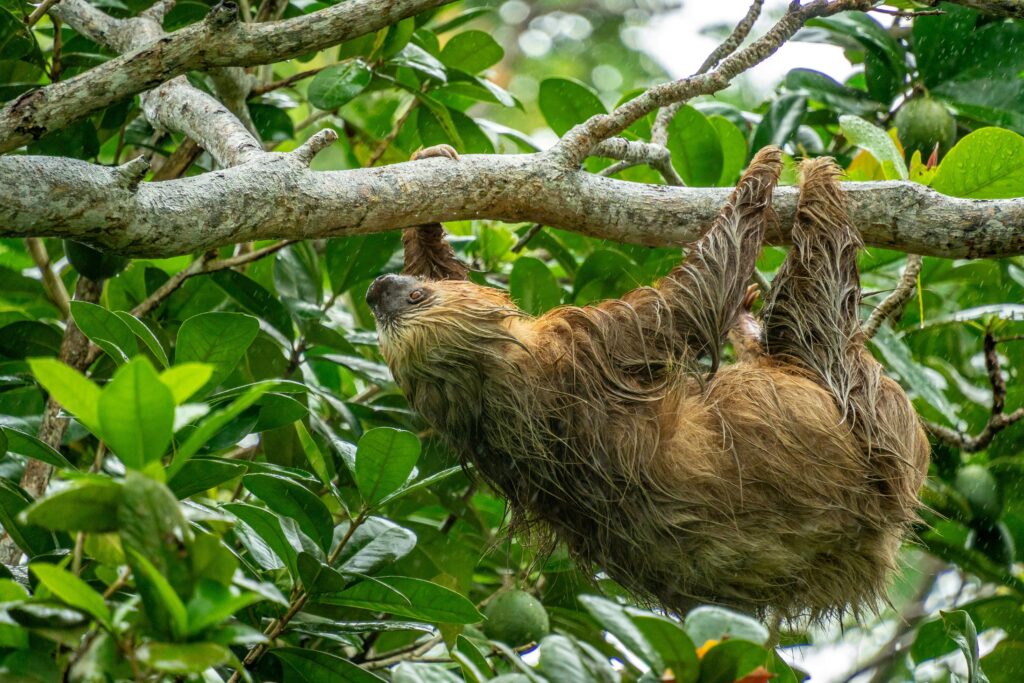
The Hoffmann’s two-toed sloth is larger but harder to find. They’re primarily nocturnal, so daytime visitors usually catch them sleeping in tight balls high in the trees. If you’re taking a night tour in the area, you might see one on the move.
Both species thrive in Manuel Antonio’s protected forests, although deforestation and development continue to put pressure on populations throughout Costa Rica.
How Do You Spot Sloths in the Wild?
Sloths are masters of camouflage, as their fur actually grows algae that helps them blend into the canopy, and most visitors walk right past them without noticing. A few tips improve your odds of a sloth sighting:
- Look up. Sloths spend nearly their entire lives in the trees, often tucked into the crooks of branches or stretched along horizontal limbs. Scan slowly and watch for movement, as even a slight shift of a limb can give away their position.
- Hire a guide. Local naturalists have finely-tuned sloth-spotting skills developed over years of daily observation. They know which trees sloths prefer and can spot them even from a distance. When you enter Manuel Antonio National Park, a certified guide dramatically increases your wildlife sightings.
- Visit early. Sloths tend to be more active in the cooler morning hours. An early start at the park gives you the best lighting for photography, and you’ll spot animals before the afternoon heat sends them into rest mode.
How Can You Support The Sloth Institute?
Even if you can’t visit TSI directly, there are several ways to contribute to their conservation work while traveling through Costa Rica’s Pacific coast.
What Is the Adopt-a-Sloth Program?
TSI’s symbolic adoption program lets you support a specific sloth’s care and rehabilitation. Your donation goes toward food, medical care, and the monitoring equipment needed to track released sloths. You’ll receive an adoption certificate featuring your sloth, which is a meaningful souvenir that actually makes a real difference to a sloth’s survival.
Adoption packages start at $35 and make thoughtful gifts for wildlife enthusiasts traveling to Costa Rica. The funds support the tree nursery that provides native food sources and the medical supplies needed for injured sloths arriving at the facility.
Can You Volunteer at The Sloth Institute?
For those who want deeper involvement, TSI accepts a limited number of volunteers and interns throughout the year. Positions include Sloth Research Technicians who assist with fieldwork, Husbandry Technicians who support daily care routines, and Social Media Interns who help spread awareness about the Institute.
Volunteer commitments typically run from one month to a year because conservation work requires dedication. For biology students or wildlife enthusiasts considering a longer stay in Costa Rica, these positions offer hands-on experience with one of the country’s most respected wildlife organizations.
What Should You Know About Ethical Sloth Tourism?
Here’s the uncomfortable truth: many sloth experiences marketed to tourists actually harm the animals they claim to help. TSI has been vocal about the difference between responsible sloth tourism and practices that exploit these much-loved animals.
Why Shouldn’t You Touch or Hold Sloths?
Sloths may look cuddly, but they’re wild animals that experience significant stress from human handling. Their slow movements and perpetual “smile” make them seem content, but those expressions don’t indicate emotion, as they do not have the facial muscles to change expressions.
Facilities that allow tourists to hold sloths often keep animals in captivity specifically for photo opportunities. This practice has driven the illegal capture and trade of wild sloths throughout Central America. Costa Rica has recognized the problem, and in 2021, the country passed Law No. 10.007 declaring both sloth species as National Symbols of Wildlife to help prevent exploitation.
Observe sloths from a distance, don’t use flash photography, and never attempt to touch or feed wild sloths. These simple practices let you appreciate these remarkable animals without contributing to their harm.
What Makes a Sloth Experience Ethical?
When choosing wildlife activities in Costa Rica, look for operations that prioritize animal welfare over tourist convenience. Ethical programs focus on wild observation rather than captive displays and use certified naturalist guides who understand animal behavior. They don’t guarantee sightings because wild animals don’t perform on schedule.
The sloth walks offered through Tulemar (in partnership with TSI) exemplify this approach. Guides share information about sloth biology and conservation while searching for wild and released sloths on the property. There’s no touching, no feeding, and no captive animals on display for photos.
How Do You Get to Manuel Antonio?
Manuel Antonio sits about 97 miles (157 kilometers) south of San José, which makes it an easy addition to most Costa Rica itineraries. The drive takes roughly three hours via Route 27 toward Caldera, then south along the coastal highway through Jacó and Quepos.
Having a rental car gives you the flexibility to explore the region on your own schedule. Many travelers combine Manuel Antonio with stops at Carara National Park for scarlet macaw sightings or continue south to the Osa Peninsula for more remote wildlife encounters.
The town of Quepos serves as the gateway to Manuel Antonio and offers all the services travelers need, including restaurants, shops, and tour operators. From Quepos, it’s a short drive down the hill to the national park entrance and the cluster of hotels that overlook the coastline.
If you’re flying into Costa Rica, Juan Santamaría International Airport (SJO) in San José provides the most direct access to Manuel Antonio. You can also fly into Liberia Airport and take a scenic route along the coast, although the drive is longer.
Frequently Asked Questions
What Steps Does The Sloth Institute Take to Protect Sloths in Costa Rica?
TSI runs a comprehensive conservation program that includes rescue and rehabilitation of injured and orphaned sloths, research on wild sloth populations, education programs for local communities and tourists, and habitat protection projects like Sloth Speedways that reconnect fragmented forests. They’ve also pioneered tracking programs that monitor released sloths for at least two years to ensure their successful reintegration into the wild.
Is the Sloth Sanctuary Worth It?
TSI is purposely not a traditional sanctuary open to public visits. If you’re staying at Tulemar Resort, the educational sloth walks offer an ethical way to observe wild and released sloths while learning about conservation. For other visitors, the best sloth experiences happen during guided walks through Manuel Antonio National Park or by supporting TSI’s work via donations and symbolic adoptions.
Can I Touch a Sloth?
Any facility that lets you touch or hold sloths should be avoided. Physical contact causes significant stress to these wild animals, and operations that offer handling often rely on illegally captured or improperly cared-for sloths. The Sloth Institute actively campaigns against “sloth selfie” tourism and encourages observation from a respectful distance instead.
What Is the Main Purpose of Sloth School?
Sloth School is TSI’s rehabilitation program that prepares orphaned and injured sloths for release into the wild. The program teaches hand-raised sloths essential survival skills, including finding native food sources, navigating the forest canopy, and living independently. As a consequence, TSI has one of the highest successful release rates for rehabilitated sloths in Costa Rica.
What Is the Lifespan of a Sloth?
In the wild, sloths typically live 20-30 years, though some individuals have reached 40 years in protected environments. Both the three-toed and two-toed sloths found in Costa Rica have similar lifespans. Their slow metabolism and limited predators (once they reach adulthood) contribute to their longevity when their habitats remain intact.
What Is the Biggest Killer of Sloths?
In the Manuel Antonio area, electrocution from power lines is the leading cause of injury and death among adult sloths. When habitat fragmentation forces sloths to travel along power lines instead of through a continuous canopy, the risk of electrocution increases dramatically. TSI’s Sloth Speedway program directly addresses this serious issue by providing safe alternative routes through the trees.