
Last Updated on February 26, 2026
Costa Rica Currency Guide: What's Covered
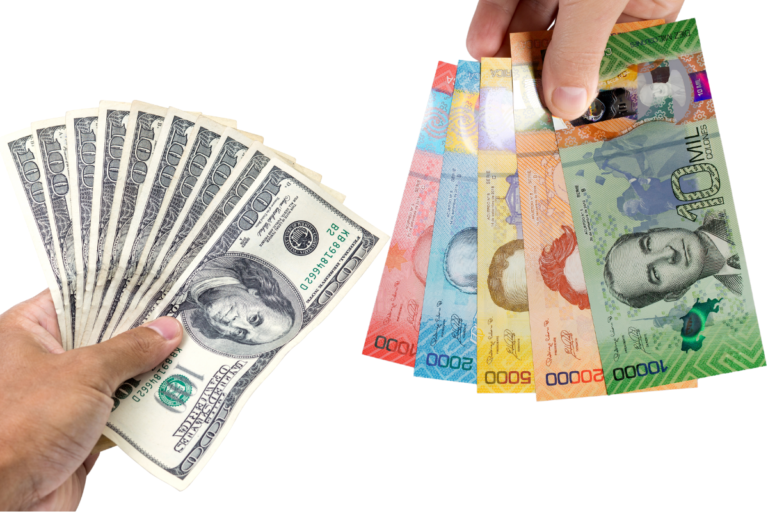
Costa Rica uses both colones (₡) and US dollars, with exchange rates fluctuating daily around 510-550 CRC to $1 USD as of 2024-2025, making it essential to know when to use each currency for the best value during your trip. While tourist services like hotels, tours, and car rentals typically quote prices in USD, smaller purchases at markets, sodas, and buses require colones for better exchange rates and convenience. Having both currencies plus a credit card gives you flexibility – withdraw colones from ATMs for the best rates rather than exchanging at airport booths.
Quick Facts:
- Bring small USD bills ($5, $10, $20) – larger bills are hard to break and must be in pristine condition
- Public buses in San José only accept colones – no exceptions
- Bank exchange rates beat airports by 5-8% – exchange just $20-50 at SJO for immediate needs
- Credit cards are widely accepted, but some areas like Tortuguero and Drake Bay are cash-only
- Budget $300 USD cash per person per week, exchanging $100 to colones upon arrival
Top 5 Money Tips:
- Use USD for Tourist Services – Hotels, tour operators, shuttles, and rental cars quote in dollars – paying in USD avoids conversion losses
- Pay Colones for Local Purchases – Farmers markets, taxis, sodas, gas stations, and tolls price in colones – you’ll save 5-10% using local currency
- ATMs Beat Exchange Booths – Banco Nacional ATMs charge the lowest fees and dispense both currencies at better rates than cambios
- Request CRC on Credit Cards – When paying by card, ask to be charged in colones to get your bank’s exchange rate instead of the merchant’s markup
- Cash-Only Destinations – Remote areas like Osa Peninsula, Santa Teresa, and Tortuguero may not accept cards – plan accordingly
Smart money management means carrying a mix of pristine USD bills, some colones for small purchases, and a no-foreign-transaction-fee credit card for larger expenses.
If you need any help with a Costa Rica car rental, contact us now!
You can absolutely use US dollars throughout Costa Rica – most tourist businesses accept them happily – but you’ll need Costa Rican colones for local sodas, fruit stands, public buses, and that incredible roadside coffee spot locals love. Bring $300-500 in small US bills (5s, 10s, 20s) per person per week, exchange about $100 to colones when you arrive, and keep both currencies handy for the best prices and smoothest transactions.
Key Takeaways
- US dollars work everywhere tourists go, but colones get you better deals at local spots
- Bring $300-500 cash per person/week in pristine small bills ($5, $10, $20)
- Exchange rate fluctuates daily – currently around 510-530 colones per $1 USD (September 2025)
- ATMs dispense both currencies at major banks (Banco Nacional has lowest fees)
- Visa credit cards accepted widely; American Express only at high-end spots
- Canadian dollars and Euros only exchangeable at airports and select banks
- Never accept torn or marked US bills – Costa Rica won’t take them
What’s the Official Currency of Costa Rica, and Can I Really Use Dollars?
The Costa Rican colón (₡) serves as the official currency, named after Christopher Columbus, but here’s what matters: US dollars function as an unofficial second currency throughout the country. Hotels, tour operators, and restaurants in Tamarindo, Manuel Antonio, and La Fortuna quote prices directly in USD. Even gas stations near tourist corridors accept dollars, though they’ll give change in colones.
The colón floats freely against the dollar, meaning exchange rates shift daily. As of mid-September 2025, you’re looking at roughly 510-530 colones per dollar, down from 560 last year. Banks post slightly different rates since the Central Bank provides reference rates rather than fixed exchanges.
How Much Cash Should I Bring to Costa Rica?
Start with $300-500 in US cash per person for a week-long trip, broken into small denominations. Those crisp $5, $10, and $20 bills work everywhere, while $50s and $100s often get rejected outside banks and casinos. Pack bills in absolutely perfect condition – no tears, stains, or even excessive creases. A tiny fold mark that seems insignificant back home? That bill won’t fly here.
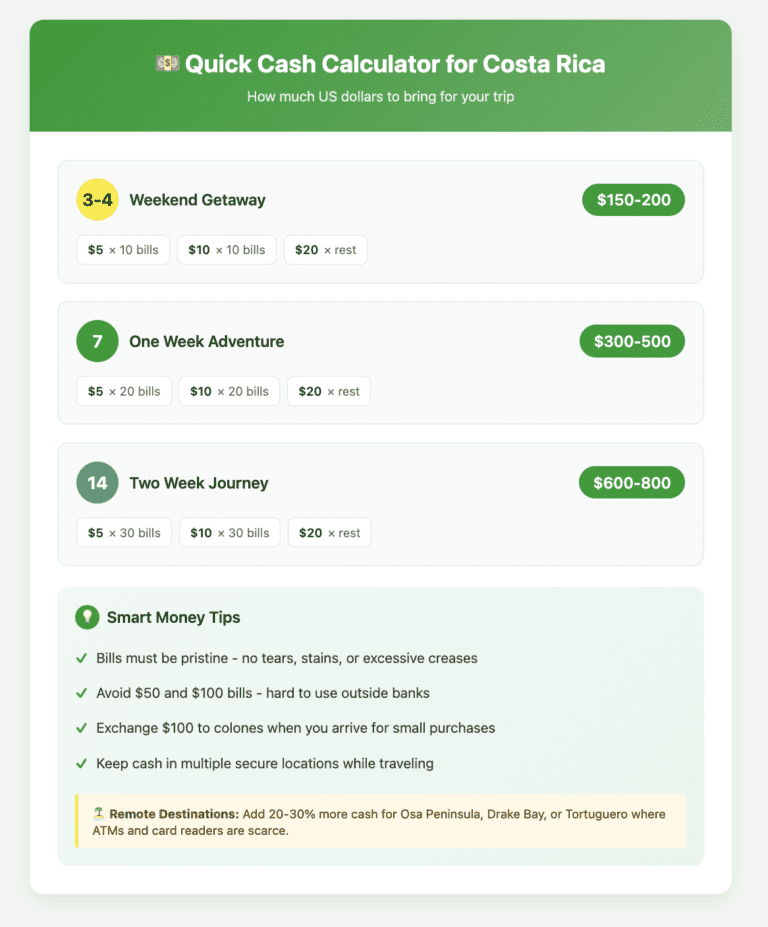
For remote destinations like Drake Bay, Tortuguero, or the Osa Peninsula, bump these amounts up 20-30% since card readers are scarce.
When Should I Use Dollars vs. Colones in Costa Rica?
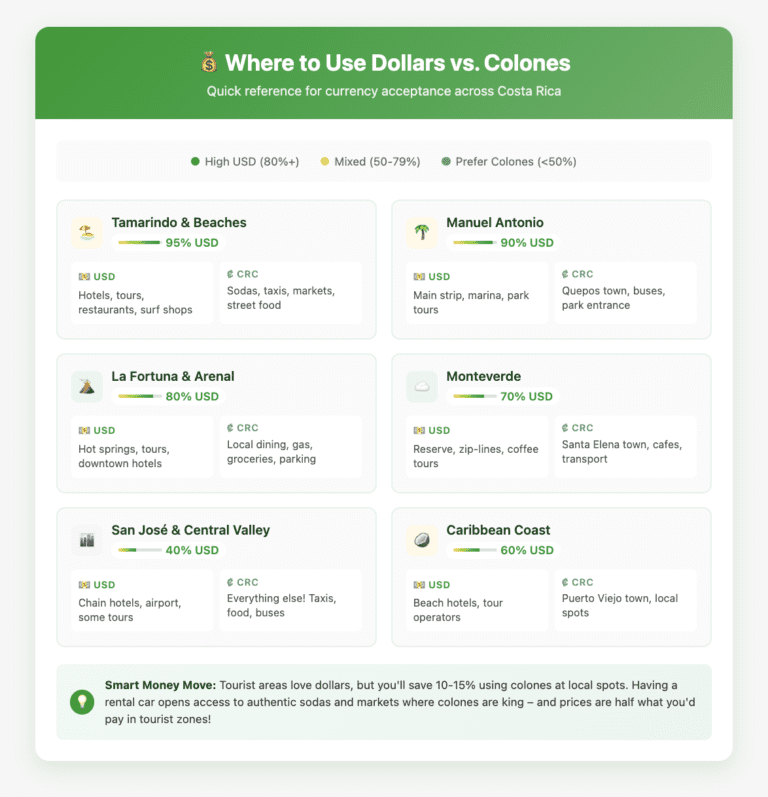
Pay in dollars for anything quoted in dollars – hotels, organized tours, shuttle services, and most sit-down restaurants in beach towns. You’ll avoid conversion confusion and typically get fair rates.
Switch to colones for everything else: sodas (small local restaurants), fruit vendors, taxi rides, public buses, national park entrance fees, and toll booths. That ₡3,500 casado lunch special? Paying with a $10 bill means you’ll get about ₡2,000 back in change using the vendor’s exchange rate, not the ₡4,500 you’d expect at bank rates.
Where Can I Get the Best Exchange Rates in Costa Rica?
Banks offer the most favorable rates for currency exchange. Banco Nacional, BCR, and Scotiabank all exchange dollars (bring your passport), with Banco Nacional typically posting the best rates. Their ATMs also charge the lowest fees – about ₡2,000 ($4) per withdrawal.
Skip the airport exchange desks unless you’re desperate. After clearing immigration at both Liberia and San José airports, you’ll find Global Exchange counters that handle USD, Euros, and Canadian dollars, but their rates run 5-10% worse than banks. If you’re heading straight to a rental car and then into rural areas, exchange just enough for immediate needs.
Supermarket chains like Auto Mercado and Más x Menos offer decent rates when you pay in dollars for groceries. Gas stations post their daily exchange rates on boards near the register – usually 10-20 colones less favorable than banks but convenient for quick conversions.
What About Canadian Dollars and Other Currencies?
Canadian visitors face limited options. Only Scotiabank and occasional Banco Nacional branches exchange Canadian dollars, and airport kiosks handle CAD at poor rates. Your best strategy? Bring some US dollars from home, then rely on a no-foreign-transaction-fee credit card for major purchases.
Request charges in colones when using Canadian credit cards – you’ll get your bank’s exchange rate from CRC to CAD directly, skipping the double conversion through USD that inflates costs by 3-5%.
Euros face similar limitations, though European visitors find slightly more exchange options at banks in San José and beach towns with Italian or German expat communities.
How Do ATMs Work Throughout Costa Rica?
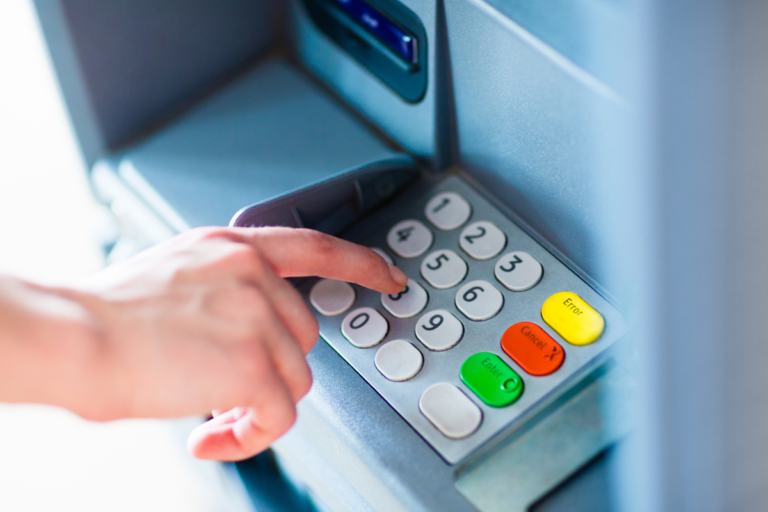
ATMs operate 24/7 at all major banks, dispensing both colones and dollars (you choose). Daily withdrawal limits range from $500-$1,000 depending on your home bank, with local fees around ₡2,000-3,000 per transaction.
Pro tip: Withdraw during banking hours (9am-3pm weekdays) when guards are present and machines get restocked. Avoid Sunday evening or Monday morning withdrawals at beach towns – machines often run empty after busy weekends.
Which Credit Cards Actually Work in Costa Rica?
Visa dominates acceptance here, working at 90% of businesses that take cards. Mastercard follows at about 70%, while American Express only flies at high-end hotels and select tour operators. Forget Discover entirely.
Always clarify the charge currency before swiping. Some payment terminals default to colones without asking, turning your expected $50 dinner into ₡50,000 (about $100). Watch that screen carefully and ask “dólares o colones?” if uncertain.
Debit cards work at ATMs but avoid them for purchases. Rental car companies won’t accept debit cards for deposits since refunds take months to process. Hotels might accept them but you’ll sign waivers acknowledging the lengthy refund timeline.
What Are Those Costa Rican Bills and Coins I’ll Handle?
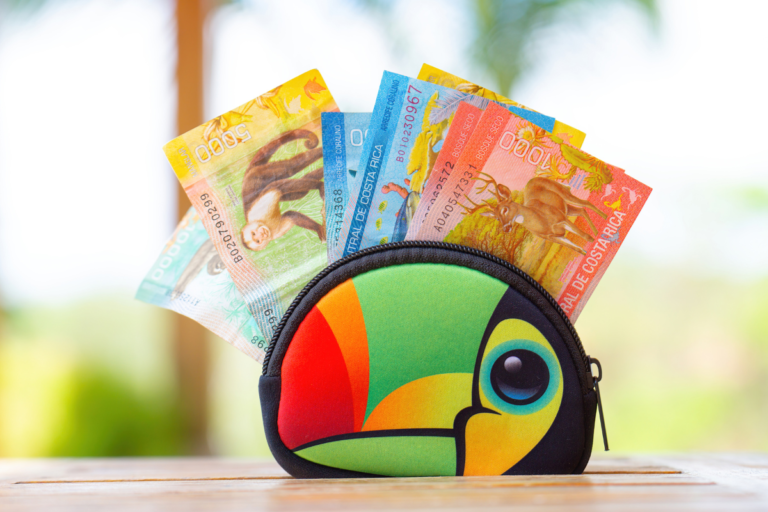
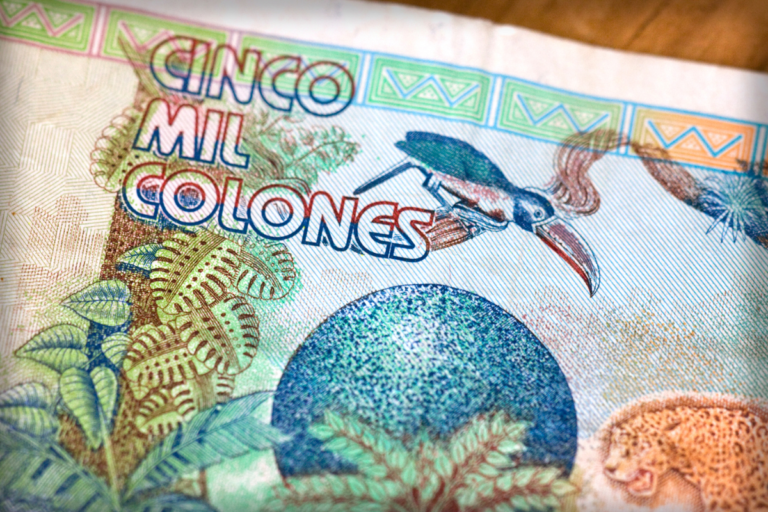
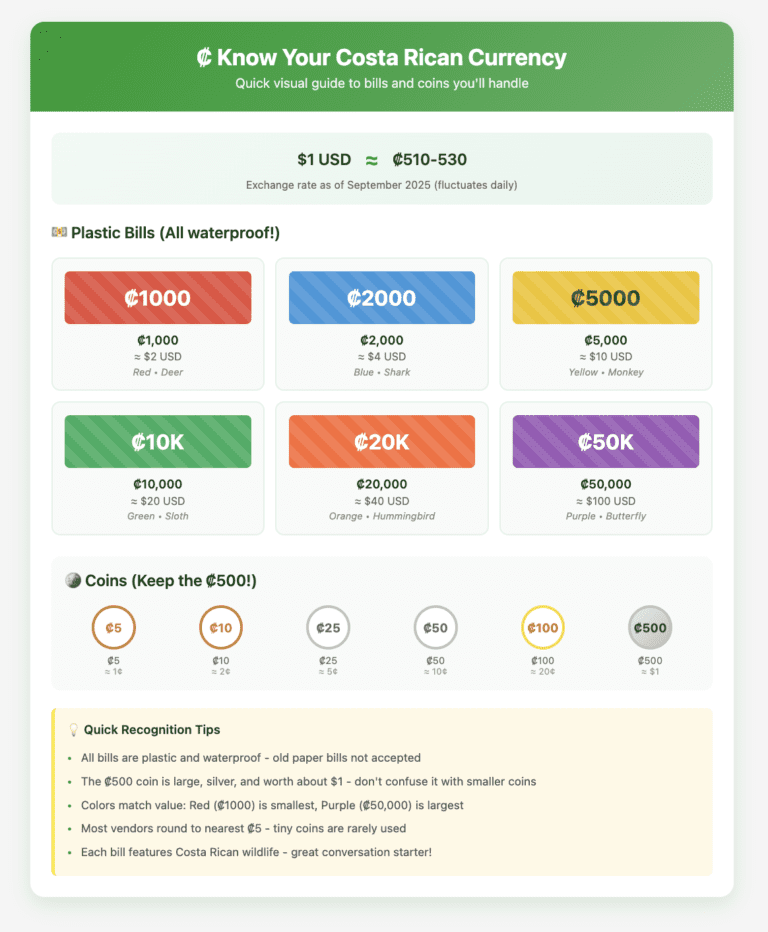
Costa Rica’s colorful plastic bills come in ₡1,000 (red), ₡2,000 (blue), ₡5,000 (yellow), ₡10,000 (green), ₡20,000 (orange), and ₡50,000 (purple) denominations. The red ₡1,000 note features a white-tailed deer, Costa Rica’s national animal.
Coins circulate in ₡5, ₡10, ₡25, ₡50, ₡100, and ₡500 denominations. Silver-colored ₡500 coins are hefty and valuable (about $1), while the smaller denominations barely buy candy. Many vendors round to the nearest ₡5 since the tiny ₡5 and ₡10 coins are more hassle than they’re worth.
Old cotton bills are no longer accepted anywhere – if someone tries handing you a faded paper note as change, politely request current plastic bills instead.
Your Money Game Plan for Costa Rica
Here’s your practical approach: Exchange $100 at a Banco Nacional after arriving, keeping the rest of your pristine US bills secure. Use dollars for big tourist expenses and colones for authentic local experiences. Having a rental car opens access to better exchange rates at banks in smaller towns versus tourist-trap currency desks.
Hit an ATM every few days rather than carrying your entire cash stash. Mix payment methods – credit cards for hotels and upscale restaurants, dollars for tours and mid-range spots, colones for sodas and markets.
This balanced approach saves money and prevents those awkward moments when vendors can’t break your $50 bill for a $3 purchase. Plus, you’ll navigate from Tamarindo’s tourist scene to San José’s local markets without constantly wondering if you’re getting ripped off on exchange rates.
Ready to explore Costa Rica without money stress? Contact Vamos Rent-A-Car to secure your vehicle and get insider tips on the best ATM locations along your route. Our team knows exactly which banks offer the best rates between the airport and your first destination.
Frequently Asked Questions
What’s the best currency to bring to Costa Rica?
Bring US dollars in small, pristine bills ($5, $10, $20) for the best flexibility. You’ll use dollars for tourist services like hotels and tours, but you’ll need colones for local spots. Skip Canadian dollars or Euros unless you’re exchanging at the airport – only select banks accept them. Pro tip: $300-500 cash per person per week works perfectly, with about $100 exchanged to colones when you arrive for sodas, fruit stands, and those amazing roadside coffee stops.
How much is $1 USD worth in Costa Rica?
As of September 2025, $1 USD equals approximately ₡510-530 colones, though rates fluctuate daily. Banks offer the best exchange rates, while hotels and tourist spots typically knock off 10-20 colones. That $1 is actually useful here – it covers a cup of excellent local coffee, a small empanada, or bus fare in San José. Just remember the ₡500 coin looks substantial but only equals about $1, so don’t get too excited when you receive one as change!
Is $20 a lot of money in Costa Rica?
It depends where you’re spending it. In tourist areas, $20 gets you a decent meal for one at a sit-down restaurant. But at a local soda, that same $20 (about ₡10,000) buys lunch for four people with drinks included. A taxi from downtown Tamarindo to Playa Langosta? About $20. But drive yourself and you’ll only spend $3 in gas. This is why having both currencies helps – you’ll quickly learn where your dollars stretch furthest.
Should I use my credit card or cash in Costa Rica?
Use credit cards (Visa works everywhere, Mastercard most places) for hotels, upscale restaurants, and tour bookings – but always confirm they’re charging in the currency you expect. Cash is king for everything else: sodas, fruit stands, taxis, park entrances, and anywhere off the beaten path. Places like Drake Bay or Tortuguero? Bring extra cash since card readers are rare. Never use debit cards for purchases, only ATM withdrawals – the refund process for holds can take months.
Do you tip in Costa Rica, and in what currency?
Yes, tipping is appreciated though not mandatory. Restaurants automatically add 10% service charge to your bill – no extra tip needed unless service was exceptional. For tour guides, $5-10 per person for half-day tours works well. Hotel staff appreciate $1-2 per bag or per day for housekeeping. Tip in either currency, but locals prefer colones since they don’t have to exchange them. That friendly attendant who helps you park? ₡500-1000 (about $1-2) is perfect.
Can I use torn or damaged US bills in Costa Rica?
Absolutely not – Costa Rica has strict standards for US currency. Even a tiny tear, stain, or excessive crease means rejection. Banks, stores, and hotels will refuse any bill that isn’t pristine. Those old bills crumpled in your wallet? Leave them home. That $20 with a small pen mark? Won’t work here. Bring only crisp, clean bills or you’ll be stuck with unusable cash. This applies everywhere from five-star resorts to roadside fruit stands.
Where can I find ATMs, and are they safe to use?
ATMs are plentiful at banks in every town, operating 24/7 with English menus. Banco Nacional offers the lowest fees (about ₡2,000/$4 per withdrawal) and reliable service. Stick to bank ATMs, not standalone machines in random locations. Withdraw during daylight hours when bank guards are present. Beach town ATMs often run empty Sunday nights and Monday mornings after busy weekends, so plan ahead. Having a rental car means you can easily hit ATMs in smaller towns where lines are shorter and machines better stocked than tourist areas.