
Last Updated on January 12, 2026
Heredia Cultural Tour: What's Covered
Heredia is absolutely worth visiting if you want to experience authentic Costa Rican culture beyond the beaches and rainforests. Known as the “City of Flowers,” this Central Valley province sits just 10 kilometers north of San José and offers colonial architecture, traditional mask-making artisans, vibrant local markets, and a window into daily Tico life that most tourists never see. While Costa Rica’s wildlife and coastlines capture most attention, the country’s 4.8 million residents actually live and work in cities like Heredia—where you’ll find the oldest churches (Basílica de la Inmaculada Concepción from 1797), colonial-era buildings, and traditions that have shaped Costa Rican identity for centuries. A cultural tour combining Barva’s mask makers, Heredia Market, and Museum of Folk Art takes half to full day, just 30 minutes from Juan Santamaría Airport at 1,137 meters elevation with pleasantly cool temperatures.
Quick Facts
- Location: 10 km north of San José, 30 minutes from Juan Santamaría Airport
- Nickname: “Ciudad de las Flores” (City of Flowers)
- Elevation: 1,137 meters (3,729 feet)—temperatures 17-28°C (62-82°F), cooler than coastal areas
- Cultural Highlights: Barva mask-making workshops (tradition dating 200 years), colonial town centers, Mercado Central
- Time Needed: Half-day (4-5 hours) for cultural tour; full day adds coffee plantation visit
- Best Experience: Organized tour combining mask makers, market exploration, Museum of Folk Art with local restaurant lunch
- Festival Timing: August 24 (Saint Bartholomew’s Day mascarada in Barva), October 31 (National Mascarada Day)
Top 5 Heredia Tips
- Visit Mask Makers in Barva for Living Tradition – Meet artisans who’ve dedicated lives to centuries-old craft; traditional papier-mâché masks took month to complete (modern carbon fiber faster but maintains hand-painted details)—custom masks start $250, depicting devils, witches, celebrities, politicians in genuine community tradition
- Experience Heredia Market for Authentic Local Life – Unlike tourist-oriented San José markets, Heredia’s Mercado Central serves local population with produce at real prices, spice varieties unavailable at supermarkets, authentic Costa Rican prepared foods—vendors may not speak much English but appreciate genuine interest
- Combine with Coffee Plantation Tour – Heredia’s volcanic soil and elevation created premier coffee region since 1800s; Finca Rosa Blanca’s 2-hour organic farm tour or Café Britt’s theatrical experience pair perfectly with morning cultural tour for complete Central Valley day
- Use as First or Last Night Alternative to San José – Better value and more relaxed atmosphere than downtown while maintaining airport accessibility (30 minutes); easily reach Poás Volcano (45 min), Irazú Volcano (1 hour), La Fortuna/Arenal (2.5 hours)
- Time Visit Around Mascarada Festivals – August 24 Saint Bartholomew’s Day in Barva features full celebrations with masked figures chasing spectators, playfully hitting them with dried cow bladders—not tourist show but genuine community tradition surviving 200 years
Heredia offers genuine cultural experiences perfect for travelers exploring beyond Costa Rica’s natural attractions. The province serves as authentic window into Tico life, making it valuable for understanding how residents actually live versus beach/wildlife tourism. Many travelers use Heredia as arrival/departure base before continuing to Arenal Volcano, Monteverde, or beaches. For building comprehensive itineraries, check our one-week and two-week plans. Standard sedans handle paved roads to Heredia fine—no 4×4 required from airport or San José. Public buses run every 10-15 minutes from San José for under $1 USD, making Heredia easy day trip without vehicle. The dry season (December-April) brings clearest weather, while green season (May-November) offers fewer tourists and lower prices with moderate Central Valley weather year-round.
If you need any help with a Costa Rica car rental, contact us now!
Heredia is absolutely worth visiting if you want to experience authentic Costa Rican culture beyond the beaches and rainforests. Known as the “City of Flowers,” this Central Valley province sits just 10 kilometers north of San José and offers colonial architecture, traditional mask-making artisans, vibrant local markets, and a window into daily Tico life that most tourists never see.
While Costa Rica’s wildlife and coastlines capture most of the attention, the country’s 4.8 million residents actually live and work in cities like Heredia. This is where you’ll find the oldest churches, colonial-era buildings, and traditions that have shaped Costa Rican identity for centuries including the famous mascarada celebrations that date back to the 1800s.
Key Takeaways
- Location: 6 miles (10 kilometers)_ north of San José, 30 minutes from Juan Santamaría Airport
- Known for: Colonial architecture, traditional mask-making, coffee plantations
- Nickname: “Ciudad de las Flores” (City of Flowers)
- Best experience: Cultural tour combining Barva’s mask makers, Heredia Market, and the Museum of Folk Art
- Time needed: Half-day to full day
- Elevation: 3,729 feet (1,137 meters) so pleasantly cooler than coastal areas
Heredia, Costa Rica
"Ciudad de las Flores" — City of Flowers
No 4WD needed — Paved roads throughout the province
What Makes Heredia Different from Other Costa Rica Destinations?
Heredia offers something you won’t find at Manuel Antonio or La Fortuna which isan authentic glimpse into how Costa Ricans actually live. The province combines several elements that make it unique:
Colonial Heritage Still Intact
Founded in 1706, Heredia is one of Costa Rica’s oldest continuously inhabited cities. Unlike San José, which has modernized rapidly, Heredia has preserved much of its colonial character. The Basílica de la Inmaculada Concepción which dates from 1797 and overlooks the central park with its solid stone construction and bells that were shipped from Peru.
El Fortín, a 42-foot (13-meter) brick fortress tower built during the Spanish colonial period, is a symbol of the city and offers visitors a physical connection to Costa Rica’s past. You can walk the same streets where coffee barons built their fortunes and where independence was celebrated in 1821.
Living Traditions
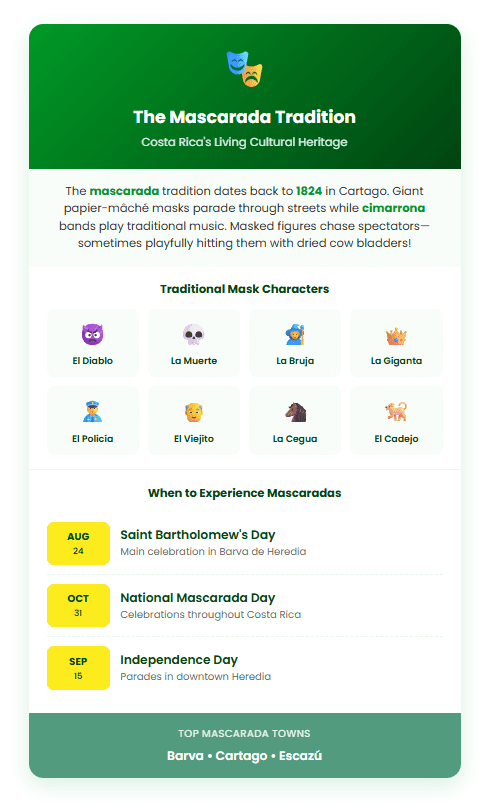
The mascarada tradition, where locals parade through streets wearing oversized masks while musicians play cimarrona music, has roots going back nearly 200 years. The Heredian colonial town, Barva, maintains one of the strongest mascarada traditions in the country. Every August 24th, the town celebrates Saint Bartholomew’s Day with masked figures who (yes, really) chase spectators and playfully hit them with dried cow bladders.
It’s a genuine community celebration that has survived the arrival of television, smartphones, and global culture rather than a show for tourists.
University Town Energy
The National University of Costa Rica brings thousands of students to Heredia, creating a young, vibrant atmosphere with cafes, bookshops, and cultural events. The university also houses the Volcanic and Seismological Observatory of Costa Rica (OVSICORI), making Heredia a center for scientific research.

What Can You See on a Heredia Cultural Tour?
A proper cultural tour covers the highlights of both Heredia city and the surrounding colonial towns. Here’s what to expect:
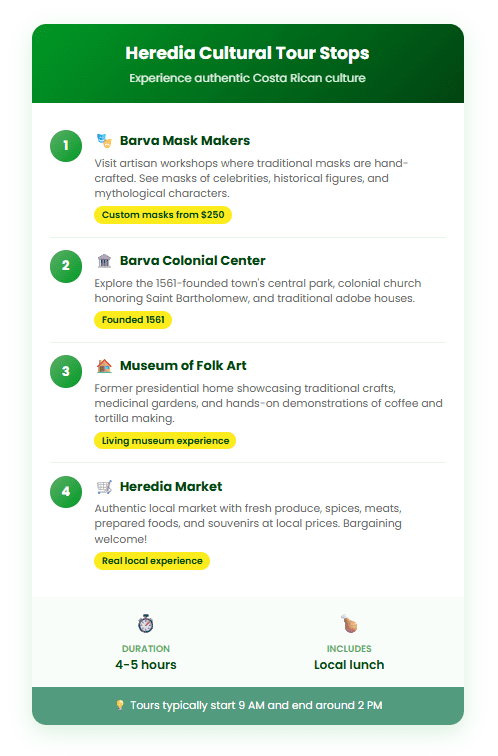
The Mask Makers of Barva
Barva was first founded by Spanish settlers in 1561 which makes it one of the oldest continuously occupied towns in the country. The town’s identity is deeply connected to mask-making as the craft that has been passed down through generations.
Visiting a mask maker’s workshop reveals the artistry behind these creations. Traditional masks used to be made from papier-mâché, which could take a month to complete. Modern techniques using carbon fiber have shortened production time while maintaining the hand-painted details that make each mask unique.
The masks depict a fascinating range of characters from traditional figures like devils, witches, and la giganta (representing wealthy colonial ladies) to contemporary celebrities and politicians. Prices start around $250 for custom masks and each is crafted specifically to the customer’s needs.
What makes this experience special is meeting artisans who have dedicated their entire lives to this craft. They’re not performing for tourists; they’re continuing a tradition that defines their community.
Barva’s Colonial Town Center
Every Costa Rican town centers around its park and church, and Barva’s central square offers a perfect example of this pattern. The park serves as the community’s living room where kids gather after school, vendors sell snacks, couples meet, and elderly residents catch up on local gossip.
The colonial church honoring Saint Bartholomew dominates one side of the square, its architecture a reminder of Spanish influence that once extended throughout Central America. The surrounding streets feature traditional adobe houses with the classic colonial style that’s increasingly rare in modernizing Costa Rica.
Museo de Cultura Popular (Museum of Folk Art and Culture)
This museum occupies the former home of ex-president Alfredo González Flores, who served from 1914 to 1917. Beyond displaying artifacts, the museum actively teaches traditional skills to local children such as coffee making, tortilla preparation, and other practices that might otherwise be forgotten.
The grounds include medicinal plant gardens and original coffee worker housing, providing context for understanding how Costa Rica’s coffee economy shaped society in this living museum.
Heredia City: Park, Church, and Market
The city of Heredia itself rewards exploration on foot. The central park and Basílica de la Inmaculada Concepción form the historic heart, with the fortress El Fortín and Casa de la Cultura nearby.
But the real highlight for many visitors is the Mercado Central (Central Market). Unlike tourist-oriented markets in San José, Heredia’s market serves the local population. You’ll find:
- Fresh produce at prices locals actually pay
- Spice vendors with varieties you won’t find at supermarkets
- Local meat and seafood counters
- Authentic Costa Rican prepared foods
- Souvenirs at reasonable prices with room to bargain
The market experience offers honest interaction with vendors who may not speak much English but appreciate when visitors show genuine interest in their products.
How Do You Get to Heredia?
From San José or the Airport
Heredia sits just 6 miles (10 kilometers) north of San José and approximately 30 minutes from Juan Santamaría International Airport. The roads are paved and well-maintained—no 4WD required.
If you’re driving a rental car, the route is straightforward. From the airport, head toward San José, then follow signs north toward Heredia. Traffic can be heavy during rush hours (6:30-8:30 AM and 4:30-6:30 PM), so plan accordingly.
Public Transportation
Buses run every 10-15 minutes during peak hour between San José and Heredia for less than $1 USD. The ride takes approximately 30 minutes depending on traffic which makes Heredia an easy day trip from the capital.
Organized Tours
Several tour operators offer cultural tours of Heredia province. Finca Rosa Blanca, a boutique coffee plantation and hotel in the Heredia highlands, offers tours that combine mask-making visits, market exploration, and museum stops with lunch at a local restaurant.
Tours typically run 4-5 hours and include transportation from hotels in the Central Valley. This option works well if you’d rather have a guide handle logistics and provide historical context.
What Else Can You Do in Heredia Province?
While the cultural tour covers the historical highlights, Heredia province offers additional experiences:
Coffee Plantation Tours
Heredia’s volcanic soil and ideal elevation have made it a premier coffee-growing region since the 1800s. Several plantations offer tours:
Finca Rosa Blanca operates a 30-acre (12-hectare) organic farm using regenerative agriculture. Their 2-hour guided walk covers shade-grown coffee cultivation, processing, and tasting with spectacular Central Valley views.
Café Britt near Heredia offers theatrical storytelling combined with plantation walks and tastings. They’ve been introducing visitors to Costa Rican coffee culture for decades.
Braulio Carrillo National Park
This massive protected area of 110,000 acres (44,115 hectares) lies within Heredia province and offers challenging hikes through multiple habitat zones. Wildlife includes howler monkeys, toucans, and the elusive quetzal. The Rainforest Aerial Tram provides a unique perspective on the forest canopy.
Barva Volcano
The inactive Barva Volcano provides trails through pristine cloud forest with fewer tourists than Poás or Irazú. Multiple lagoons surrounded by dense vegetation to reward those willing to make the trek.
What’s the Best Time to Visit Heredia?
Weather Considerations
Heredia sits at 3,730 feet (1,137 meters) elevation which gives it a pleasant climate year-round. Temperatures typically range from 17-28°C (62-82°F) which is noticeably cooler than coastal destinations.
The dry season (December-April) offers consistently clear mornings, though afternoon clouds can roll in whereasthe rainy season (May-November) brings afternoon showers but also greener landscapes and fewer tourists.
For the cultural tour specifically, weather rarely interferes since most activities happen indoors or in covered market areas.
Festival Timing
If you want to experience Heredia’s traditions at their peak:
- August 24: Saint Bartholomew’s Day in Barva features full mascarada celebrations
- October 31: National Day of the Traditional Costa Rican Mascarada brings festivities throughout the province
- September 15: Independence Day parades in downtown Heredia
How Does Heredia Fit into a Costa Rica Itinerary?
First or Last Night Base
Heredia makes an excellent alternative to staying in San José when arriving or departing from the airport. You get Central Valley accessibility with a more relaxed atmosphere and better value than downtown San José hotels.
From Heredia, you can easily reach:
- Poás Volcano (45 minutes)
- Irazú Volcano (1 hour)
- Arenal/La Fortuna (2.5 hours)
- Monteverde (3 hours)
Cultural Contrast Day
Many Costa Rica trips focus exclusively on nature. Adding a half-day in Heredia provides cultural contrast that deepens understanding of the country. Pair the morning cultural tour with an afternoon coffee plantation visit for a complete Central Valley experience.
Extended Central Valley Exploration
If you have time for deeper exploration, combine Heredia with other Central Valley highlights:
- Day 1: Arrive, cultural tour of Heredia and Barva
- Day 2: Poás Volcano morning, coffee plantation afternoon
- Day 3: Depart for beaches or cloud forest
This approach means you’re not just passing through the Central Valley—you’re actually experiencing it.
How Safe Is Heredia?
Heredia is generally safe for tourists, especially in the historic center, colonial towns like Barva, and the university area. Standard precautions apply:
- Don’t display expensive jewelry or electronics
- Keep bags close in market crowds
- Use official taxis or ride-sharing apps at night
- Stay aware of your surroundings in any urban environment
The smaller towns surrounding Heredia city like Barva, Santo Domingo, San Rafael tend to be even safer, with tight-knit communities where everyone knows their neighbors.
Compared to San José, Heredia feels noticeably calmer and less chaotic, which many visitors find more comfortable for walking and exploring.
Frequently Asked Questions
Is Heredia worth visiting?
Yes, Heredia offers authentic Costa Rican culture that most tourists miss. The “City of Flowers” combines colonial architecture, traditional mask-making artisans, vibrant local markets, and pleasant weather in a location just 30 minutes from the airport. If you want to understand how Ticos actually live rather than just seeing beaches and wildlife, Heredia delivers that experience.
What is the best month to visit Costa Rica?
December through April (dry season) offers the most reliable weather, with sunny mornings throughout the country. However, the Central Valley around Heredia has moderate weather year-round due to its elevation. May and November (shoulder seasons) bring lower prices and fewer tourists while weather remains manageable. For cultural experiences specifically, timing your trip around festivals like the August mascarada celebrations adds extra dimension.
How far is Heredia from the beach?
Heredia sits in the mountains, approximately 1.5-2 hours from Pacific beaches like Jacó and 2.5-3 hours from Caribbean beaches like Puerto Viejo. The Nicoya Peninsula beaches require about 4 hours including the ferry crossing. Most visitors combine a day in Heredia with coastal destinations before or after, rather than doing day trips between them.
Is Heredia walkable?
The historic center of Heredia is very walkable, with the main attractions clustered around the central park. The market, church, El Fortín, and Casa de la Cultura are all within easy walking distance. Colonial towns like Barva also feature compact centers designed for pedestrians. Public transportation connects these areas efficiently for those without cars but having your own vehicle makes exploration much easier.
How safe is Heredia?
Heredia is considered safe for tourists, particularly in the historic center, university area, and surrounding colonial towns like Barva. Standard urban precautions apply soavoid flashy jewelry, keep belongings secure in crowded markets, and use official taxis at night. The province feels noticeably calmer than downtown San José because there are tight-knit communities in the smaller surrounding towns.
What time of year is it cheapest to go to Costa Rica?
The green season (May through November, excluding July and August) offers the lowest prices, with accommodations and tours sometimes 30-40% cheaper than peak season. September and October typically see the most rain but also the best deals. The Central Valley receives less rainfall than Caribbean or southern Pacific regions, making Heredia relatively comfortable even during rainy months.
How much can $100 get you in Costa Rica?
In Heredia, $100 goes further than in tourist beach towns. A market lunch costs $5-8, local transportation under $1, museum admissions $3-5, and coffee plantation tours around $25. You could realistically enjoy a full cultural day in Heredia including transportation, market lunch, museum entry, and coffee tour—for under $50. The remaining budget covers souvenirs from the market or dinner at a local restaurant.
What are the unspoken rules in Costa Rica?
Ticos appreciate politeness—always greet shopkeepers when entering stores, say “con permiso” (excuse me) when passing close to someone, and learn basic Spanish phrases. Punctuality is flexible and arriving 15-30 minutes late is normal socially, but tourists are expected to be on time for tours. Tipping isn’t mandatory but appreciated (10% at restaurants). Most importantly, embrace the “pura vida” attitude as rushing and complaining are considered poor form.