
Last Updated on June 19, 2026
Ostional Wildlife Refuge: What's Covered
Ostional Wildlife Refuge on Costa Rica’s Nicoya Peninsula hosts the world’s largest mass nesting of olive ridley turtles—called arribadas—bringing up to 500,000 females to one beach. Entry is ~$10 USD with a mandatory guide. It’s 15 minutes from Nosara and 2h 15min from Liberia Airport; Route 160’s unpaved section requires a 4×4 rental.
Quick Facts:
- Arribadas occur 1–2x monthly, lasting 3–7 days; peak September–November
- Green season (May–Dec): daily turtle sightings likely even between mass events
- Dry season (Feb–Apr): easier roads, but very few turtles
- Wear black or dark clothing only — guides enforce this at the beach entrance
- Best times: sunset ~5 PM for nesting mothers, sunrise ~5 AM for hatchlings
Top 3 Experiences:
- Mass Arribada — Hundreds of thousands of turtles nesting simultaneously. September–November peak.
- Hatchling Dawn Walk — 5 AM beach walks, watching baby turtles sprint to the ocean.
- Community Conservation Tour — The world’s only legal egg harvest program; guides explain how locals fund 24/7 beach protection.
Ostional connects naturally to Tamarindo (1.5hrs) and Samara — a logical stop on any Guanacaste road trip.
If you need any help with a Costa Rica car rental, contact us now!
Ostional Wildlife Refuge protects one of the most extraordinary wildlife events on Earth—the arribada, where hundreds of thousands of olive ridley sea turtles storm the same beach to nest simultaneously. Located on Costa Rica’s Nicoya Peninsula about 31 miles (50 km) from Nicoya city, this 238-hectare refuge hosts the planet’s largest mass nesting of olive ridley turtles. If standing among ancient creatures performing a ritual unchanged for millions of years ranks anywhere on your bucket list, this one earns its spot on any Guanacaste itinerary.
Key Takeaways
- Arribadas occur monthly: Mass nesting events happen once or twice per month, with the largest gatherings from July through December.
- Guided tours are mandatory: You cannot enter the refuge without a licensed local guide—rangers enforce this at the beach entrance.
- Entry costs approximately $10 USD: This covers your guide during arribadas.
- A 4×4 or high-clearance vehicle is essential: Route 160’s unpaved section requires it, especially May through January.
- Wear dark clothing only: Bright colors visible from the water deter turtles from coming ashore.
- Best viewing windows: Sunset (around 5 PM) for nesting mothers, sunrise (around 5 AM) for hatchlings.
- Rainy season is prime time: May through December offers the best chances—you can see turtles almost every single day.
What Is an Arribada and Why Does It Happen at Ostional?
The word arribada means “arrival” in Spanish, and nothing quite prepares you for watching it unfold. Picture standing on a 9.3-mile (15 km) stretch of dark sand as thousands of olive ridley turtles emerge from the Pacific, crawling over each other to find space to lay eggs. During peak events in September through November, single arribadas can bring up to 500,000 nesting females ashore over three to seven days.
This phenomenon occurs at only eight beaches worldwide—and two of them are in Costa Rica. Nancite Beach inside Santa Rosa National Park and Playa Ostional both host mass nestings, but Ostional consistently records the largest gatherings on the planet. Scientists still don’t fully understand the synchronized trigger, but turtles typically begin arriving right before a new moon when darkness provides the most protection.
Unlike typical sea turtle nesting—where females arrive individually at night—arribada turtles will nest during daylight hours when beach space runs out. Seeing hundreds of turtles at 2 PM during a peak event isn’t unusual. Space gets so tight that later-arriving turtles crawl directly over earlier nests, which actually plays into the refuge’s unique conservation model.
The refuge was established in 1983 specifically to protect this nesting site after poaching had caused serious population declines. Today, it functions as one of Costa Rica’s most significant wildlife watching destinations, drawing conservation researchers, wildlife photographers, and travelers who simply want something they can’t find anywhere else. Lonely Planet’s Costa Rica guide consistently ranks Ostional among the country’s must-see wildlife experiences.
Where Is Ostional Wildlife Refuge?
Ostional sits on the central Nicoya Peninsula in Guanacaste province, roughly 9 miles (15 km) north of Nosara and about 37 miles (60 km) from Tamarindo. If you’re using Nosara as a base, Ostional is a straightforward 15-minute drive—making it the easiest day trip from that stretch of coast.
The refuge covers 238 hectares of protected land, including the beach itself, adjacent forest, estuary, and mangrove zones at the south end near the Nosara River. That southern section holds excellent wildlife beyond turtles—iguanas, coatis, monkeys, and a wide range of coastal bird species all use those estuaries regularly.
How Do You Get to Ostional?
Driving from Liberia Airport
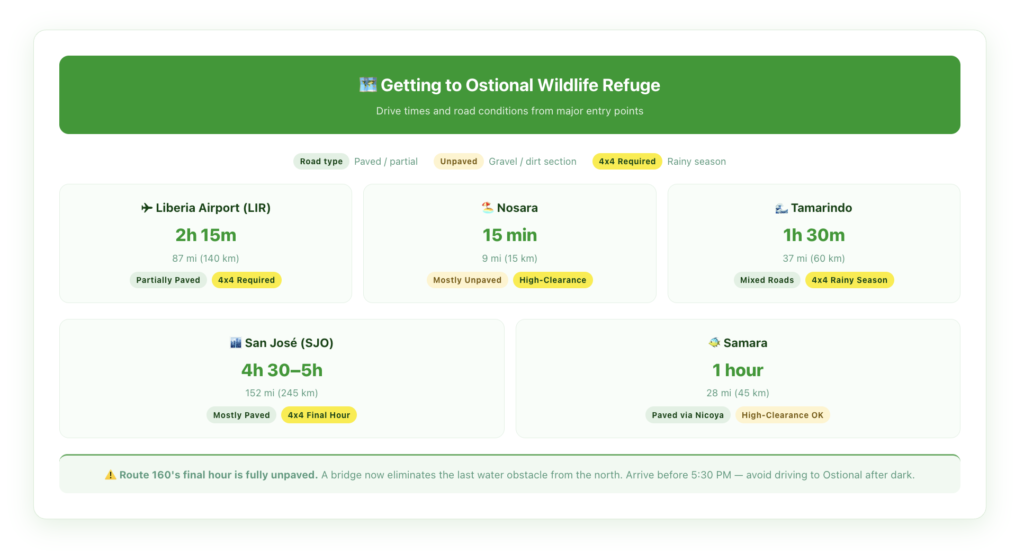
Flying into Liberia (LIR) puts you about 2 hours and 15 minutes from Ostional—the closest international gateway. The drive routes you through Guanacaste’s interior before descending to the coast via Route 160.
That final hour on Route 160 is completely unpaved. During the dry season (December through April), a high-clearance vehicle manages these roads adequately. During the rainy season (May through January), you need a proper 4×4—the road gets genuinely muddy with significant potholes that can catch low-clearance vehicles off guard. Choosing the right rental vehicle before you leave Liberia makes all the difference for this route.
Good news: a bridge now crosses the final river before Ostional from the north, eliminating what was once a challenging water obstacle. Plan to arrive before 5:30 PM—driving after dark in Costa Rica on unpaved roads with minimal signage is genuinely risky and not worth it.
Driving from San José
From San José, budget 4.5 to 5 hours. Take the Friendship Bridge (Puente de la Amistad) over the Tempisque River to access the Nicoya Peninsula, then follow Route 21 toward Nicoya before connecting to coastal roads. Anyone choosing between SJO and LIR with Ostional on their itinerary should strongly consider flying into Liberia—it cuts hours off the trip.
By Bus
Buses run from Santa Cruz to Ostional, departing at noon with a return at 5 PM. Alternatively, take the 5:30 AM bus from San José to Nosara and hire a taxi for the short remaining distance. Bus travel works for budget-conscious visitors, though having your own vehicle gives you the flexibility to time your visit around the best viewing windows at sunset and sunrise.
When Is the Best Time to Visit Ostional?
Rainy Season (May Through December): Prime Turtle Season
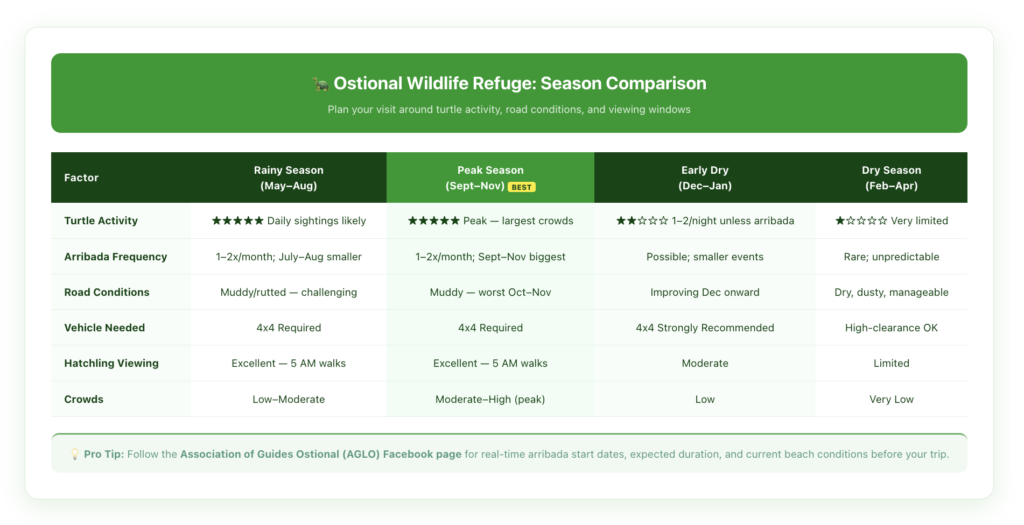
The best turtle watching happens during the green season when activity is highest. You can see turtles almost every day during these months, even outside official arribada events. September through November deliver the most intense mass nestings, with November historically recording the largest gatherings. The trade-off is real: road conditions on Route 160 get serious in these months, and you’ll genuinely need that 4×4. The Tico Times has documented several recent record-breaking September and October events at Ostional.
Dry Season (December Through April): Easier Access, Fewer Turtles
During the driest months (February through April), turtle activity drops significantly. You might see only one or two turtles per night unless you happen to arrive during an arribada. Road conditions improve dramatically during the dry season, making access easier and high-clearance vehicles more manageable without full 4×4 capability.
How to Track Actual Arribada Timing
Arribadas typically occur once per month, sometimes twice, lasting three to seven days each. They generally begin right before a new moon. The Association of Guides in Ostional Facebook page posts real-time updates—when one starts, how long it’s expected to last, and current beach conditions. Following that page before your trip is the single most useful thing you can do to time your visit.
What Time of Day Should You Show Up?
Turtles strongly prefer darkness, making these windows optimal:
- Sunset (around 5 PM): Mother turtles start arriving; often the best time to catch the first wave coming ashore
- Early morning (around 5 AM): Best chance to witness hatchlings racing to the ocean
- During peak arribadas: Turtles nest around the clock, including midday when the beach is completely overrun
What Species Will You See at Ostional?
Olive Ridley Sea Turtles
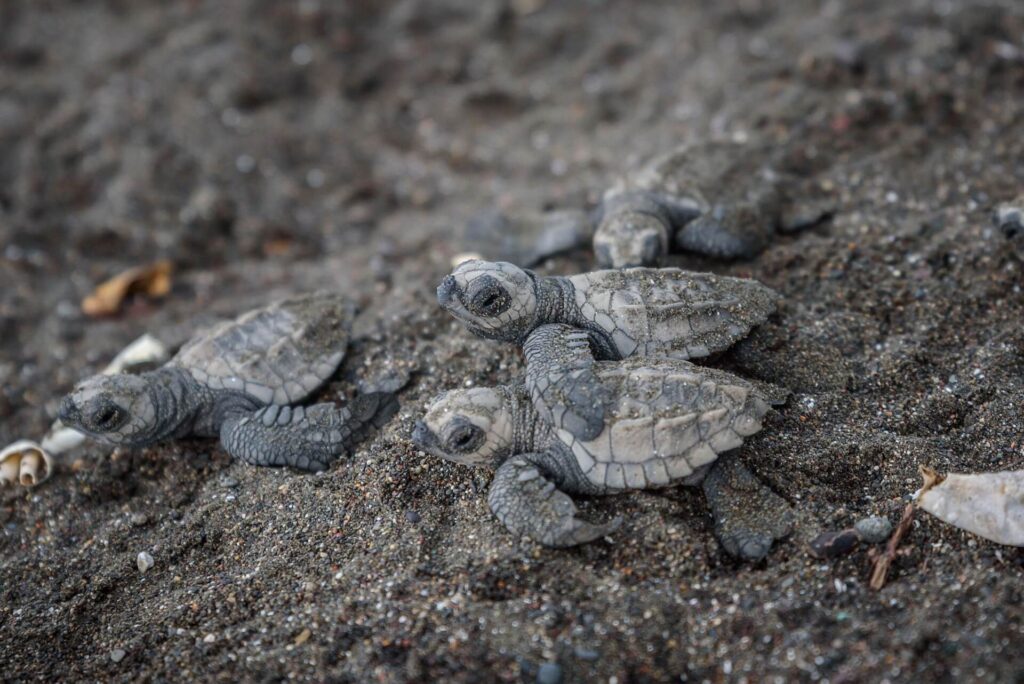
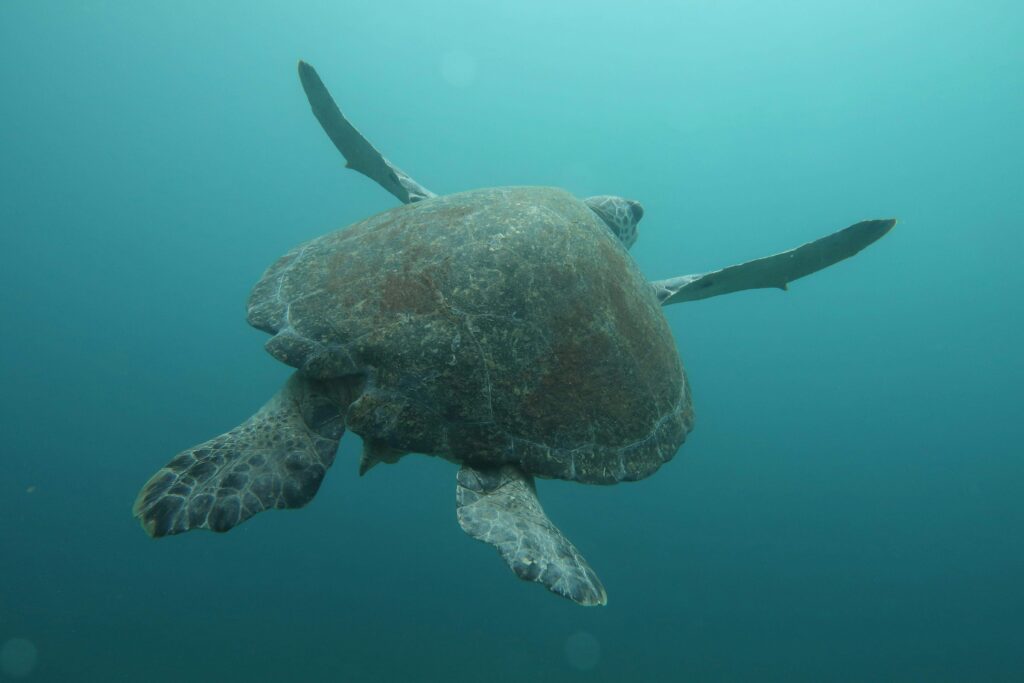
The olive ridley (Lepidochedys olivacea) dominates at Ostional. Named for their olive-green heart-shaped shells, these are the world’s most abundant sea turtle species—yet they’re still classified as Vulnerable on the IUCN Red List due to decades of egg harvesting and habitat loss. They’re the only sea turtle species that nest in synchronized mass events.
Females typically lay 80 to 100 eggs per nest. Incubation takes 45 to 54 days, depending on sand temperature. Once hatched, the babies face an immediate gauntlet—vultures and dogs patrol the beach actively, while predators wait offshore. The survival rate from egg to adult is estimated at roughly one in 1,000, which is part of why the sheer scale of the arribada matters so much biologically. Sea Turtle Conservancy research notes that Ostional’s protected status has stabilized local population numbers significantly since the 1983 refuge establishment.
Leatherback and Pacific Green Turtles
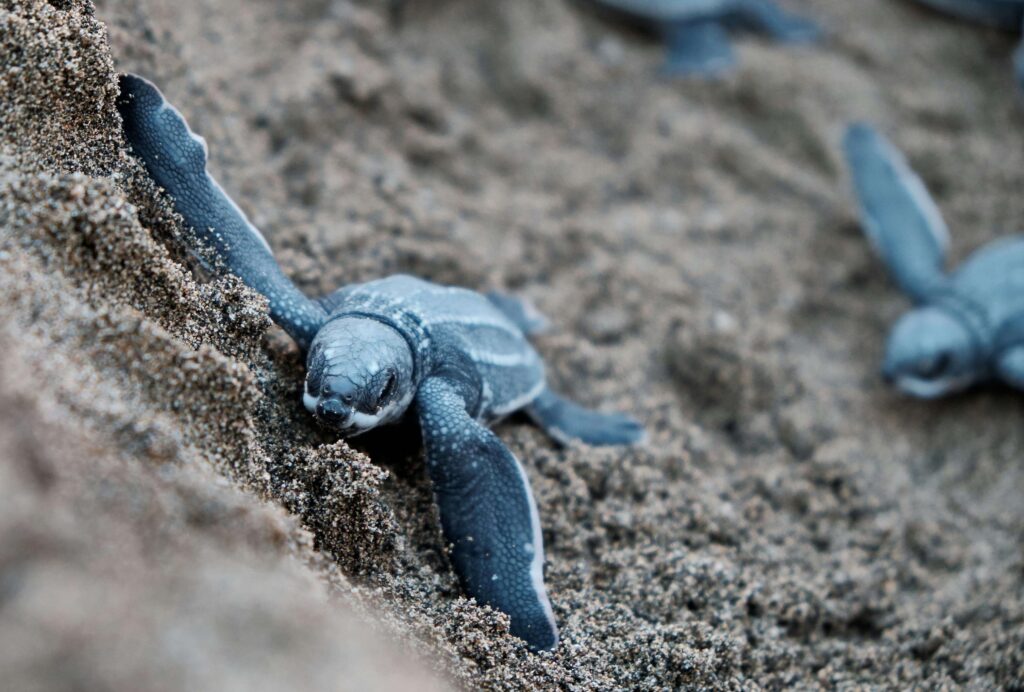
During certain months, you may also spot leatherback and Pacific green turtles nesting at Ostional. These are less common but genuinely exciting when they appear. The leatherback is the largest living turtle species—sometimes exceeding 2,000 pounds (900 kg)—and seeing one on the same beach as the much smaller olive ridleys creates a striking contrast.
Do You Need a Guide at Ostional?
Yes—this is non-negotiable. Rangers stop unaccompanied visitors at the beach entrance. This isn’t bureaucratic inconvenience; guides ensure the protocols that protect nesting turtles actually get followed.
If you’re traveling independently, go to the Guide Association office in Ostional town, located next to the soccer field. You can also message the official Ostional Guide Association Facebook page in advance to book a guide before you arrive. During busy periods—especially peak arribadas—booking ahead means you won’t be left waiting.
Day trips from Tamarindo or Playas del Coco are also available through tour operators for $50 to $80 per person, depending on your starting point. This works well if you prefer not to navigate the unpaved roads yourself or if you don’t have a rental vehicle.
What Are the Rules for Visiting?
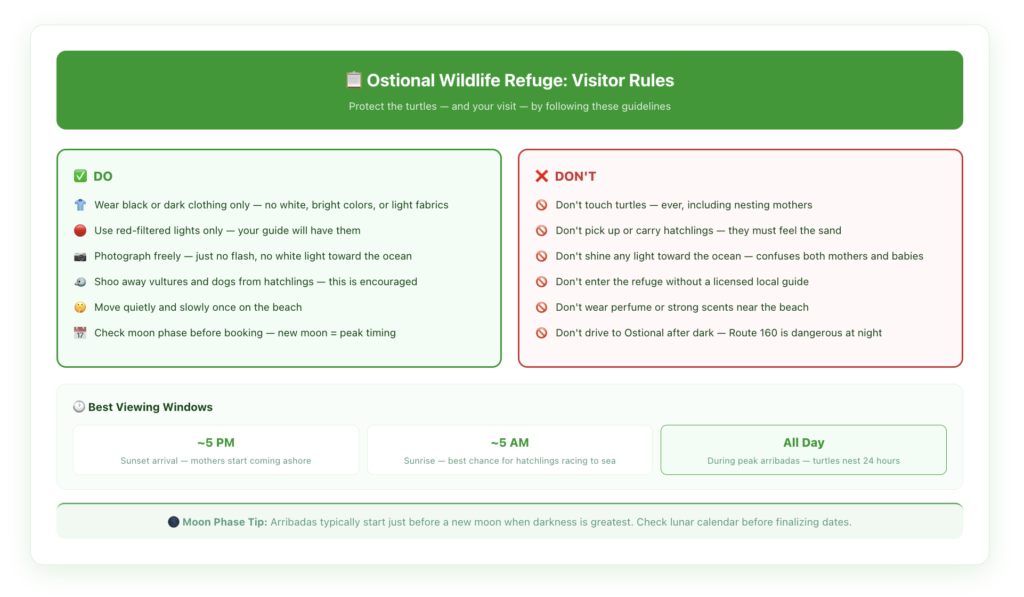
The refuge enforces these guidelines consistently, and your guide will reinforce them on the beach:
Clothing: Wear black or dark clothing only. Turtles swim near shore and pop up to check beach conditions before committing to nesting. Bright colors or white fabric visible from the water will deter them from coming ashore. Guides enforce this rule strictly.
Photography: No flash photography, period. White light disorients both nesting mothers and hatchlings. Guides carry red-filtered lights that don’t affect the animals—use those instead. You can still photograph turtles effectively in natural light or with red-filtered gear.
Behavior: Don’t touch turtles or approach them without your guide’s direction. Stay quiet and move slowly. Never shine any light toward the ocean.
Helping hatchlings: If you see baby turtles making their run to the water, you can shoo away vultures or dogs that are hunting them. What you should not do is pick up or carry the hatchlings. They must feel the sand and orient themselves through it—females imprint on their birth beach and return to the exact same stretch of coast to nest 15 to 20 years later. Carrying them disrupts that process.
What Makes Ostional's Egg Harvest Program Different from Every Other Refuge?
Ostional is the only beach in the world where harvesting sea turtle eggs is legal. That sounds counterintuitive until you understand the biology behind it.
During intense arribadas, so many turtles nest that later arrivals inevitably dig up earlier nests. Research found that eggs laid in the first days of an arribada have almost zero chance of survival—they get destroyed by the next wave of nesting females. The Costa Rican government implemented a controlled harvest program in 1987, allowing the local community to collect eggs from the first three days of each arribada only.
In exchange, villagers protect the turtles, remove debris and plastics from the beach, and patrol against poachers around the clock. This community-based conservation model has proven remarkably effective. The SINAC refuge management page maintains stable turtle populations while providing sustainable income for local families. National Geographic’s wildlife coverage has highlighted the Ostional model as a rare example of how sustainable harvest programs can actually incentivize conservation rather than undermine it. If you see community members collecting eggs during your visit, that’s the program in action—eggs get washed, packed, and sold legally throughout Costa Rica.
Where Should You Stay Near Ostional?
Ostional town is genuinely small—one soda (local restaurant), a few pulperías (corner stores), and basic lodging options. If you want to maximize turtle viewing by catching both sunset and sunrise without nighttime driving, staying locally makes a lot of sense.
Ostional Turtle Lodge offers the area’s most comfortable rooms with proximity to the beach.
Cabinas Ostional and Cabinas Arribadas are budget-friendly options close enough to walk to the beach for early morning hatchling watching.
Camping is available on some private properties for around 5,000 colones (approximately $10 USD) per person, usually with access to basic bathroom and shower facilities.
For more amenities, Nosara sits just 15 minutes away and offers everything from luxury surf camps to yoga retreats to boutique hotels starting around $250 per night. Samara is about an hour south and works well as a family-friendly base with calmer waters and a wider range of services.
What Else Can You Do Around Ostional?
Surfing: Playa Ostional has solid surf breaks that see far fewer crowds than Tamarindo or Nosara. If you surf, this beach rewards you with uncrowded conditions, especially outside peak tourist months. Surfline’s Nicoya Peninsula guide lists Ostional as an intermediate-friendly break that works best at mid-to-high tide.
Wildlife watching beyond turtles: The estuary and mangrove zone at the south end of the refuge attracts iguanas, howler monkeys, coatis, herons, and numerous shore birds. Early morning walks along the estuary edge produce reliable sightings even when you’re between turtle events.
Day trips from Ostional: With your own vehicle, the surrounding area opens up considerably. Barra Honda National Park is about 1.5 hours away and offers Costa Rica’s only underground cave system—a completely different kind of wildlife experience. Rincon de la Vieja National Park is roughly 2.5 hours north and pairs volcanic landscapes with adventure activities. If you’re building a longer Nicoya Peninsula loop, Caño Negro Wildlife Refuge and Palo Verde National Park round out the inland wildlife options nicely.
How Does Ostional Compare to Tortuguero?
Costa Rica’s two iconic turtle experiences could hardly be more different. Tortuguero National Park on the Caribbean coast focuses on endangered green turtles nesting individually at night in a lush rainforest canal setting—and reaching it requires boat or plane access with no road option. Ostional delivers the raw spectacle of mass nesting, unlike anything else on the planet, is drivable (with the right vehicle), and operates year-round with monthly events.
If you’re comparing the two for a single trip, Ostional wins on accessibility and frequency. Tortuguero wins on an immersive multi-day rainforest experience. If your itinerary is based around Liberia Airport and the Nicoya Peninsula, Ostional is the clear choice. If you’re doing a two-week Costa Rica itinerary, hitting both coasts, both are worth building in.
What Should You Pack for Ostional?
- Black or dark-colored clothing (non-negotiable)
- Closed-toe shoes for beach walking in the dark
- Camera without flash capability or red-filtered light
- Insect repellent
- Rain jacket if visiting May through December
- Water and snacks—the town has limited options
- Cash in small denominations (USD or colones both accepted)
Ostional represents one of those rare travel experiences where the reality genuinely lives up to what you’ve heard about it. The scale is hard to process until you’re standing on the beach. Get the right vehicle, check the moon phase, follow the Facebook page, and plan to stay at least one night so you catch both the evening arrivals and the morning hatchlings. That combination—mothers nesting at sunset, babies racing to the sea at sunrise—is what people remember for years.
Frequently Asked Questions
What exactly happens during an olive ridley arribada?
During an arribada, females that have been gathering offshore for days suddenly come ashore in near-simultaneous waves. They excavate nests using their hind flippers, deposit roughly 80 to 100 eggs, cover the nest, and return to the ocean—each female taking about an hour total. At peak events, so many turtles crowd the beach that they dig through each other’s nests. The coordinated trigger appears to relate to moon phase and ocean temperature, though researchers still study the exact mechanism.
Is it possible to visit Ostional during the dry season and still see turtles?
It depends on timing. During the driest months (February through April), your chances drop dramatically outside of an official arribada. Individual turtles may still nest, but you might see just one or two per night rather than hundreds. If your trip dates fall in those months, check the Association of Guides Facebook page closely—even small dry-season arribadas can offer worthwhile sightings. January and December tend to have more activity than February through April.
How early should I book if I want to see a major arribada?
The challenge is that exact timing isn’t predictable more than a few days out. Rather than booking months in advance for a specific date, build flexibility into your trip—plan to be in Nosara or Ostional for at least two to three nights during the September-November peak window. Follow the Association of Guides Facebook page for real-time arrival reports. If you’re on a tighter schedule, organize through a tour operator who monitors conditions daily.
Are children allowed to visit Ostional Wildlife Refuge?
Yes, children can visit. The experience requires nighttime beach walking on uneven terrain with minimal lighting, so kids who are comfortable with that environment tend to enjoy it. The dark clothing rule applies to everyone. Guides work well with families and will position the group appropriately to keep younger visitors safe while still getting good viewing angles.
Can you snorkel or swim at Ostional Beach?
Playa Ostional isn’t primarily a swimming beach—the surf conditions and currents make it better suited for surfing than casual swimming. The beach is protected land, and the primary draw is the turtles rather than water recreation. For swimming and snorkeling, Nosara’s Playa Guiones (15 minutes away) is a far better option with calmer conditions and beach services.
What happens to the turtle eggs that are harvested?
Under Costa Rica’s legally sanctioned program, the local community collects eggs only from the first three days of each arribada—the period when eggs have virtually zero survival probability due to disturbance from subsequent nesting waves. These eggs are washed, inspected, and sold legally in markets and bars throughout Costa Rica. The revenue goes directly to community members who also provide 24/7 beach patrol against poachers and maintain the beach environment. It’s a conservation-through-community-benefit model that international researchers have studied as a potential template for other high-density nesting sites.
What should I do if I accidentally encounter a turtle nesting alone outside the refuge area?
Give it space and observe from a distance. Don’t approach the nesting turtle, shine any light toward it, or attempt to touch it. If you’re with a guide, they’ll direct you appropriately. If you’re outside the refuge and encounter a nesting turtle without a guide, simply observe quietly from 15 to 20 feet (4.5 to 6 m) away until it finishes and returns to the water. Nesting females are focused and relatively undisturbed by quiet observers at that distance.