
Last Updated on June 19, 2026
Curi Cancha Reserve: What's Covered
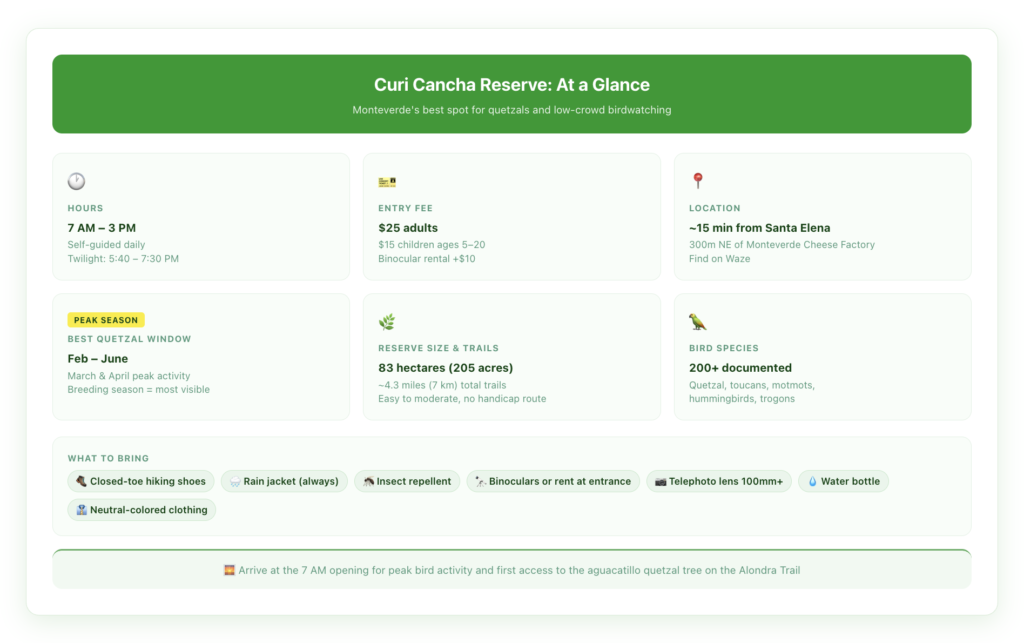
Curi Cancha Reserve is an 83-hectare (205-acre) private wildlife refuge in Monteverde open daily 7 AM–3 PM ($25 adults). It’s the top pick for resplendent quetzal sightings—particularly February through June at the Alondra Trail aguacatillo tree. Fewer crowds than the main cloud forest reserve and open habitat edges keep birds consistently visible. A vehicle with clearance handles the gravel approach with no problem.
Quick Facts:
- Best quetzal season: Feb–June; peak March–April at Alondra Trail avocado tree
- Hours & fee: 7 AM–3 PM ($25 adults, $15 children); twilight 5:40–7:30 PM
- Location: 15 minutes from Santa Elena; find on Waze
- 200+ bird species: quetzals, toucans, motmots, hummingbirds, trogons
- Binocular rental: $10 at the entrance; guides bookable on-site
Top 3 Experiences:
- Aguacatillo Tree — Wait 15–20 min at Alondra Trail bench; quetzals feed here during breeding season
- Full Trail Circuit — Leo, Puma, and Manga trails cover 4.3 miles in 3–4 hours
- Twilight Session — Evening visits reveal kinkajous, sloths, and tree frogs
Pair an early Curi Cancha morning with the Monteverde Cloud Forest Reserve in the afternoon. A 4×4 for Monteverde’s roads lets you hit the 7 AM opening when bird activity peaks.
If you need any help with a Costa Rica car rental, contact us now!
If you’re visiting Monteverde and a resplendent quetzal is on your list, skip the main cloud forest reserve line. Curi Cancha Reserve—a compact, privately managed 83-hectare (205-acre) wildlife refuge—consistently delivers better quetzal sightings, far less foot traffic, and a genuinely more satisfying wildlife experience. It’s been welcoming visitors since 2011, and local birding guides treat it as their first recommendation for anyone serious about bird photography.
Key Takeaways
- Best quetzal season: February through June (breeding season), with March–April being peak
- Entrance fee: $25 USD adults, $15 USD children ages 5–20 (verify current rates at arrival)
- Hours: 7 AM – 3 PM daily for self-guided visits; 5:40 PM – 7:30 PM for twilight tours
- Quetzal hot spot: The aguacatillo (wild avocado) tree near the Alondra Trail entrance—wait 15–20 minutes
- Getting there: 15-minute drive from Santa Elena; gravel road after El Establo Hotel—bring a vehicle with clearance.
- Trail difficulty: Easy to moderate, no handicap-accessible route; closed-toe shoes required
Why Does Curi Cancha Produce Better Quetzal Sightings Than the Main Reserve?
It comes down to habitat design and visitor volume.
The Monteverde Cloud Forest Biological Reserve attracts over 70,000 visitors annually. During high season—December through April—you’re sharing tight, forested trails with tour groups and school excursions. Wildlife reads that foot traffic as a threat and retreats deeper into the forest.
Curi Cancha was built differently. The reserve combines virgin rainforest with secondary growth and open pastures, creating habitat edges where birds move between cover and open clearings. Those transition zones are exactly where species like quetzals, toucans, and motmots show themselves. The aguacatillo tree near the Alondra Trail entrance sits right at one of these edges—there’s a bench and small viewing platform where photographers set up tripods and wait. You’re not hiking past it. You can stay as long as you want.
The geography of the Monteverde region also works in Curi Cancha’s favor. At around 4,921 feet (1,500 meters) elevation on the Pacific slope of the Continental Divide, the reserve sits in the cloud belt where mist rolls in, and birds concentrate in the fruiting trees. The quetzals here aren’t passing through—they’re residents feeding on wild avocados from the Lauraceae family throughout breeding season. The Tico Times regularly covers Monteverde conservation news, and the broader protected corridor that includes Curi Cancha has been highlighted as a model for private reserve management in Costa Rica.
Where Is Curi Cancha Reserve, and How Do You Get There?
From Santa Elena town center, head east toward the Monteverde Cloud Forest Reserve. The road turns to gravel shortly after the El Establo Hotel. Keep going for a few minutes and look for a large signed turnoff on your left. Turn in and drive another minute to the entrance. The reserve sits about 300 meters northeast of the Monteverde Cheese Factory—you can find it on Waze, which works better than Google Maps for this area.
The gravel road is entirely manageable but typical of Monteverde’s road conditions. During green season (May through November), a vehicle with decent ground clearance makes the final stretch noticeably easier when roads get rutted and muddy.
If you’re picking up your rental at SJO or flying into Liberia, an SUV handles Monteverde’s mountain approach confidently, regardless of season. A standard sedan technically works during the dry season, but it limits your options throughout the wider Monteverde zone.
The drive from San José to Monteverde takes about 3–3.5 hours. Most travelers approach from the Central Valley via a route that’s now fully paved up to Santa Elena itself—the gravel only starts on the reserve roads. If you’re routing from La Fortuna and Arenal, the drive between the two areas takes roughly 3 hours along scenic mountain and lake roads.
What Birds Will You Actually See at Curi Cancha?
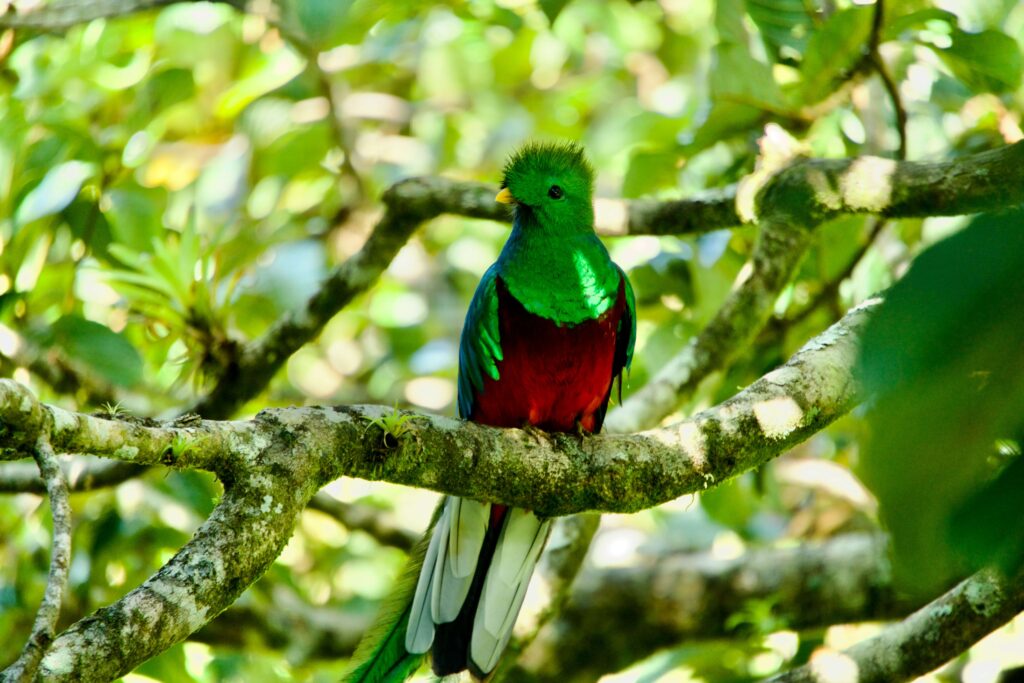
Over 200 species have been documented in the reserve. What you realistically spot depends on timing, patience, and whether you hire a guide. Costa Rica is home to over 900 bird species—roughly 10% of all bird species on Earth—making the Monteverde corridor one of the highest-density birding zones in the Western Hemisphere. Here’s what the reserve delivers consistently:
Will You See a Resplendent Quetzal?
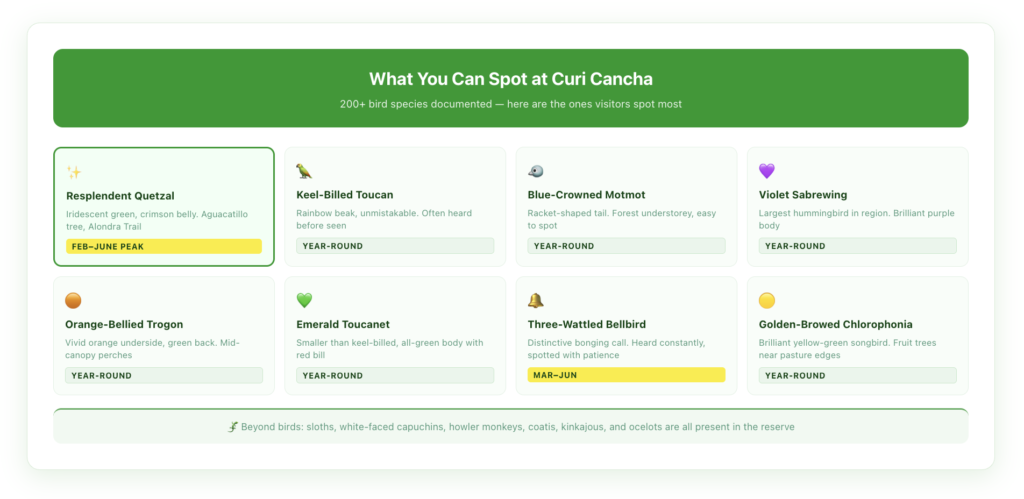
If you visit during breeding season (February through June) with a guide, the odds are genuinely good. The male quetzal’s iridescent green plumage and crimson belly make it one of the most visually striking birds in Central America—and during breeding season, males are unusually active, calling loudly and flying around to attract females. The Monteverde Conservation League has helped stabilize quetzal populations throughout this region through decades of habitat protection work. According to BirdLife International, the resplendent quetzal is classified as Near Threatened globally, making protected corridors like Curi Cancha essential to the species’ long-term survival.
The key spot is the aguacatillo tree near the Alondra Trail, a five-minute walk from the main entrance. Wild avocados from this tree are a primary quetzal food source throughout the breeding season. Tips that actually help: arrive at the 7 AM opening, wait at the bench viewing area for at least 15–20 minutes (quetzals sit completely still for long stretches), listen for a soft “koy-koy” whistling call, and watch for movement when males display, or birds eat.
Outside breeding season, quetzal sightings drop significantly but don’t disappear entirely. Costa Rica’s ICT tourism board notes that Monteverde’s year-round quetzal populations remain stable thanks to the protected habitat corridor. Lonely Planet consistently ranks Monteverde as one of Central America’s top destinations, specifically because of reliable quetzal sightings—Curi Cancha is a key part of that reputation.
What Else Can You Expect to See?
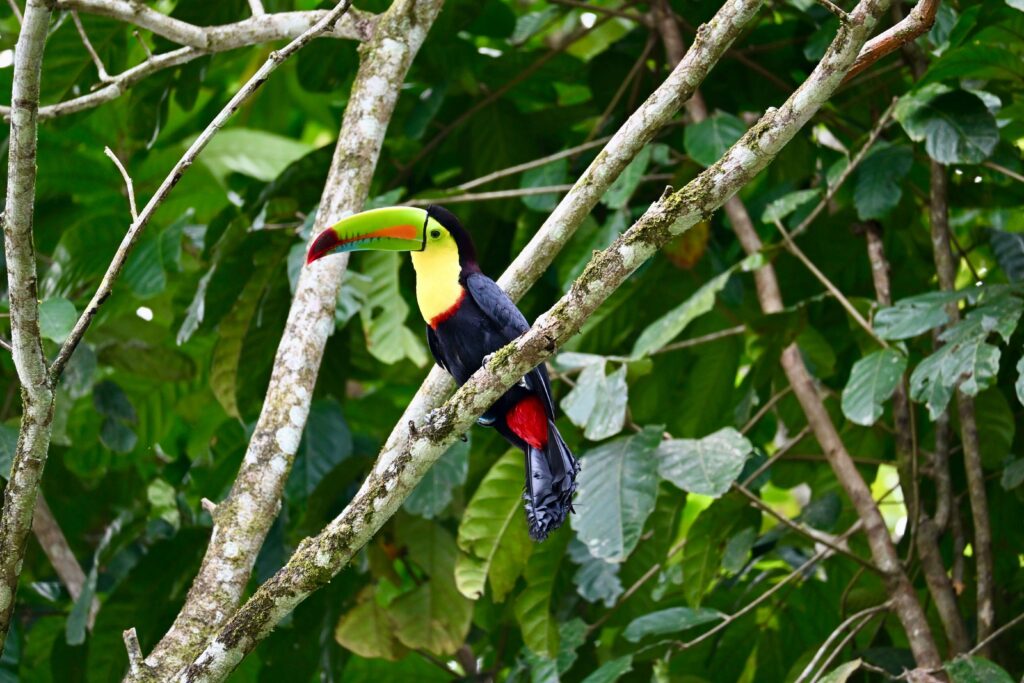
The birdwatching diversity here goes well beyond quetzals. Regular sightings include keel-billed toucans (the rainbow-beak variety), blue-crowned motmots with their distinctive racket-shaped tails, violet sabrewing hummingbirds, orange-bellied trogons, emerald toucanets, three-wattled bellbirds (heard more often than seen), and golden-browed chlorophonias. Birding guides with spotting scopes regularly tally 30–50 species on a morning visit during peak season.
Beyond birds, the reserve hosts two-toed sloths, white-faced capuchin monkeys, howler monkeys, coatis, agoutis, kinkajous, and occasionally ocelots. The habitat edges make mammal sightings more likely here than in dense primary forest reserves, where animals stay hidden.
What Are the Trails Like at Curi Cancha?
The reserve has approximately 4.3 miles (7 km) of maintained trails spread across nine named routes. None are technically demanding, though the forest floor stays damp year-round. Closed-toe hiking shoes with good grip are non-negotiable—sandals won’t cut it on muddy slopes.
Alondra Trail — The starting point for most visitors. A 15-minute walk from the entrance brings you to the aguacatillo tree viewing area. This is where quetzal sightings concentrate during breeding season, and it’s worth spending 30–45 minutes here before moving on.
Leo Trail — A tunnel of trees runs along this path, making it worth the walk for atmosphere alone. It’s a good stretch for spotting motmots and various tanagers in the mid-canopy. At 0.9 miles (1.5 km), it’s the longest trail in the reserve.
Puma Trail — Leads to a viewpoint overlooking the Continental Divide. On clear mornings, views extend toward the Gulf of Nicoya. Worth the detour, especially if you arrive at opening.
Manga and Ficus Trails — The Manga trail runs beside a small river and offers a short detour down to the water. The Ficus trail has remarkably large fig trees with protruding roots—photogenic even outside bird season.
Main Road — A central path connecting all trails, useful for looping back to the entrance without retracing your steps.
Hiking at a leisurely wildlife-watching pace, a full visit covering the major trails runs 3–4 hours. Serious photographers and birders often stay the entire 7 AM to 3 PM window, particularly during quetzal season, when waiting at the avocado tree pays off with extended viewing sessions.
One practical note: there’s no handicap-accessible route in the reserve. The trails involve gentle slopes and some uneven terrain throughout. Bathrooms are located at the entrance and at a central rest area inside the reserve.
When Should You Visit Curi Cancha?
For Quetzal Sightings
February through June is breeding season, with March and April typically producing the highest concentration of sightings. Outside this window, quetzals are still present in the Monteverde zone but behave more cryptically and spend less time near the aguacatillo tree. If quetzals are your specific goal, build your Costa Rica itinerary around these months.
For General Birdwatching
Curi Cancha delivers excellent birding in Monteverde year-round. Resident species like toucans, motmots, and 20+ hummingbird varieties are present regardless of season. If you visit in September or October—when the crowds thin dramatically—you’ll find quieter trails and more active morning bird behavior.
Time of Day
Arrive at the 7 AM opening. Bird activity peaks during the cooler early morning hours before the midday heat shifts behavior patterns. By 10–11 AM, clouds typically start rolling in, which creates beautiful atmospheric hiking conditions but can reduce bird visibility. The evening twilight session (5:40 PM – 7:30 PM) works well for different species and nocturnal wildlife like kinkajous and sloths.
Weather Considerations
Monteverde’s weather sits at a permanent cloud belt regardless of season. Even during the dry season (December through April), morning mist is normal, and afternoon rain happens. A rain jacket isn’t optional gear here—it’s as essential as your binoculars. During the green season, afternoon showers are almost guaranteed, which is exactly why morning visits matter.
Do You Need a Guide, or Can You Go Self-Guided?
Both options work, but they produce very different experiences.
Self-guided visits make sense if you’re comfortable with birdwatching basics, have binoculars, and are visiting in a season when quetzals are active enough to spot without expert assistance. Pick up the free map at the ticket office, follow the Alondra Trail first, and plan to wait at the aguacatillo tree.
Guided visits are worth the additional cost if quetzals or specific species are your primary goal. Guides at Curi Cancha bring professional spotting scopes that let you photograph birds through your phone at distances that would otherwise require a 400mm+ telephoto lens. More importantly, experienced guides know where specific birds have been seen that morning, can identify every species by call before you even see it, and position you for the best sighting angles. Reviews across multiple platforms consistently credit guides for quetzal sightings that self-guided visitors missed entirely. You can also book directly through the reserve’s official website.
If you’re traveling from San José and fitting this into a larger trip that includes La Fortuna and other Monteverde activities, booking a morning guided tour at Curi Cancha and leaving the afternoon for adventure parks or the main cloud forest reserve is an efficient day structure.
What Should You Bring to Curi Cancha?
Footwear and clothing: Closed-toe hiking shoes with a solid grip—the trails stay muddy year-round. Bring long pants, a light jacket for cooler mornings at elevation, and a rain jacket for the inevitable cloud forest drizzle.
Optics: Binoculars are available to rent at the entrance for $10 USD—worth it if you don’t own a pair. For photography, 100–400mm is the practical minimum; serious bird photographers bring 150–600mm setups and a tripod. National Geographic describes the resplendent quetzal as one of the world’s most beautiful birds—its iridescent plumage genuinely photographs differently depending on the angle of light, making patience at the viewing bench essential. The bench at the aguacatillo tree gives you a stable setup area.
Practical items: Insect repellent (cloud forest mosquitoes are persistent), water, a small snack for longer visits, and a waterproof bag or rain cover for camera gear. The reserve doesn’t have an on-site café or food vendor.
Colors: Stick to neutral tones—greens, browns, grays. Bright clothing isn’t dangerous, but wildlife responds better to visitors who blend with the forest.
How Does Curi Cancha Compare to Other Monteverde Reserves?
Curi Cancha vs. Monteverde Cloud Forest Biological Reserve
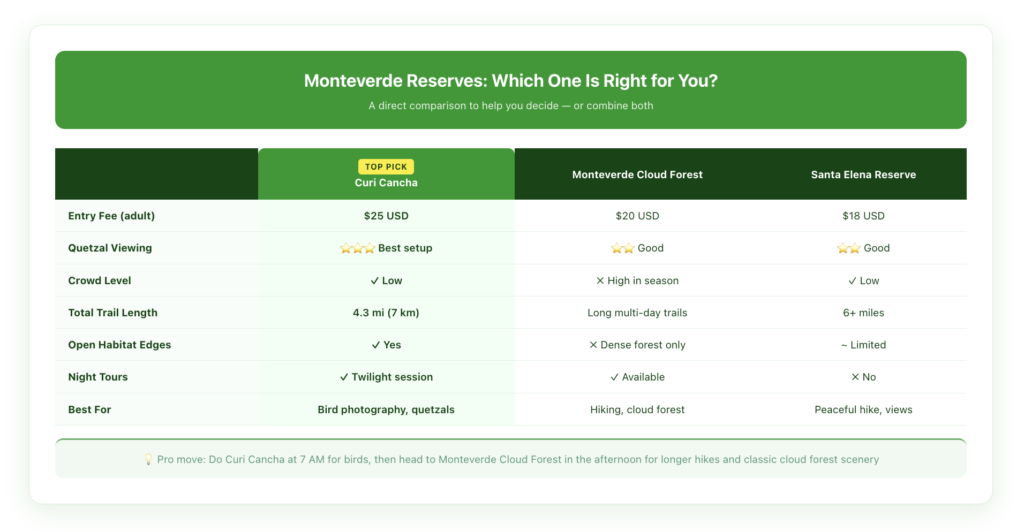
The main cloud forest reserve offers more extensive trails, longer hiking options, and dramatic cloud forest scenery, including a Continental Divide viewpoint where you can sometimes see both the Pacific and Caribbean coasts. The tradeoff is crowd density during high season, which pushes wildlife deeper into the forest.
Choose Curi Cancha if wildlife spotting—especially quetzals—is your primary reason for being there. Choose the main reserve if you want longer hikes and classic cloud forest immersion. If your schedule allows it, do both: Curi Cancha at 7 AM for birds, the main reserve in the afternoon for scenery and longer trails.
Curi Cancha vs. Santa Elena Cloud Forest Reserve
Santa Elena is community-managed, less visited than the main reserve, and excellent for birding—including its own quetzal sightings during breeding season. What it lacks is Curi Cancha’s combination of open habitat edges and the famous aguacatillo tree setup that makes quetzal photography predictable rather than lucky.
Curi Cancha vs. Children’s Eternal Rainforest
The Children’s Eternal Rainforest is a 56,000-acre reserve covering seven life zones—a completely different scale. It rewards longer hiking commitments and delivers excellent wildlife diversity, but it’s less compact and doesn’t have the quetzal-specific infrastructure that Curi Cancha has developed at the aguacatillo tree. For context on the broader protected area that surrounds Curi Cancha, SINAC (Costa Rica’s National System of Conservation Areas) oversees the Monteverde Conservation Area, which encompasses multiple reserves protecting one of the most biologically significant zones in Central America.
Planning a Broader Monteverde Visit Around Curi Cancha
Santa Elena town is the natural base. It puts you 15 minutes from Curi Cancha and within easy reach of Treetopia ziplines and hanging bridges, the wider Monteverde attraction circuit, and restaurants without requiring long drives after a full morning of hiking.
Most travelers who prioritize wildlife give Monteverde two full days: one morning at Curi Cancha for focused birdwatching, a second day split between the main cloud forest reserve and an adventure activity. That split captures the reserve’s distinct strengths without rushing either. The Monteverde navigation guide covers how to move efficiently between the reserves and activity parks—useful context if you’re mapping out a tight day-by-day schedule.
Monteverde also fits naturally into a classic Costa Rica loop. Many travelers pair the cloud forest zone with La Fortuna and Arenal hot springs before continuing to Pacific beaches or the Osa Peninsula.
A two-week Costa Rica itinerary can comfortably include Monteverde, Arenal, and one or two beach regions without feeling rushed.
Having your own vehicle makes Curi Cancha significantly more practical. The 7 AM opening is the sweet spot for birds—and that’s hard to hit reliably on shared shuttle schedules. A 4×4 SUV handles every road in the Monteverde zone confidently, including the gravel approach to Curi Cancha and the steeper reserve roads that can get slippery after rain. If you’re planning a trip that includes Monteverde and want to make the most of early morning wildlife windows, contact Vamos Rent a Car to match the right vehicle to your itinerary.
Frequently Asked Questions
Is the entrance fee at Curi Cancha worth it compared to other Monteverde reserves?
Curi Cancha’s entry is higher per acre than the larger reserves, but you’re paying for a controlled-access experience that directly translates to better wildlife viewing. Fewer visitors means less noise, less movement on trails, and animals that stay visible longer. For anyone with quetzals on their list, that tradeoff is straightforward.
Can you see quetzals at Curi Cancha outside of breeding season?
Quetzals are present in the Monteverde zone year-round—they don’t migrate. Outside the February–June breeding season, they’re simply less active and spend more time deep in the forest canopy. Sightings happen in any month but are far less predictable. If spotting one is a priority, time your visit to the breeding window.
Does Curi Cancha have night tours?
Yes. The twilight session runs from 5:40 PM to 7:30 PM daily and offers a genuinely different wildlife experience—kinkajous, sloths in active mode, red-eyed tree frogs, and various nocturnal insects become visible. Night walks in the reserve are guided and separate from the daytime self-guided admission.
What’s the difference between the guided birdwatching tour and the natural history tour at Curi Cancha?
The birdwatching tour is run by specialist birding guides with high-powered spotting scopes, focused on maximizing bird species counts—ideal if you’re keeping a life list or want to photograph specific species. The natural history tour is broader in scope, covering plants, trees, ecology, insects, and mammals alongside birds. Both include guide accompaniment; the choice depends on whether you want depth on birds specifically or a more general cloud forest interpretation.
Is Curi Cancha accessible to visitors with limited mobility?
There is no designated handicap-accessible trail at Curi Cancha. The trails involve some uneven terrain and gentle slopes that can be slippery when wet. The entrance area and ticket office are accessible, and the bench at the aguacatillo tree viewing area is reachable on the Alondra Trail with a short flat walk from the entrance—the first 5–10 minutes of the trail are relatively even.
Can you see quetzals at Curi Cancha on a rainy day?
Yes, though sightings are less predictable. Quetzals are resident birds that remain active in light rain, and some photographers argue that overcast conditions produce softer, more even lighting for photos. Heavy sustained rainfall does reduce bird activity, which is why morning visits during the green season matter—most serious rainfall comes in the afternoons.
What makes Curi Cancha better for bird photography than other Monteverde reserves?
The key is the open habitat layout combined with the aguacatillo tree setup. In dense primary forest, birds tend to perch high in the canopy with foliage blocking sight lines and light. Curi Cancha’s habitat edges push birds into clearings and open-canopy areas where you can actually frame a shot. The bench and viewing area at the quetzal tree are specifically designed to give photographers stable shooting positions without blocking trail traffic.