
Last Updated on June 19, 2026
Costa Rica's National Theater: What's Covered
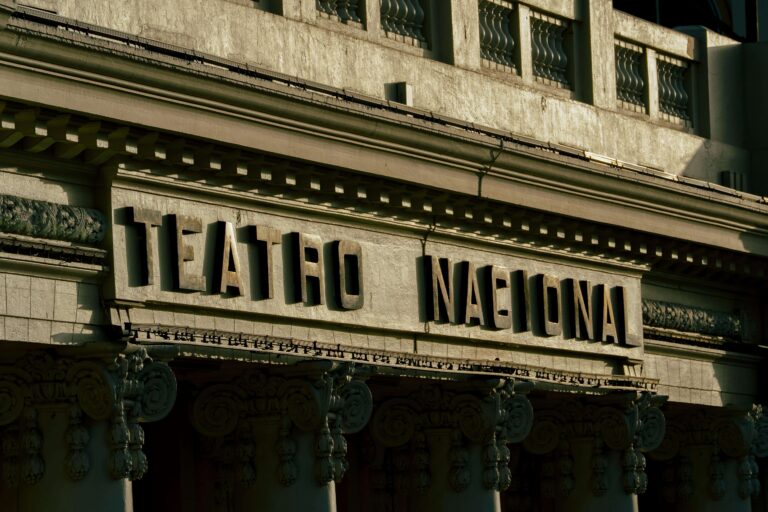
Most travelers skip right past San José on their way to beaches and rainforests, but the National Theater (Teatro Nacional) is one attraction that genuinely deserves a stop.
Quick Facts
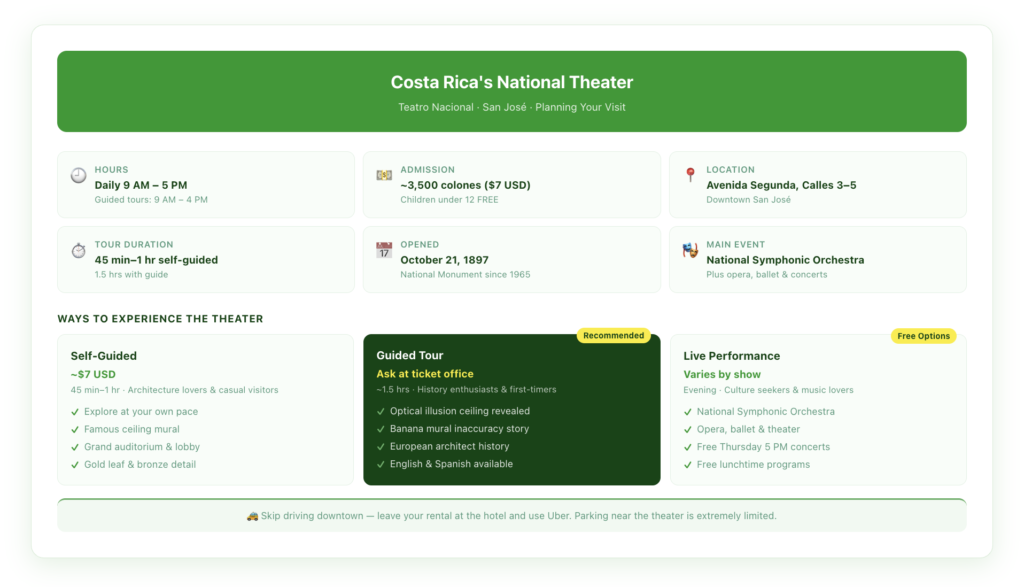
- Hours: Daily 9 AM-5 PM; guided tours available 9 AM-4 PM
- Admission: Approximately 3,500 colones ($7 USD) for adults; children under 12 free
- Location: Avenida Segunda between Calles 3 and 5, downtown San José—best reached by walking from downtown hotels or Uber
- History: Opened October 21, 1897, funded by coffee export tax; declared a National Monument in 1965
- Tour Duration: 45 minutes-1 hour self-guided; 1.5 hours guided (English/Spanish available)
- Don’t Miss: “Allegory of Coffee and Bananas” ceiling mural with banana-carrying inaccuracy, optical illusion ceiling painting upstairs
- Nearby: Gold Museum, Central Market, Jade Museum, all within a 10-15 minute walk—perfect for a full day of cultural immersion.
Costa Rica’s National Theater offers genuine cultural experiences perfect for travelers exploring beyond beaches and rainforests. The building anchors downtown San José’s walkable museum district, making it valuable for understanding the country’s coffee boom prosperity and cultural ambitions. Many travelers use San José as an arrival/departure base, spending one day experiencing the capital before continuing to Arenal Volcano, Monteverde cloud forests, or Manuel Antonio beaches. For building comprehensive itineraries, check our one-week and two-week plans. The theater demonstrates why capital deserves at least one exploration day—understanding the coffee industry that funded the building enriches appreciation for the plantations visited later. Standard sedans handle Central Valley day trips fine (Irazú Volcano, Cartago, Heredia all within an hour on paved roads); 4×4 needed only for destinations like Monteverde with unpaved mountain sections. Spring-like weather year-round at 1,200 meters elevation makes visiting comfortable any season.
If you need any help with a Costa Rica car rental, contact us now!
Most travelers skip right past San José on their way to beaches and rainforests, but the National Theater (Teatro Nacional) is one attraction that deserves a stop. This stunning 19th-century building sits in the heart of downtown and offers a window into Costa Rica’s cultural heritage that you simply won’t find at any national park or beach town. Whether you catch a performance by the National Symphonic Orchestra or simply wander through the ornate halls on a self-guided tour, the theater rewards visitors with architecture, history, and stories that connect you to a different side of this country.
Key Takeaways
- The National Theater opened in 1897 and remains Costa Rica’s finest historic building, featuring neoclassical architecture funded by a coffee export tax.
- Visit between 9 AM and 5 PM Monday through Sunday; self-guided tours take 45 minutes to an hour, while guided tours run about 1.5 hours.
- Entrance costs approximately 3,500 colones (around $7 USD) for adults; children under 12 enter free.
- Located on Avenida Segunda between Calles 3 and 5, the theater is best reached by walking from downtown hotels or via Uber.
- Don’t miss the famous “Allegory of Coffee and Bananas” ceiling mural with its intentional (or unintentional) inaccuracies.
- Combine your visit with nearby attractions like the Gold Museum, Central Market, and Jade Museum for a full day of San José culture.
What Makes Costa Rica's National Theater So Special?
How Did Coffee Build a Theater?
The story behind the National Theater starts with Costa Rica’s coffee industry, which dominated the economy in the late 1800s. When San José’s population hovered around just 19,000 people, the city’s cultural elite wanted a venue that could attract world-class performers and showcase their country’s sophistication.
President José Joaquín Rodríguez Zeledón came up with a creative solution: a tax on coffee exports. Given that coffee was the country’s primary export at the time, this tax generated enough funds to build something truly magnificent. Construction began in 1891 under the direction of European architects, although early problems led to an Italian engineer being brought in to correct structural issues and oversee completion.
After seven years of meticulous work, the theater finally opened its doors on October 21, 1897, with a performance of Goethe’s Faust. The building replaced the Teatro Mora (Municipal Theater), which had been destroyed by an earthquake in 1888.
Why Do Locals Call It Their Cultural Crown Jewel?
For Costa Ricans, the National Theater represents far more than beautiful architecture. The building symbolizes an investment in cultural refinement by this small Central American nation during a period of prosperity. According to Costa Rica’s official tourism board, the theater was declared a National Monument in 1965 and recognized as a “Símbolo Nacional de Patrimonio Histórico Arquitectónico” (National Symbol of Historic Architectural Heritage) in 2018.
The theater still serves as the primary venue for the National Symphonic Orchestra and hosts a broad range of events from ballets to operas to concerts by international artists. Walking through the doors connects you to over 125 years of Costa Rican cultural history.
What Will You Actually See Inside?
Where Should You Start Your Visit?
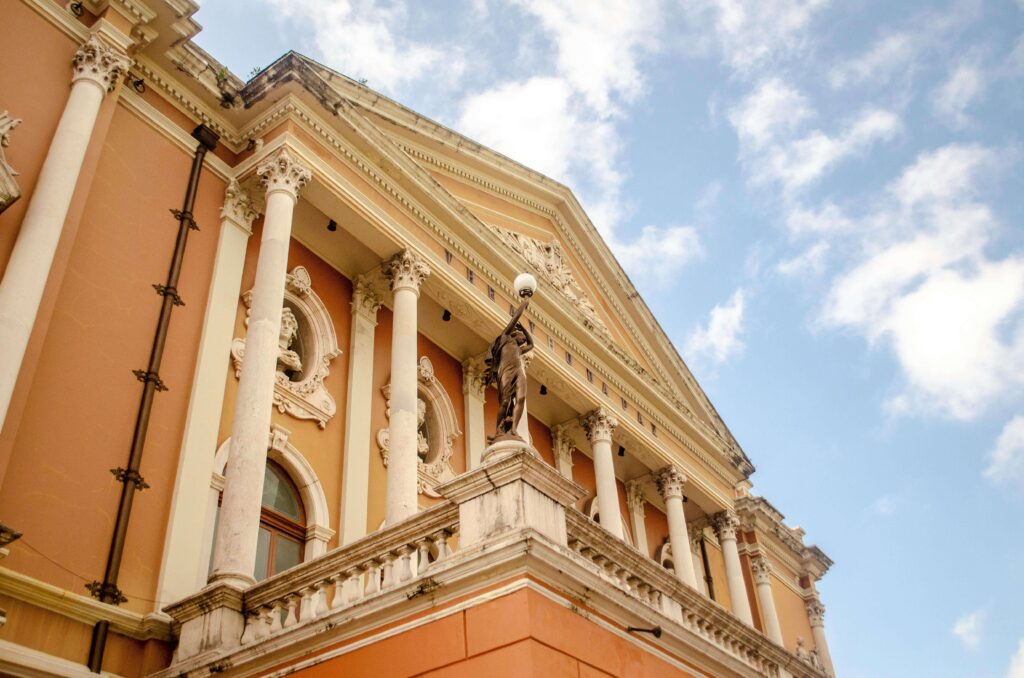
The experience begins before you even enter. Standing outside on Plaza de la Cultura, you’ll notice two imposing statues flanking the entrance: Spanish dramatist Calderón de la Barca and composer Ludwig van Beethoven. A statue of Frédéric Chopin also graces the entry walkway.
Step inside, and the lobby alone will make you pause due to the intricate detail that took teams of skilled artisans years to complete. Gold leaf adorns the walls, bronze lamps light your way, and the craftsmanship is incredible.
What’s the Story Behind That Famous Ceiling Painting?
The theater’s most talked-about feature is the ceiling mural “Allegory of Coffee and Bananas” by Italian artist Aleardo Villa. This painting celebrated Costa Rica’s agricultural prosperity and once appeared on the now-discontinued five-colón bill.
The story behind the work of art is interesting because Villa never actually visited Costa Rica. The painting shows a man awkwardly carrying bananas in his arms, whereas actual banana workers hoisted the heavy stems onto their shoulders. It’s become a beloved quirk and proof that even masterpieces sometimes miss the mark on practical details.
The foyer upstairs houses an even larger ceiling painting with a clever optical illusion. Look at the girl in pink from the right side of the room, then walk to the left and look up again. She appears to be looking in a completely different direction. The same trick works with a young boy banging cylinders in the painting. Guided tours point out these secrets, but you can discover them yourself if you know where to look for them.

How Does the Main Theater Compare to European Opera Houses?
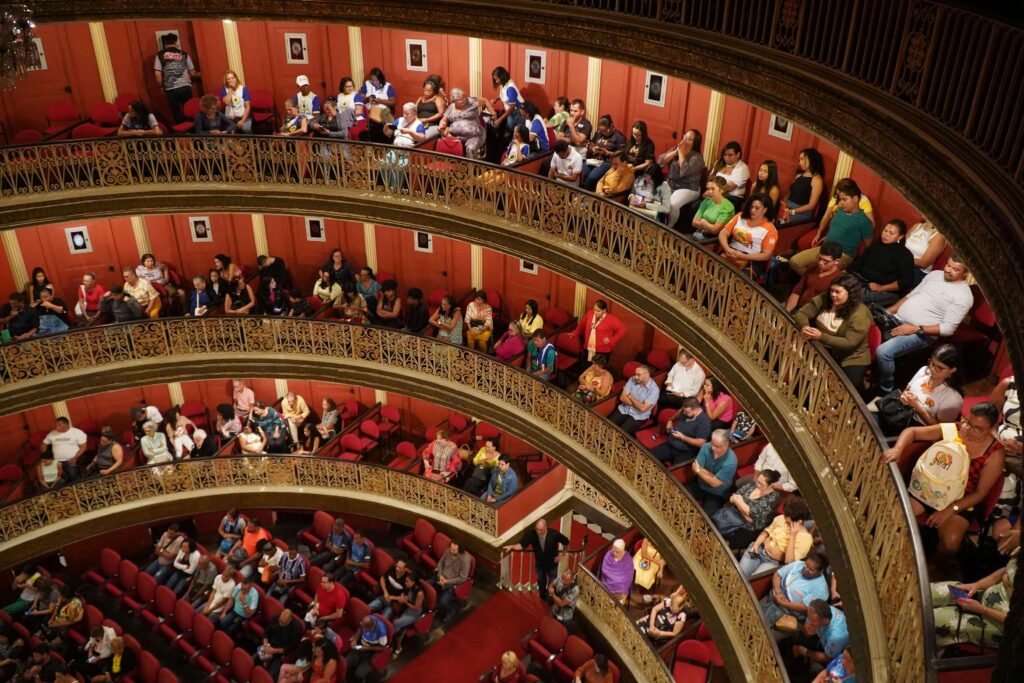
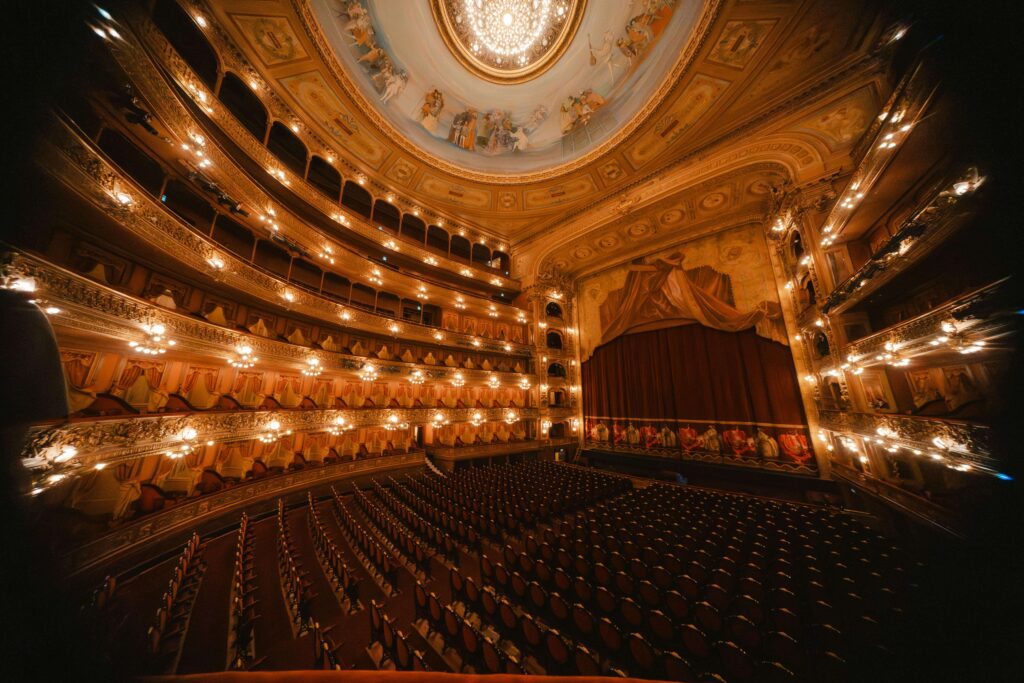
The main auditorium seats approximately 1,140 people across three levels: the main floor (stalls), the principal boxes, and the upper gallery. Red velvet seats, ornate gold moldings, and a grand crystal chandelier create an atmosphere that transported 19th-century audiences to a cultured world and still impresses visitors today.
One of the amazing features of the main auditorium is that the seats in the stalls can be removed and the floor winched up to stage height with an Italian pulley and lever system, which is over a hundred years old. The transformation takes several hours and is used for state events today rather than the lavish balls of the past.
The theater was designed with European opera houses as inspiration, particularly the Paris Opera House. Neoclassical columns, marble staircases, and baroque-influenced details blend together in ways that feel both grand and welcoming.
How Should You Plan Your Visit?
What Are the Hours and Admission Costs?
The National Theater opens daily from 9 AM to 5 PM, with guided tours available between 9 AM and 4 PM. Here’s what you need to know about admission:
Self-guided visits cost approximately 3,500 colones (around $7 USD) for adult foreigners. Children under 12 enter for free. If you’d like a guided tour in English or Spanish, you can request one at the ticket office or make reservations through the theater’s official website.
Arrange your time appropriately, as self-guided walks typically take 45 minutes to an hour if you want to appreciate the details. Guided tours run about 1.5 hours and include stories about the art, architecture, and historical figures that most visitors would otherwise miss.
What’s the Best Way to Get There?
The National Theater sits on Avenida Segunda, between Calles 3 and 5 in downtown San José. You can find it on Google Maps or Waze by searching “Teatro Nacional de Costa Rica.”
If you’re staying in downtown San José, walking to the theater is the best option for your visit. The theater lies within the compact, walkable downtown center where most attractions are clustered together. However, there’s essentially just limited street parking available.
For those staying outside the immediate downtown area, Uber works perfectly and costs a fraction of official taxi tariffs. We recommend taking an Uber or taxi to and from the theater in the evening performances rather than walking through San José after dark.
If you’re driving from the airport or exploring the broader Central Valley, consider leaving your vehicle at your hotel for downtown sightseeing. The narrow streets and lack of parking make driving through the city center more frustrating than practical.
Can You Catch a Performance?
What Shows Does the National Theater Host?
The theater presents a rich calendar of events throughout the year. The National Symphonic Orchestra performs regularly as part of its concert season, featuring both Costa Rican and international composers. You’ll also find:
- Operas and operettas
- Ballet performances (including seasonal favorites like The Nutcracker)
- Theatrical productions (both Spanish-language and international touring shows)
- Classical music concerts
- Contemporary dance performances
The main season runs from March to November, although performances take place year-round. Several tour operators include theater visits as part of broader San José city tours.
Are There Free Performances?
Yes! The theater typically offers free musical programs during lunch hours and on Thursday afternoons at 5:00 PM. These shorter performances allow you to experience the acoustic beauty of the space without purchasing tickets for a full evening show. Check the current schedule through the theater’s website or social media channels.
What Else Can You Do in the Area?
Which Museums Should You Combine with Your Visit?
The National Theater is at the heart of a walkable museum district in downtown San José. Within a 10-15 minute walk, you’ll find several excellent cultural institutions that complement your theater visit.
The Pre-Columbian Gold Museum sits beneath Plaza de la Cultura and is directly adjacent to the theater. This underground museum houses an extraordinary collection of gold artifacts dating from 500 BC to 1500 AD, which are tiny ornaments with both human and animal features that symbolize the beliefs of ancient indigenous peoples. The museum also traces the history of Costa Rica’s currency, the colón.
The Jade Museum (Museo del Jade) reopened in 2014 in a modern five-story building near Plaza de la Democracia. Despite its name, the collection includes pottery, bone artifacts, and other pre-Columbian treasures alongside stunning jade pieces. Interactive displays and holograms bring ancient daily life to vivid reality and make the theater a fun trip for children.
The National Museum (Museo Nacional) occupies the historic Bellavista Fortress, where bullet holes from Costa Rica’s brief 1948 civil war still mark the walls. Exhibits cover natural history, archaeology, and Costa Rican culture, with a particularly charming butterfly room.
Where Should You Eat Near the Theater?
The National Theater has its own café, Alma de Café, located in the original “Cantina de mujeres” (women’s canteen) space. They serve coffee, cake, sandwiches, and soup, which is perfect for refueling after exploring the building. The setting itself adds to the visit as there are rotating art exhibitions and you’re surrounded by the building’s architectural beauty.
For a more substantial meal, the nearby Central Market offers authentic Costa Rican cuisine at local prices. Soda Tapia (also called Soda Tala) is a popular spot within the market for traditional casado plates and fresh fruit smoothies.
If you’re looking for evening dining after a performance, the Barrio Escalante neighborhood has emerged as San José’s culinary hotspot with everything from innovative Costa Rican cuisine to international options.
How Does the National Theater Fit Into a Costa Rica Trip?
Should You Spend a Night in San José?
Many travelers treat San José as merely a layover and a place to sleep before an early morning departure to beaches or volcanoes, but the National Theater demonstrates why the capital deserves at least a day of exploration.
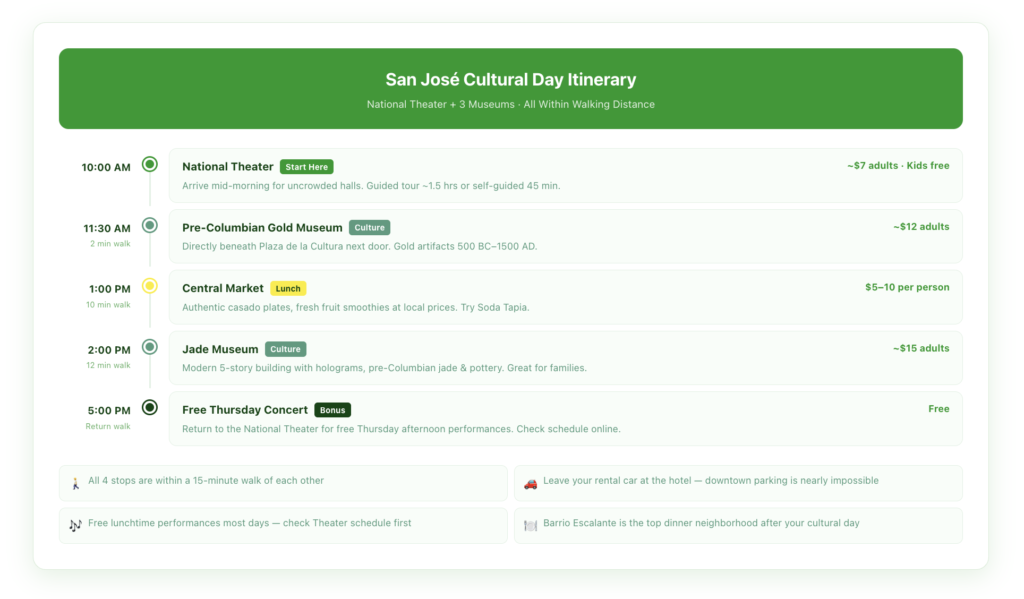
Consider arriving a day early or departing a day late to experience Costa Rica’s cultural side. A sample itinerary might include:
- Morning: Guided tour of the National Theater (starting around 10 AM)
- Midday: Lunch at the Central Market, browsing local vendors and souvenir stalls
- Afternoon: Gold Museum or Jade Museum (both excellent, so pick based on your interests)
- Evening: Return to the theater for a performance, or explore Barrio Escalante’s restaurant scene
This cultural immersion provides context that enriches the rest of your Costa Rica adventure, and understanding the coffee boom that funded the theater helps you to appreciate the coffee plantations, which might also be part of your itinerary. Learning about pre-Columbian cultures in the museums gives meaning to the stone spheres you might encounter on the Osa Peninsula.
What About Driving in San José?
If you’ve rented a car for exploring Costa Rica, you might wonder whether to drive in San José. Our advice is to avoid driving downtown for sightseeing.
San José traffic can be heavy, particularly during rush hours (6:30-8:30 AM and 4:00-6:30 PM). Street parking near the theater is extremely limited, and navigating the grid system while searching for spots creates unnecessary stress. Costa Rican addresses often use landmarks rather than street numbers, which adds another layer of confusion to city driving.
Instead, use your rental car for day trips to nearby attractions like Irazú Volcano National Park (about an hour from San José with spectacular crater views) or the charming colonial towns of Cartago and Heredia. Then park at your hotel and use Uber or walk for downtown exploration.
The Central Valley surrounding San José offers excellent paved roads connecting to major attractions. A standard sedan handles all these routes comfortably, and you only need a 4×4 if you’re heading to destinations like Monteverde with its unpaved mountain roads.
What Should You Know Before You Go?
What’s the Weather Like?
San José sits in the Central Valley at about 3,900 feet (1,200 meters) elevation, giving it spring-like weather year-round. Average temperatures hover around 75°F(24°C), which is comfortable for walking around downtown without breaking a sweat.
The dry season (December through April) offers more reliable sunshine for outdoor exploration before or after your theater visit. During the green season (May through November), afternoon showers are common, but mornings typically stay clear. The theater itself provides perfect shelter if rain catches you off guard.
Is Downtown San José Safe?
Downtown San José is generally safe for daytime sightseeing, especially in the areas around Plaza de la Cultura, the museums, and major pedestrian zones like Avenida Central. The compact walkable center sees plenty of foot traffic from locals and tourists alike.
Standard urban precautions apply: stick to busier streets, avoid flashing expensive electronics, and keep valuables secured. After dark, take an Uber or taxi rather than walking, even for short distances. The theater neighborhood transforms after business hours close, and well-lit tourist areas become harder to distinguish from less-traveled streets.
What Currency Should You Bring?
Costa Rica uses the colón, although US dollars are widely accepted in tourist areas. The theater accepts both currencies for admission, but you’ll likely receive change in colones.
Current exchange rates vary but can be found here. Rather than exchanging money at airport booths (which offer poor rates), withdraw colones from ATMs once you arrive, and Banco Nacional ATMs typically charge the lowest fees for foreign cards.
For small purchases like museum admission, café snacks, and Central Market meals, having colones makes transactions smoother and ensures you’re not losing money on unfavorable exchange rate calculations.
Beyond the Theater: Exploring More of Costa Rica
The National Theater provides an excellent introduction to Costa Rica’s cultural heritage, but this country offers so much more. After experiencing the capital’s sophistication, you’re well-positioned to explore the natural wonders that make Costa Rica famous.
From San José, popular routes lead north to Arenal Volcano and its legendary hot springs, west to the Monteverde cloud forests, or south to Manuel Antonio National Park, where rainforest meets Pacific beaches. Each destination offers experiences unavailable almost anywhere else on Earth.
Having your own transportation opens up flexibility that organized tours can’t match. Stop at roadside fruit stands, chase unexpected waterfalls, and adjust your schedule based on weather or wildlife sightings. The Central Valley’s well-maintained roads make San José an ideal starting point for exploration in any direction.
Whether you’re planning your first trip to Costa Rica or returning to discover new corners of this remarkable country, don’t overlook San José’s National Theater. It offers a perspective on Costa Rica that beaches and rainforests simply cannot provide, which is a glimpse into the ambitions, artistry, and cultural pride that helped shape the nation you’re going to explore.
Frequently Asked Questions
Why is the National Theater of Costa Rica important?
The National Theater stands as Costa Rica’s finest historic building and one of Central America’s most renowned opera houses. Beyond its architectural beauty, the theater represents the cultural aspirations of a young nation during its 19th-century coffee boom. It was declared a National Monument in 1965 and continues to host the National Symphonic Orchestra, ballet, opera, and theatrical productions. For Costa Ricans, it symbolizes their commitment to arts and culture during a period when the country was establishing its identity on the world stage.
Where is the National Theatre located?
The National Theater sits in the heart of downtown San José, Costa Rica’s capital city, on Avenida Segunda between Calles 3 and 5. It’s directly adjacent to Plaza de la Cultura and within easy walking distance of other major attractions, including the Gold Museum, Jade Museum, and Central Market. Search “Teatro Nacional de Costa Rica” on Google Maps or Waze for exact navigation.
What is the purpose of the National Theatre?
The National Theater serves dual purposes. As a performing arts venue, it hosts the National Symphonic Orchestra’s regular season, plus operas, ballets, theatrical productions, and concerts by both Costa Rican and international artists. It also welcomes visitors daily for self-guided and guided tours that showcase its neoclassical architecture, European-influenced art, and historical significance to Costa Rican culture.
Who built the National Theater?
The National Theater’s construction involved multiple European architects and engineers. Construction began in 1891 under Belgian architect Lucien Rougier and Italian architect Cristoforo Molinari. When early construction problems arose, an Italian engineer was brought in to correct errors and direct completion. The building was financed through a tax on coffee exports, which was implemented by President José Joaquín Rodríguez Zeledón. The theater took seven years to complete and opened with a performance of Goethe’s Faust on October 21, 1897.