
Last Updated on July 31, 2026
Lankester Botanical Garden: What's Covered
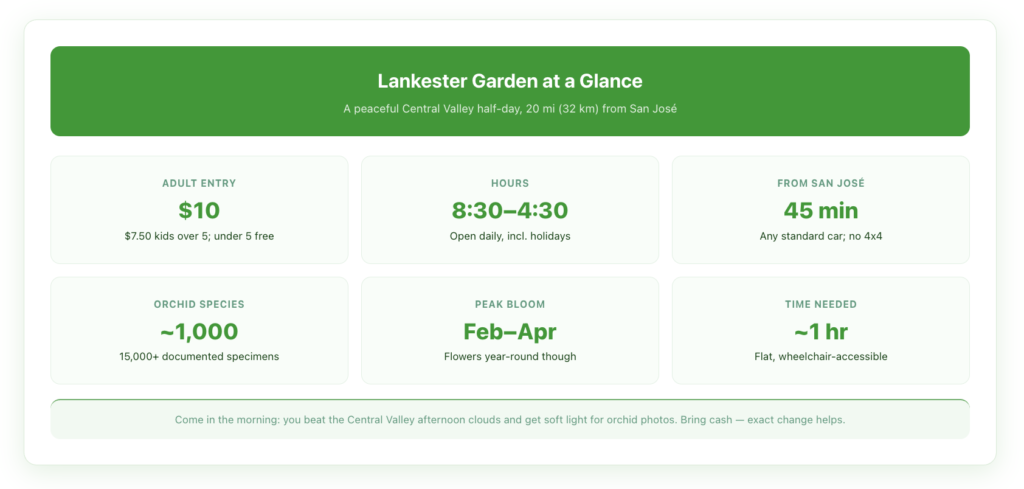
Lankester Botanical Garden holds nearly 1,000 orchid species across 27 acres in Cartago, about 20 miles (32 km) from San José. Entry is $10 for adults, $7.50 for kids over 5, and it’s open daily 8:30 AM–4:30 PM. It’s a flat, 45-minute drive through the Central Valley — any rental car handles it.
Quick Facts:
- 15,000+ documented specimens; peak orchid bloom February–April
- $10 adults, $7.50 kids over 5, under 5 free; cash preferred
- Flat, wheelchair-accessible trails; plan about an hour to walk them
- 45 min from San José via well-paved roads, no 4×4 needed
- Home to the Guaria Morada, Costa Rica’s national flower
Top 3 Sections:
- Orchid greenhouses – Thousands of plants displayed at eye level
- Bamboo forest – Ponds and shade with an almost Japanese-garden calm
- Cactus & succulents – A recently updated water-adapted collection
Pair it with Irazú Volcano or Braulio Carrillo for a full Central Valley day. If you need any help with a Costa Rica car rental, contact us now!
Costa Rica’s Lankester Botanical Garden houses nearly 1,000 orchid species across 27 acres (11 hectares)of meticulously maintained grounds, which makes it one of Latin America’s most important orchid research centers. Located just 20 miles (32 kilometers) from San José in the historic city of Cartago, this hidden gem operated by the University of Costa Rica offers a peaceful half-day escape that most travelers completely miss. Whether you’re a serious orchid enthusiast or simply looking for something beyond beaches and wildlife tours, Lankester delivers an unforgettable botanical experience.
Key Takeaways
- Lankester Botanical Garden features over 3,000 plant species, including nearly 1,000 orchid varieties displayed at eye level.
- Best visited February through April when orchids reach peak bloom, although you’ll find flowers year-round
- Entry costs $10 for adults and $7.50 for children over 5; open daily from 8:30 AM to 4:30 PM.
- Located 20 miles (32 kilometers) from San José and is an easy 45-minute drive through the Central Valley
- Flat, accessible trails make the gardens perfect for visitors of all mobility levels, including wheelchair users.
- Guided tours significantly enhance your experience and help you spot the world’s smallest orchid.
What Makes Lankester Botanical Garden Worth Your Time?
The moment you step into Lankester’s greenhouses, you’re surrounded by vibrant pinks, purples, whites, and reds from hundreds of orchids blooming simultaneously. Unlike trying to spot orchids in the wild, where they grow high in the canopy and might only flower for a day or two, Lankester displays these treasures at eye level to appreciate their intricate details.
The garden spans 27 acres (11 hectares) and sits at 4,498 feet (1,371 meters). This means pleasant year-round temperatures around 70°F, which provide perfect conditions for both orchids and visitors exploring the grounds. Beyond the famous orchid collection, you’ll discover dedicated sections for bamboo, cacti, bromeliads, and tropical flowers.
What sets Lankester apart from other botanical gardens is its dual role as both a public attraction and a serious research facility. Scientists from around the world come here to study Costa Rica’s incredible biodiversity, and the garden has become one of the most active botanical institutions in the entire Neotropical region.
Who Was Charles Lankester and Why Does This Garden Exist?
The story begins in 1910 when British naturalist Charles H. Lankester moved to Costa Rica and developed an obsession with the country’s diverse flora. He started collecting orchid samples and sending them to experts at Kew Gardens in England for identification.
In 1924, Lankester purchased a former coffee farm called Las Cóncavas near Cartago. The property featured a large lagoon that attracted migratory birds, and near it, Lankester created a special area he named “El Silvestre” (the untamed) specifically for orchids and tropical plants.
When Lankester died in 1969, his daughter Dorothy inherited the property. In 1973, she sold it to the University of Costa Rica with the condition that it had to remain a botanical garden forever. The funds for this purchase came from joint efforts between the Costa Rican Orchid Society, the American Orchid Society, and the Stanley Smith Horticultural Trust.
Under the direction of Dr. Dora Emilia Mora de Retana, the garden developed Costa Rica’s first formal orchidology course in 1984 and grew into the internationally recognized research center it is today.
When Should You Visit for the Best Experience?
February through April delivers the most spectacular orchid blooms, which coincides with Costa Rica’s dry season when vibrant colors explode across the greenhouses. March is particularly special because you’ll see the Guaria Morada (Costa Rica’s national flower) at its peak.
That said, Lankester’s massive collection means hundreds of orchids bloom throughout the year, and you’ll find plenty to photograph and admire even during green season visits. The garden opens every day from 8:30 AM to 4:30 PM, including holidays.
Morning visits work best because you’ll beat the afternoon clouds that sometimes roll in over the Central Valley, and the soft morning light creates ideal conditions for photographing those delicate orchid petals.
What Will You Actually See on the Trails?
The garden is divided into several distinct sections, each offering something different. The trails are flat, even, and well-maintained; therefore, they’re nothing like the challenging terrain at Monteverde’s cloud forest reserves.
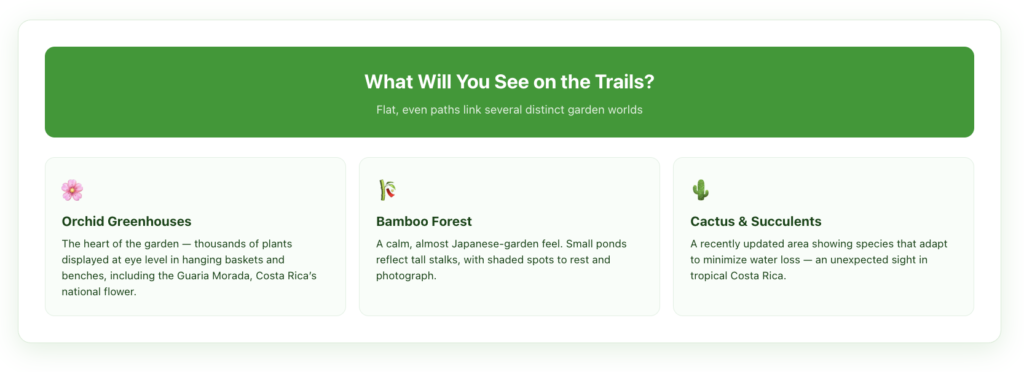
The orchid greenhouses form the heart of Lankester, where thousands of plants cascade from hanging baskets, climb tree branches, and fill benches arranged at perfect viewing height. Guides can point out remarkable local and international orchid specimens.
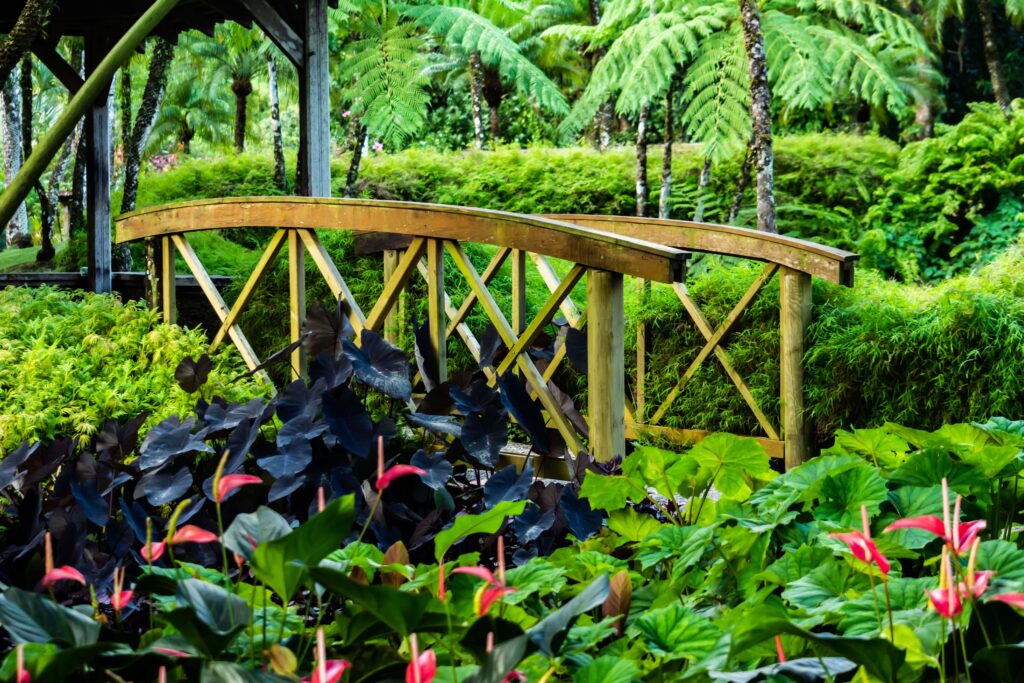
The bamboo forest creates a peaceful, almost Japanese garden atmosphere. Small ponds reflect the tall bamboo stalks, offering shaded spots to rest and photograph. This sculptured area feels worlds away from Costa Rica’s beaches and jungle trails.
The cactus and succulent garden showcases plants you might not expect in Costa Rica’s tropical climate. This recently updated area, sponsored by the Alonso Guzmán family, displays species from diverse families with adaptations to minimize water loss.
Throughout the gardens, you might spot hummingbirds, butterflies, and various bird species that have made the garden their home. The identification tags and interpretive materials help you learn to recognize plants you may encounter later at national parks throughout your trip.
Should You Take a Guided Tour or Explore Independently?
Guided tours transform a pleasant garden stroll into an educational adventure. Many visitors lack background knowledge about tropical flora, and guides fill that gap by explaining the fascinating adaptations that allow orchids to thrive in their specialized niches.
Guides know exactly where to find blooming specimens and can point out details you’d otherwise miss, such as the characterization of orchids as epiphytes that harmlessly attach to trees and draw nutrients from air and rain rather than soil. They’ll show you the Guaria Morada in bloom and explain why Costa Ricans consider it a symbol of good fortune.
For independent exploration, plan about an hour to walk all the trails at a leisurely pace. The garden provides enough signage to navigate without getting lost, and the flat terrain means you can take a pleasant stroll without becoming tired.
The garden also offers specialized courses throughout the year covering topics like orchid cultivation, medicinal plant identification, and butterfly spotting. If you’re visiting during one of these programs, it’s worth checking availability.
How Do You Get to Lankester Botanical Garden?
From Juan Santamaría International Airport (SJO), Lankester sits about 45 minutes to an hour southeast, depending on traffic. The route passes through downtown San José and continues to Costa Rica’s former capital, Cartago.
The drive follows well-paved roads suitable for any rental vehicle, and you don’t need a 4×4 for this destination. Use Waze or Google Maps to navigate, as street signs can be unreliable in Costa Rica.
If you’re staying in San José, consider combining Lankester with other Central Valley attractions. The garden pairs perfectly with a morning visit to Irazú Volcano, as Costa Rica’s tallest active volcano is just 30 minutes beyond Cartago. On clear days, you can see both the Caribbean Sea and the Pacific Ocean from Irazú’s summit.
Alternatively, explore the historic Basílica de Nuestra Señora de los Ángeles in Cartago on your way to or from the garden. This beautiful church attracts pilgrims year-round to leave offerings and offers insight into Costa Rican religious traditions.
What Should You Know About Practical Details?
Admission fees:
- Adults: $10 USD
- Children (over 5): $7.50 USD
- Children under 5: Free
- Costa Rican residents pay reduced rates in colones
Hours: Open daily 8:30 AM to 4:30 PM, including holidays
Facilities: The garden has a small souvenir store, cafeteria, restrooms, and wheelchair access on the universal access trail. Wheelchairs are available at the front desk.
What to bring: Water, sunscreen, a hat, and comfortable walking shoes. During the green season, pack a rain jacket or umbrella. The elevation keeps temperatures pleasant, but the sun can be intense.
Rules: No smoking. Pets are allowed on leash. Groups should make reservations in advance.
Payment: Cash payments accepted. Bring exact change if possible.
Can You Combine Lankester with Other Day Trips?
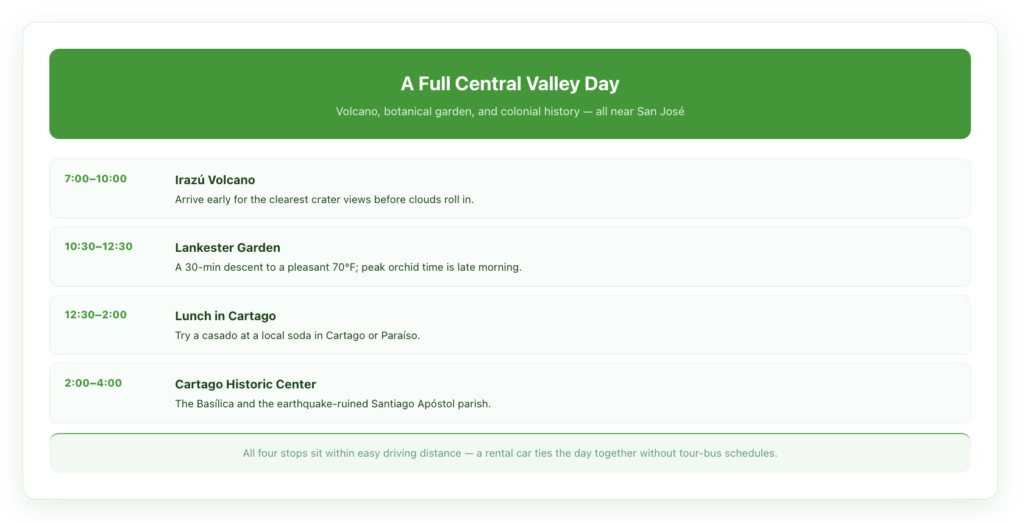
Absolutely, and you should. Lankester works beautifully as part of a Central Valley exploration day. Here’s a suggested itinerary that maximizes your time:
Morning (7:00 AM – 10:00 AM): Drive to Irazú Volcano National Park. Arrive early for the best visibility before clouds roll in. The surreal crater lake and potential views of both coasts make this worthwhile.
Mid-morning (10:30 AM – 12:30 PM): Head to Lankester Botanical Garden. The 30-minute drive descends from the volcano’s chilly heights to the garden’s pleasant 70°F climate.
Lunch (12:30 PM – 2:00 PM): Enjoy lunch at a local soda in Cartago or Paraíso. Try the traditional casado for an authentic Costa Rican food experience.
Afternoon (2:00 PM – 4:00 PM): Explore Cartago’s historic center, including the Basílica and the ruins of the Parish of Santiago Apóstol. The ruins from an 1841 earthquake provide a haunting glimpse into the region’s history.
This full-day itinerary showcases three completely different Central Valley experiences: volcanic landscapes, botanical wonders, and colonial heritage, all within easy driving distance of San José.
Why Do Orchid Enthusiasts Consider Lankester a Must-Visit?
Costa Rica hosts over 1,500 native orchid species, which are more varieties per square mile than almost anywhere on Earth. Yet spotting orchids in the wild proves surprisingly difficult because most grow as epiphytes high in the forest canopy, and many species flower for just a day or two each year.
Lankester solves this problem as the garden cultivates over 15,000 scientifically documented specimens representing nearly 1,000 species, and most of them are native to Mesoamerica. The sheer volume means something is always blooming, and the eye-level displays let you appreciate details which would be hard to see in wild settings.
The collection includes specimens of the Guaria Morada, declared Costa Rica’s national flower in 1939. According to Tico tradition, this purple orchid brings good fortune. You’ll see it prominently displayed at Lankester with information about its cultural significance.
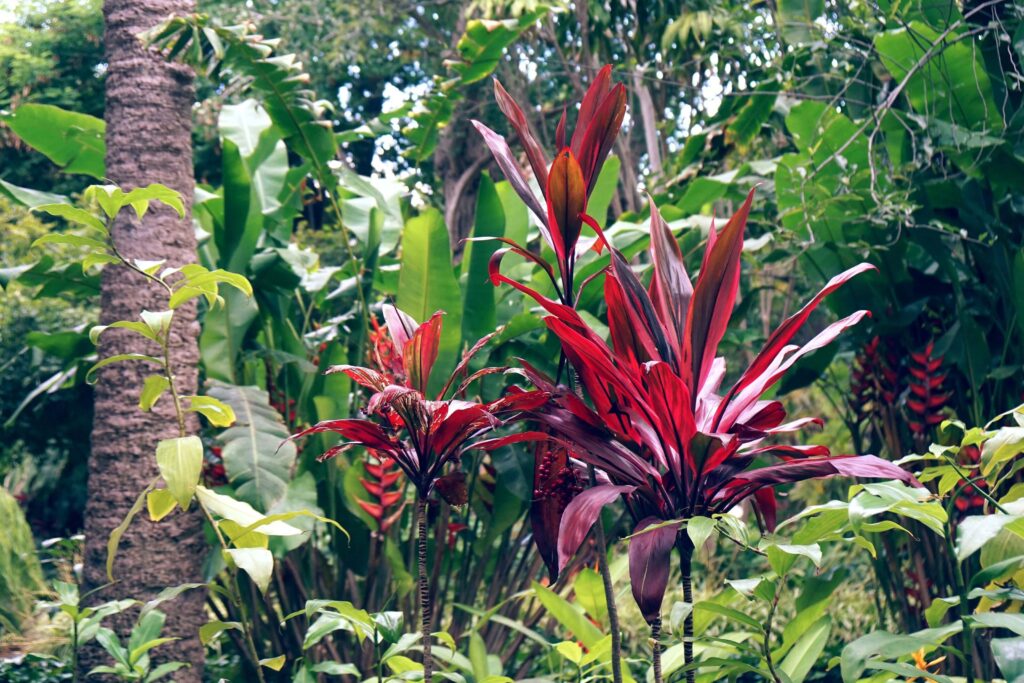
Beyond orchids, the garden’s bromeliad and heliconia collections rival any in Central America. These tropical plants create the perfect complement to the orchid displays and demonstrate the incredible diversity of Costa Rica’s plant life.
How Does Lankester Compare to Other Costa Rica Attractions?
If your Costa Rica itinerary focuses solely on beaches and ziplines, Lankester might not make your list. But for travelers seeking a deeper understanding of Costa Rica’s natural heritage, the garden delivers a unique experience.
Unlike the crowded trails at Manuel Antonio or the adventure-focused atmosphere of Arenal, Lankester offers contemplative beauty. You won’t be jostling for position with tour groups or racing to spot wildlife before it disappears into the canopy.
The garden also provides excellent value for families traveling with children. The flat trails accommodate strollers, the colorful flowers captivate young visitors, and the relatively short visit time prevents boredom from setting in. Educational signage helps older kids learn about ecology without feeling like they’re in school.
For first-time Costa Rica visitors, Lankester works perfectly as a first stop. The identification tags and interpretive materials help you familiarize yourself with plants you’ll encounter later throughout the country. Learning to recognize cecropia trees here, for example, will help you spot sloths in their favorite hangout in the wild.
Having your own rental car makes visiting Lankester easy. The Central Valley’s well-maintained roads don’t require a 4×4, and the freedom to explore at your own pace lets you combine the garden with other attractions without being tied to tour schedules.
Frequently Asked Questions
Where exactly is Lankester Botanical Garden located?
Lankester Botanical Garden sits in Paraíso, Cartago province, which is about 20 miles (32kilometers) southeast of San José. The drive takes approximately 45 minutes from the capital through well-paved roads. From Juan Santamaría International Airport, expect about an hour’s drive, depending on traffic conditions.
What is the most beautiful botanical garden in the world?
Beauty is subjective, but Lankester Botanical Garden ranks among the world’s most important orchid collections. For tropical orchid diversity specifically, few gardens match its nearly 1,000 species displayed at eye level. Other renowned botanical gardens include Singapore’s Gardens by the Bay, Kew Gardens in England, and Jardín Botánico Nacional in Cuba.
What exactly is a botanical garden?
A botanical garden is a curated space where plants are grown for scientific study, conservation, display, and education. Unlike regular parks, botanical gardens organize plants systematically, often by family, region, or habitat. Lankester focuses specifically on epiphytic plants like orchids, bromeliads, and related species native to Central America and the Caribbean.
Why is Lankester famous among orchid researchers?
Lankester serves as one of Latin America’s most important orchid research facilities. Operated by the University of Costa Rica, the garden combines public exhibition with serious scientific study. Researchers worldwide visit to study its collection of over 15,000 scientifically documented specimens. The garden developed Costa Rica’s first formal orchidology course and has published significant research on tropical epiphyte conservation.
Which country has the prettiest gardens?
England claims famous gardens like Kew and Hidcote, while Japan is renowned for its traditional landscape gardens. However, Costa Rica’s tropical gardens, including Lankester, showcase plant diversity impossible to replicate in temperate climates. With over 1,500 native orchid species, Costa Rica punches well above its weight in botanical significance.
What are the top botanical gardens to visit in Costa Rica?
Besides Lankester, consider La Paz Waterfall Gardens near Poás Volcano, which combines wildlife rescue with botanical displays. Wilson Botanical Garden in the Osa Peninsula offers lowland rainforest species, and Else Kientzler Botanical Garden in Sarchí features decorative plants in a more manicured setting.
How much time do you need at Lankester Botanical Garden?
Plan for 1-2 hours depending on your interest level. A casual walk through all sections takes about an hour. Photography enthusiasts and serious orchid lovers often spend 2-3 hours exploring the greenhouses thoroughly. Guided tours typically last 1.5 hours and provide much deeper insight into the collections.
Can you see Costa Rica’s national flower at Lankester?
Yes, the Guaria Morada (Guarianthe skinneri) features prominently in Lankester’s collection. This purple orchid was declared Costa Rica’s national flower in 1939 and blooms most spectacularly from February through April. The garden provides detailed information about its cultural significance and conservation status.