
More Smiles,
Less Hassles
No Hidden Fees!
More Smiles,
Less Hassles
No Hidden Fees!


By the Vamos Rent-A-Car team. Last updated November 10, 2026.
Driving in Costa Rica is safe for most visitors who take it slow, plan their days around daylight and pick the right car for their route. Vamos has rented cars near San José and Liberia airports since 2004, and this guide covers what our counter staff go over with renters every day: driving on your home license, road conditions, the rules of the road, police checkpoints, gas stations and when you need a 4x4.
The roads ask for more patience than you may be used to at home. The main highways are paved, many roads to beaches, lodges and waterfalls are gravel, one-lane bridges are common, and a two-hour GPS estimate can stretch to three on a mountain road. In return, a car lets you set your own schedule and stop wherever something catches your eye.
QUICK ANSWERS
IN THIS GUIDE
Yes. A valid driver's license from your home country, including a US, Canadian or UK license, lets you drive in Costa Rica for as long as your legal stay. Article 91 of the traffic law (Ley 9078), as rewritten in 2024, allows a foreign license for the same period Migración authorizes when you enter the country. Before 2024 the limit was three months.
Visitors from the US and Canada can be given up to 180 days, but the immigration officer at the airport decides the number, and it can be less, so check the date on the entry stamp in your passport. Carry your passport and your license every time you drive, because police checkpoints ask for both. If your stay will run past three months, call us before you book, because an older clause of the same law that was never updated still mentions a three-month limit for foreign drivers.
Vamos does not ask for an International Driving Permit unless your license is printed in a non-Latin alphabet, such as Arabic, Chinese or Hebrew. To rent from us, every driver needs to be at least 18 and bring a valid driver's license plus a passport or photo ID, and the renter needs a credit card in their own name for the deposit. Drivers aged 18 to 20 pay a higher collision deductible, and our rental requirements page lists every detail.
Questions before you book? Call 1-800-601-8806 toll-free from the US and Canada, +506 4000-0557 in Costa Rica, or text 1-213-261-8586.
Yes, for drivers who slow down and stay alert. Costa Rica drives on the right and follows the same basic rules as North America, with speed limits in kilometers per hour. The habits on the road take some getting used to: drivers pass on curves, motorbikes ride the shoulder, and pedestrians, cyclists, dogs and cattle share roads that often have no sidewalk.
The most common trouble comes from three things: driving after dark, trying to cover too much ground in one day, and taking a small car down a road that needed a 4x4. Each one has an easy fix, covered below. Keep plenty of space ahead of you, slow down on blind curves, and give yourself extra time for every drive.
Road quality changes fast. You can spend a morning on a smooth four-lane highway and the afternoon on a gravel track with a river beside it, so check the last few kilometers to your hotel before you pick a car.
Numbered national routes connect the cities and the main tourist areas, and most are paved and signed. Route 27 runs from San José to the Central Pacific coast, Route 1 (the Interamericana) runs north to Liberia and the Nicaraguan border, and Route 32 crosses Braulio Carrillo National Park to the Caribbean. Route 32 is narrow, foggy and sometimes closed by landslides in heavy rain, so check our traffic alerts before you take it.
Secondary roads to many beaches, lodges, hot springs and waterfalls are gravel or dirt. In the dry season they get dusty and corrugated, and in the green season they turn to mud. New shocks and tires will not smooth out every rut, so slow down, keep the windows up in the dust and enjoy the view.
A pothole ahead may have no cones or tape around it. Locals often mark a big one with an old tire or a tree branch, so treat either one sitting in the road as a warning. Steer around large puddles, which can hide holes much deeper than they look, and take corners carefully, since missing drain covers tend to sit near the curb. Speed bumps (reductores de velocidad) appear without warning near schools and towns, and many are unpainted.
Many bridges carry one lane of traffic. A sign at each end shows which side has the right of way, and the side with the CEDA EL PASO (yield) sign waits. When it is your turn, cross promptly, because drivers on the other side will start across if you hesitate. Some bridges have loose or damaged planks, so if you can see the river below, take it slow.
Some rural roads cross streams with no bridge at all. Turn around and find another route. Damage from driving through rivers, streams, estuaries or along beaches is excluded from our insurance policy with the Instituto Nacional de Seguros, so the renter pays for it, which our insurance guide explains in full.
Mountain roads bring hairpin turns, steep grades and drop-offs without guardrails. Fog can drop visibility to a few meters in minutes around Monteverde and on the passes over the Central Valley. Turn on your headlights, slow right down, and pull over somewhere safe if you cannot see the road.
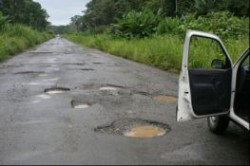
Potholes on a country road. Photo © VamosRAC

A pothole marked with a tire. Photo © VamosRAC
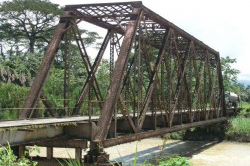
A one-lane bridge. Photo © VamosRAC

Oxen on the road. Photo © VamosRAC
The dry season runs roughly from December to April and brings the easiest driving of the year. Gravel roads firm up, mountain views clear, and some places that need a 4x4 in the rainy months can be reached in a standard car. Expect dust on unpaved roads and more traffic around the holidays.
The green season runs roughly from May to November, with sunny mornings and heavy afternoon rain on most days. Gravel roads turn muddy, streams rise, and landslides can close mountain roads for hours. Add 30 to 45 minutes to any mountain drive, plan to arrive by early afternoon, and pick a car with more ground clearance. If a downpour gets too heavy to see through, pull over at a gas station or another wide, safe spot until it eases. The national weather service (IMN) posts forecasts and weather warnings, and our green season guide covers the rest of the trip.
Pick your car for the roughest road on your itinerary. A sedan or small SUV is fine for the Central Valley, Route 27 to Jacó and Manuel Antonio, the paved roads to most Guanacaste beach towns, and La Fortuna. A 4x4 or a high-clearance SUV makes sense for Monteverde, Santa Teresa and the southern Nicoya Peninsula, the Osa Peninsula and Drake Bay, and many hilltop rentals and eco-lodges on gravel roads. In the green season, move one step up.
Four-wheel drive and low gear are for slow driving on mud or steep climbs, under 40 km/h. Switch back to two-wheel drive once you reach pavement, because driving in 4x4 above 40 km/h counts as misuse under the rental terms and the renter pays for any damage. Rent a manual car only if you drive stick at home, since a steep gravel hill in a foreign country is a hard place to learn.
These are the drive times and cars we suggest for popular routes in the dry season:
| Route | Car we suggest | Typical drive time |
|---|---|---|
| Liberia to Tamarindo | Standard car | 1 to 1.5 hours |
| San José to Manuel Antonio | Standard car | 2.5 to 3 hours |
| San José to La Fortuna (Arenal) | Standard car or SUV | 3 to 3.5 hours |
| San José to Puerto Viejo | Standard car | 3.5 to 4 hours |
| Liberia to Nosara | Standard car or 4x4 | 2 to 2.5 hours |
| Quepos to Dominical | Standard car or 4x4 | 1.5 to 2 hours |
| San José to Monteverde | 4x4 recommended | 3 to 4 hours |
| La Fortuna to Monteverde | 4x4 | 2.5 to 4 hours |
| Either airport to Santa Teresa | 4x4 | 4 to 6 hours |
| Either airport to Drake Bay | 4x4 | 6 hours or more |
No road runs into Tortuguero village. Most visitors drive past Cariari to the La Pavona dock, leave the car in the dock's parking lot and finish by boat, and the national parks service (SINAC) recommends a 4x4 for that road. Our guide to choosing a rental car for Costa Rica goes destination by destination.
Costa Rica has few street names and even fewer house numbers. Addresses are given from landmarks, such as "300 meters north of the church" or "200 meters east of the soccer field," so it helps to know iglesia (church), escuela (school), plaza or cancha (soccer field) and pulpería (corner store). Signs to the main tourist towns are posted on the highways, though they are easy to miss the first time past, and many towns are signed in one direction only.
Waze is the navigation app most drivers here rely on, because other drivers report accidents, closures, landslides and police checkpoints as they happen. Download offline maps before you head into the mountains or down remote coasts, where the signal drops, and add 25 to 50 percent to any GPS time on a mountain or gravel route.
Every Vamos rental comes with a free cell phone, so you can call us for directions or help at any time. For turn-by-turn directions, our WazePhone is a smartphone running Waze that also works as a Wi-Fi hotspot, for $5 a day. We have a limited number, so ask for one when you book. And when all else fails, ask at a gas station or a corner store, where people are glad to point the way.
These rules come from Costa Rica's traffic law, Ley 9078, and the fines below are the amounts in force in 2026.
Most road signs use the same shapes and colors as in North America, with the words in Spanish:
| Sign | Meaning |
|---|---|
| ALTO | Stop |
| CEDA EL PASO | Yield |
| DESPACIO | Slow down |
| REDUCTOR DE VELOCIDAD | Speed bump ahead |
| PUENTE ANGOSTO | Narrow bridge |
| UNA VÍA | One-way street |
| NO ADELANTAR | No passing |
| DESVÍO | Detour |
| DERRUMBE | Landslide |
| CRUCE DE FAUNA | Wildlife crossing |
| NO ESTACIONAR | No parking |
| NO HAY PASO | Do not enter |
| ZONA ESCOLAR | School zone |
| PELIGRO | Danger |
Costa Ricans, or Ticos, are famously relaxed people, and most of that carries over to the road. A few local habits are worth knowing before you set out:
Our Tico driving tips add a few more insider habits from our local staff.
Plan every drive to finish before dark. Costa Rica sits close to the equator, so the sun sets between about 5:10 and 6:05 p.m. all year. Most rural roads have no streetlights, potholes and washouts go unmarked, and pedestrians, cyclists and animals use the road without lights.
The US State Department advises visitors to Costa Rica, "Try not to drive outside of urban areas at night," and also not to stop at the roadside or at a gas station after dark.
Many international flights land in the late afternoon or evening. If yours does, stay the first night near the airport and start driving in the morning. Our shuttle between the office and any San José metro-area hotel, including Heredia and Alajuela, is free, and we can deliver your car to a San José-area hotel for $9.
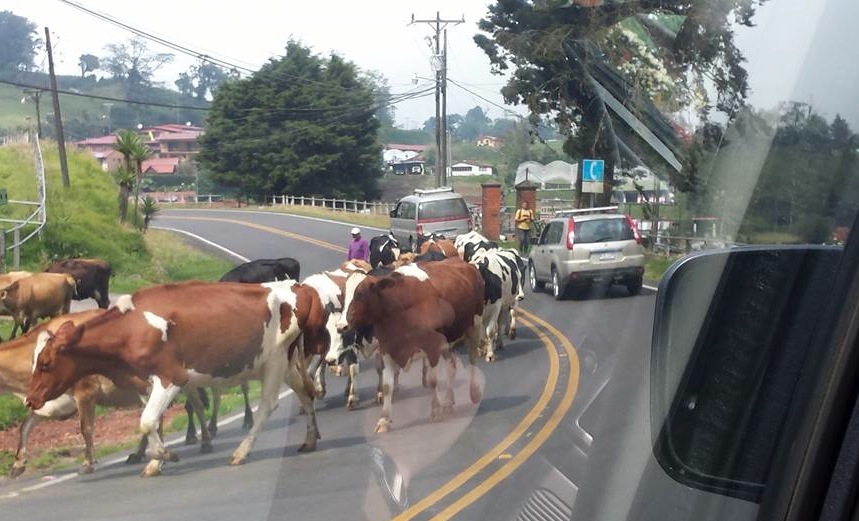
"Cows" © Shere y Paul
Transit police (Policía de Tránsito) run checkpoints on highways and at town entrances, and other drivers often flash their headlights to warn you about one ahead. If an officer signals you to stop, pull over and have your driver's license, your passport with its entry stamp and the rental papers from the glove box ready.
Traffic fines are paid at a state bank, so never hand an officer money at the roadside.
If you get a ticket during your rental, pay it at a state bank and bring us the receipt when you return the car. An unpaid fine comes back to us, so we charge it to your card along with the cost of handling it.
Parking illegally can cost far more than the fine. Transit police can remove the license plates from a car parked on a yellow curb, a sidewalk, a bike lane or at a bus stop, and a car without plates cannot be driven. The renter then pays the fine, the tow truck to bring the car back to our office and the cost of getting the plates back, which takes days and several government offices. Our FAQ on parking tickets explains the process.
Stay at the scene and leave the cars where they are. The national insurer, INS, requires drivers to wait for both the transit police and an INS inspector before the vehicles are moved, and the US State Department gives visitors the same advice. Call 911 to report the accident and to get an ambulance if anyone is hurt, and report it to INS at 800-800-8000, the INS accident line.
Call Vamos right away on the free cell phone that comes with your car, or at +506 4000-0557, and we will walk you through the rest. An accident report from the authorities is required for the collision waiver to apply, so wait for it even after a minor bump.
Gas stations are called bombas or gasolineras, and an attendant fills the tank for you, so you can stay in the car. Ask for "lleno con regular, por favor" for a full tank of regular. Stations sell Plus 91, which everyone calls regular, plus Súper and diesel. Fuel prices are set nationally, so every station charges the same price. On November 10, 2026, RECOPE’s price table listed ₡807 a liter for Plus 91 and diesel and ₡805 for Súper. Tipping the attendant is up to you.
Stations are spread thin in the Osa Peninsula, the southern Nicoya Peninsula and other remote areas, so fill up in the larger towns before you head out, and carry some colones, because small rural stations may not take cards. Return your Vamos car with the same fuel level you received it with, or the difference comes off your deposit.
Route 27 between San José and the Pacific coast has several toll booths, with rates in colones: a car paid ₡380 at the Escazú booth in October 2026. The booths take debit and credit cards, except American Express, and have lanes for the Quick Pass electronic tag. Keep some colones handy as a backup.
Parked rental cars attract thieves, and a few habits keep your belongings safe:
Expect heavy traffic, one-way streets and very few signs. Rush hours run from about 6:30 to 8:30 a.m. and 4:30 to 6:30 p.m., so time your airport runs around them. If you can, route around downtown San José, and use a guarded lot when you do stop. Our guide to road trip routes from SJO airport maps the main drives out of the valley.
Guanacaste is mostly flat, with paved roads linking Liberia airport with Tamarindo, Playas del Coco, Flamingo and the other beach towns. The heat is the main challenge, so carry water. See our Guanacaste driving routes from Liberia airport, the drive to Tamarindo from either airport, and our Liberia airport car rental page.
The main roads into La Fortuna are paved and scenic, and the drive around Lake Arenal is one of the prettiest in the country. Some hot springs, lodges and waterfall trailheads sit on rougher side roads.
The climb to Monteverde is steep and winding, with gravel stretches, and fog and wind are common near the top. Allow extra time and drive it in daylight.
The coastal highway south of Jacó is an easy drive with ocean views. Beach access roads vary a lot, and the roads to Santa Teresa, Montezuma and much of the southern Nicoya Peninsula are gravel with steep grades and, in the green season, stream crossings.
The road to Puerto Viejo and Cahuita is paved but narrow, and Route 32 over the mountains can close after landslides. Tortuguero is reached by boat or small plane only.
The southern Pacific is the most remote part of the country. Roads toward Drake Bay and Puerto Jiménez are long, rough and best done in a 4x4, with few gas stations along the way.
If you plan to visit only one or two places, shared and private shuttles run between the airports and the main tourist towns, and our shuttle services guide compares them. Public buses are cheap and cover the whole country, though frequent stops and changes can double the travel time. Domestic flights save a long drive to the Osa Peninsula or Tortuguero. For a trip with several stops, a car is usually the simplest way to see the country at your own pace.
Yes, for drivers who take it slow and stay alert. The main highways are paved, many rural roads are gravel, potholes and one-lane bridges are common, and other drivers pass on curves. Drive in daylight, allow extra time and choose a car with enough ground clearance for your route.
Yes. Under article 91 of Costa Rica's traffic law, a valid US license works for as long as the stay Migración authorizes when you enter, which can be up to 180 days. Check the entry stamp in your passport, and carry your passport and license whenever you drive.
No. Costa Rica's traffic law asks for a valid license from your home country and does not mention an International Driving Permit. Vamos asks for one only when a license is printed in a non-Latin alphabet, such as Arabic, Chinese or Hebrew.
The right side, the same as the United States and Canada. Cars are left-hand drive, and you pass on the left.
Yes, unless a sign prohibits it. Come to a full stop, yield to pedestrians, cyclists and cross traffic, and turn only when the way is clear.
It depends on your route. A sedan handles the main highways, the Central Valley, Manuel Antonio and most Guanacaste beach towns. A 4x4 or high-clearance SUV is the better choice for Monteverde, Santa Teresa, the Osa Peninsula and gravel roads to lodges, especially from May to November.
Avoid it when you can. Most rural roads have no streetlights, potholes go unmarked, and pedestrians and animals use the road, and the US State Department advises visitors not to drive outside urban areas at night. The sun sets between about 5:10 and 6:05 p.m. all year.
For a trip with several stops, yes. A car lets you set your own schedule and reach beaches, trailheads and small towns that shuttles skip. For one or two destinations, shuttles or domestic flights can be simpler.
Every Vamos rental includes a free cell phone, free additional drivers, a cooler and roof racks on request, and a meet-and-greet shuttle at both airports. The price we quote is the price you pay.
Call 1-800-601-8806 toll-free from the US and Canada, +506 4000-0557 in Costa Rica, text 1-213-261-8586, or email info@vamosrentacar.com.
HELP & SUPPORT
VAMOS RENT-A-CAR
CONTACT US
JOIN US
